
Paying Your Singapore Income Tax 2026: GIRO Instalments and Deadlines
Your Singapore income tax is due one month after your Notice of Assessment. Learn how GIRO spreads the bill into up to 12 interest-free instalments, the payment methods available, and how to avoid the 5% late-payment penalty.
This article is for general information only and is not tax or financial advice. Payment methods, deadlines, and penalties are set by the Inland Revenue Authority of Singapore (IRAS). Always confirm the latest details on the IRAS website or with a licensed tax professional before acting.
Filing your Singapore tax return is only half the job — the other half is paying your income tax on time. Once IRAS issues your Notice of Assessment (NOA), the clock starts, and freelancers and self-employed business owners who miss the window face an automatic penalty. This guide explains when Singapore income tax is due, how GIRO instalments can spread the cost interest-free, the payment methods available, and how to avoid the 5% late-payment penalty. If your NOA has just landed, this is what to do next.
When is your Singapore income tax due?
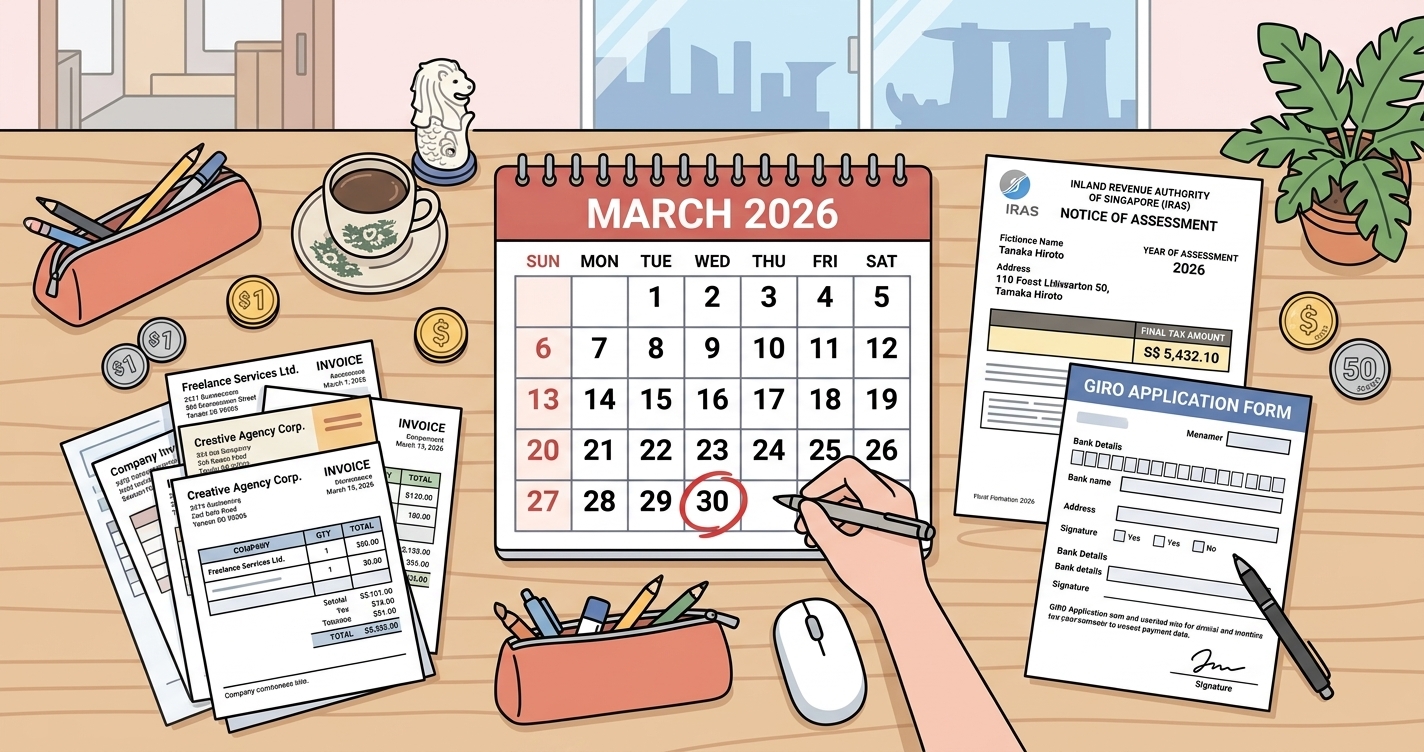
Your income tax is payable within one month from the date of your tax bill (the Notice of Assessment), regardless of whether you intend to object or amend it. For Tax Season 2026, direct NOA recipients generally receive their bills from mid-March, while those under the No-Filing Service or required to file typically receive theirs between end-April and end-September.
Two points catch people out. First, the one-month deadline runs from the date on the bill, not the day you read it. Second, filing an objection or an "Amend Tax Bill" request does not pause the payment deadline — you are still expected to pay while any review is under way.
The 5% late-payment penalty
If you do not pay by the due date, IRAS imposes a 5% late-payment penalty on the unpaid tax, unless you are on an approved instalment plan. Further penalties can be added if the tax remains outstanding. The single most effective way to avoid this is to be on GIRO before the due date, or to pay in full on time.
An approved GIRO arrangement shields you from the 5% penalty because your instalments count as paying on time. Getting on GIRO early is the simplest insurance against a late-payment charge.
Paying by GIRO: interest-free instalments
GIRO is the most popular way for individuals to pay income tax, and for good reason. It lets you spread your bill into up to 12 monthly interest-free instalments, or make a one-time yearly deduction, straight from your bank account.
- Interest-free: unlike a credit-card balance, GIRO instalments carry no interest.
- Automatic: deductions are taken on scheduled dates, so you will not forget a payment.
- Rolling plan: once you are on GIRO, IRAS places you on a Provisional Instalment Plan (PIP) that continues from May each year to April the following year, based on an estimate, and is adjusted when your actual bill is finalised.
The catch: your GIRO application must be approved before the payment due date to avoid the late-payment penalty. Applications can take a little time to process, so apply as soon as you can — ideally as soon as your NOA arrives, or even ahead of it if you were on GIRO last year.
How to apply for GIRO
- Log in to myTax Portal and apply for GIRO under your income tax account, or apply through your bank's digital services where supported.
- Provide your bank account details for the deduction.
- Wait for approval — IRAS will confirm your instalment schedule.
- Check your instalment plan in myTax Portal and ensure funds are available on each deduction date.
Other ways to pay
If you prefer to pay in one go, or you are not on GIRO, common options include:
- PayNow QR: pay instantly via your banking app by scanning the QR in myTax Portal.
- Internet or mobile banking: add IRAS as a billing organisation and pay using your tax reference number.
- AXS and other channels: available for one-off payments.
Whichever method you use, pay a few days early so the payment clears before the deadline.
A worked example
Example: Priya, a self-employed graphic designer
Priya receives her NOA in late April showing S$6,000 of tax payable, with a due date one month later. Paying it all at once would strain her cash flow during a quiet quarter. She applies for GIRO through myTax Portal as soon as the bill arrives, and IRAS approves a plan of 12 monthly instalments of S$500. Because her GIRO is approved before the due date, no 5% penalty applies, and the S$6,000 is spread painlessly across the year instead of leaving in one lump sum.
Contrast that with her friend who ignored the bill, paid two weeks late, and was charged a 5% penalty of S$300 on a S$6,000 bill — money that simply did not need to be spent.
Plan ahead: set aside tax as you earn
The deeper lesson for freelancers and SME owners is that a tax bill is easier to pay when you have been setting money aside all year. Because self-employed income has no tax withheld at source, the whole amount arrives at once — which is exactly why GIRO instalments are so useful. Keeping clean, up-to-date records helps you estimate your liability early and avoid surprises.
Tools like Denpyo let you photograph each receipt and invoice so AI can extract the date, amount, and expense category automatically, keeping your income and deductions current throughout the year. With your numbers visible in real time, you can estimate your tax and set aside the right amount each month. Denpyo also shows an estimated tax-saving effect for each expense, so you can see how proper record-keeping lowers the bill you will eventually pay.
To forecast what you might owe, try Denpyo's free income tax calculator, and use the tax savings estimator to see how claimable expenses reduce your assessable income.
Common mistakes to avoid
- Assuming an objection pauses payment. It does not — pay by the due date and get a refund later if your bill is reduced.
- Applying for GIRO too late. It must be approved before the due date to count.
- Letting a GIRO deduction bounce. Keep sufficient funds in the account on each deduction date.
- Forgetting the provisional instalment plan. Once on GIRO, deductions continue into the next cycle; check the schedule in myTax Portal.
- Not saving for tax as you earn. Set aside a portion of each payment so the bill never blindsides you.
Summary
Singapore income tax is due within one month of your Notice of Assessment, and missing it triggers a 5% late-payment penalty. The simplest protection is GIRO: apply through myTax Portal as soon as your NOA arrives, get approved before the due date, and spread the bill across up to 12 interest-free monthly instalments. Filing an objection does not pause payment, so pay on time regardless. Best of all, keep your records current throughout the year so you can set money aside and treat your tax bill as a planned expense rather than a shock. Start by checking the due date on your NOA and applying for GIRO today.

Track expenses, maximize deductions
Denpyo scans your receipts and finds tax savings automatically.