
Carrying Forward Business Losses in Hong Kong: A Freelancer's Guide (2026)
A loss year isn't wasted in Hong Kong. Learn how Profits Tax losses carry forward indefinitely, how Personal Assessment lets a business loss offset your salary this year, and the records you need to make a loss claim stick.
This article is general information based on Inland Revenue Department (IRD) guidance as of August 2026. It is not tax advice. Hong Kong tax rules and deadlines change, so confirm your position with the IRD or a qualified tax adviser before acting.
Not every year is a profitable one. A slow patch, a big equipment purchase, or a client that disappears can leave a freelancer or small-business owner with a loss for the year. The good news in Hong Kong is that a business loss is not simply wasted — under Profits Tax you can carry it forward to reduce future tax, and in many cases you can even use it to cut this year's tax on your salary or rental income. The catch is that you can only claim losses you can prove, and you have to make the right election in time. This guide explains how loss set-off and carry-forward work for sole proprietors, and how to keep the records that make a loss claim stick.
How business losses work under Hong Kong Profits Tax
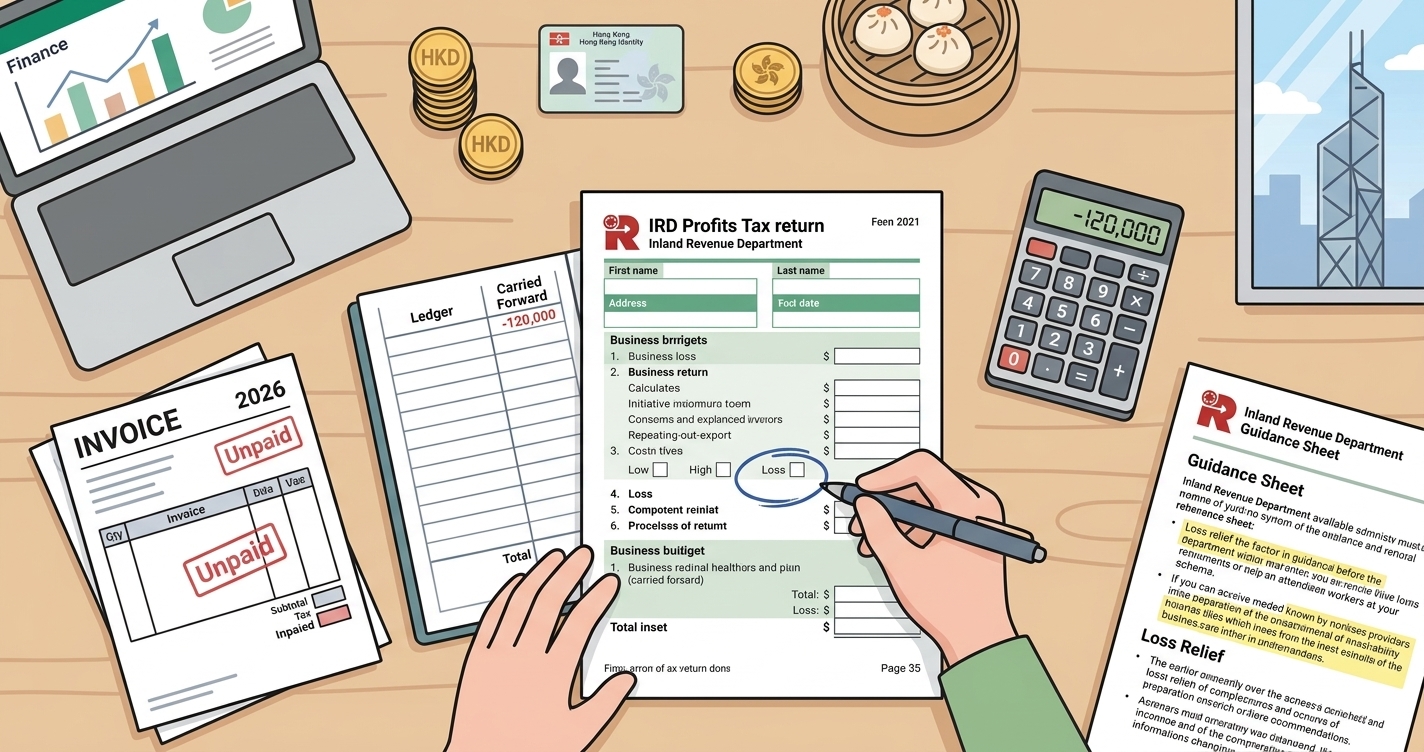
If you run a business as a sole proprietor, your profit or loss is worked out as assessable income minus allowable business expenses and depreciation allowances, and reported on your Tax Return – Individuals (BIR60). When allowable deductions exceed your business income, the result is a Profits Tax loss for that year of assessment (Hong Kong's tax year runs 1 April to 31 March). Unincorporated businesses are taxed at the two-tiered rates of 7.5% on the first HK$2 million of assessable profits and 15% on the balance, so reducing future profits with a brought-forward loss has real value (IRD, "Profits Tax").
A loss is only as good as the records behind it. The IRD can ask you to substantiate both the income and the expenses that produced the loss, and businesses must keep sufficient records for at least seven years. A loss claim supported by shoebox receipts and vague memory is exactly the kind of claim that gets challenged.
Carry-forward: indefinite, same business, no carry-back
The core rule is straightforward. A Profits Tax loss can be carried forward indefinitely and set off against the future assessable profits of the same trade, profession or business. There is no time limit on how long the loss can be carried, so a loss from a difficult year can shelter profits several years later once the business recovers.
Two limits matter. First, Hong Kong does not allow losses to be carried back to earlier profitable years — you cannot reclaim tax already paid. Second, for a sole proprietor the loss belongs to that business; you cannot buy a loss-making business purely to inherit its losses, and the IRD applies anti-avoidance rules to arrangements whose sole or dominant purpose is to obtain a tax benefit from losses.
Personal Assessment: use a business loss against your salary or rent this year
Carry-forward is useful, but it only helps once the business is profitable again. If you also have a salary, rental income, or other income taxed under Salaries Tax or Property Tax, you may be able to use your business loss right now by electing Personal Assessment (PA).
Personal Assessment aggregates your income from all sources — business profits, employment income and net rental income — into a single computation taxed at the progressive rates, after your personal allowances. Crucially, a business loss for the year is deducted in that aggregation, so it can offset your salary or rental income in the same year and produce a refund or a lower bill, rather than sitting unused until the business turns a profit. Any loss not fully absorbed under PA can still be carried forward.
A few conditions apply. You must be an individual who is a permanent or temporary resident of Hong Kong, PA must actually reduce your total tax (the IRD will not force it on you if it makes you worse off), and if you are married the treatment of a spouse's income may need to be considered. The election is made in your tax return, and there is a time limit — generally within two years after the end of the year of assessment, or one month after the notice of assessment, whichever is later. Check the current deadline on the IRD website before you rely on it (IRD, "Personal Assessment").
A worked example
Suppose in the year of assessment 2025/26 May runs a freelance design studio that makes a loss of HK$120,000 after allowable expenses, and she also earns HK$400,000 from a part-time employment.
- Without Personal Assessment: her salary is taxed under Salaries Tax, and the HK$120,000 business loss is carried forward. If her studio makes HK$200,000 profit in 2026/27, the loss reduces that to HK$80,000 of assessable profits — she saves tax next year, but pays full Salaries Tax this year.
- With Personal Assessment: the HK$120,000 loss is set off against the HK$400,000 salary this year, reducing her total assessable income to HK$280,000 before allowances. She pays less tax now, and there is no loss left to carry forward.
Which is better depends on the numbers — your marginal rate, your allowances, and whether you expect large profits soon. It is worth modelling both. Our expense deductibility checker helps you confirm which costs count toward the loss, and the income tax calculator lets you compare scenarios before you commit to an election.
You can only claim losses you can prove
Because a loss reduces tax, the IRD scrutinises loss claims. To protect yours, keep for at least seven years: sales invoices and records of all business income; receipts and invoices for every expense you deducted; bank and payment records that tie to those transactions; and computations showing how the loss was worked out. If you claim depreciation allowances on equipment, keep the purchase documents too. Records that are complete, dated and reconcilable turn a loss from a red flag into a routine entry.
Common mistakes to avoid
- Letting a loss disappear. If you do not report the loss on your BIR60, it is not automatically tracked for you. Report it and keep the computation.
- Assuming a loss offsets salary automatically. It does not — you must elect Personal Assessment for that to happen.
- Missing the election deadline. Personal Assessment must be elected within the time limit; leaving it too late forfeits the in-year benefit.
- Thin records. Deductions you cannot document can be disallowed, which can shrink or wipe out the loss you were counting on.
Keep loss-ready records with Denpyo
The difference between a loss you can defend and one you cannot usually comes down to record-keeping during the year, not scrambling at filing time. With Denpyo you photograph each receipt or invoice and it extracts the vendor, date, amount and category automatically, building a clean, searchable expense record as you go. Everything is digitised and stored, so when you compute a loss you can show exactly which deductible costs produced it — and satisfy Hong Kong's seven-year record requirement without a filing cabinet. Because the app also totals your deductible spending, you get an early read on whether the year is trending toward a loss and can plan your Personal Assessment decision with real numbers.
Summary
A business loss in Hong Kong is an asset, not a dead end. Under Profits Tax it can be carried forward indefinitely against future profits of the same business, though it cannot be carried back. If you also have salary or rental income, electing Personal Assessment can let the loss offset that income in the same year for an immediate benefit. Both routes depend on complete records kept for seven years, so the freelancers who benefit most are the ones who document every deductible expense as they go. Report your loss, keep the evidence, and model both options before you file.

Track expenses, maximize deductions
Denpyo scans your receipts and finds tax savings automatically.