
Side Income Tax in Hong Kong: Reporting Freelance Earnings Alongside Your Job (2026)
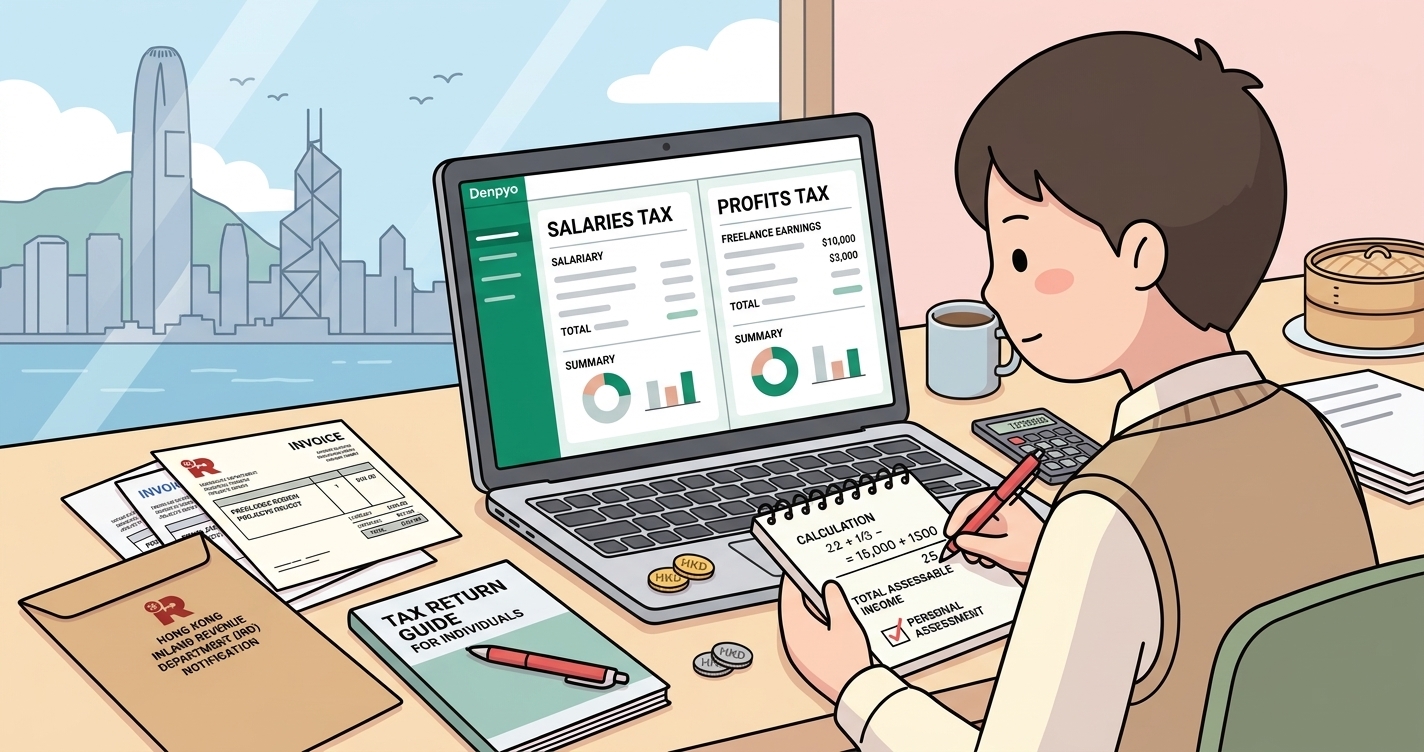
Got a salaried job and a freelance side hustle in Hong Kong? Your salary falls under Salaries Tax while your freelance profit is taxed as Profits Tax—two regimes, one return. This guide explains how to report both, when to register a business, what expenses you can deduct, and how Personal Assessment can lower your bill.
Disclaimer: This article is general information as of June 2026 and is not professional tax advice. Tax rules and allowances change. For your situation, consult the Inland Revenue Department (IRD) or a qualified tax adviser.
More and more Hong Kong professionals hold a salaried job and run a freelance side hustle—design work after hours, weekend consulting, an online shop, content creation. The moment that side work starts earning, a sensible question follows: how is it taxed, and do I report it differently from my salary? The short answer is that Hong Kong taxes your two income streams under two separate regimes: your employment income under Salaries Tax and your freelance profit under Profits Tax. The good news is that, for most individuals, both can be reported on the same annual return.
Two regimes, explained simply
Hong Kong does not have a single "income tax." Instead, different types of income are charged under different headings:
- Salaries Tax applies to income from an office or employment. It is charged at progressive rates of 2% to 17%, with the total capped at the standard rate (15% on the first HK$5 million of net income and 16% above). Personal allowances—such as the basic allowance—reduce what you pay.
- Profits Tax applies to profits from a trade, profession or business carried on in Hong Kong. For unincorporated businesses (sole proprietorships and partnerships, which is how most freelancers operate), the two-tiered rates are 7.5% on the first HK$2 million of assessable profits and 15% on the remainder.
So your salary is taxed as salary, and your freelance profit—your freelance income minus allowable business expenses—is taxed as business profit.
Is your side hustle actually a "business"?
A one-off favour for a friend is not a business; regular freelance work for clients almost certainly is. The IRD looks at the substance of the activity—whether you are carrying on a trade or profession with a view to profit. If you invoice clients, advertise your services, or do the work repeatedly and systematically, treat it as a business for tax purposes.
That distinction matters because carrying on a business in Hong Kong generally triggers a business registration obligation. Under the Business Registration Ordinance, you are normally required to register your business with the IRD within one month of starting, obtain a Business Registration Certificate, and renew it. Many side-hustlers overlook this step.
One return, two parts: how to file
If you are an individual with both a salary and a sole-proprietorship side business, you usually report everything on the Tax Return – Individuals (BIR60):
- Employment income goes in the salaries section, matching the figures from your employer.
- Sole-proprietorship results—your gross freelance income, business expenses and net profit—go in the profits/sole-proprietor section.
Keep the two streams clearly separated in your own records. If your freelance work is run through a partnership or a limited company, a separate Profits Tax Return may be required instead; check which return the IRD issues to you.
What you can deduct against freelance profit
Here is the real advantage of the Profits Tax side: you are taxed on profit, not turnover, so legitimate business expenses reduce your taxable amount. Commonly deductible costs for a freelancer include:
- Software subscriptions, professional tools and equipment
- A reasonable, apportioned share of home-office costs where you work from home
- Professional fees, training directly related to your trade, and relevant insurance
- Business travel, client-meeting costs and marketing
- Depreciation allowances on bigger equipment purchases
Personal allowances like the basic allowance (HK$132,000 for 2025/26, with the government having proposed an increase to HK$145,000 for 2026/27) sit on the Salaries Tax / Personal Assessment side—they are not the same thing as business expense deductions. Keep the two ideas distinct.
Personal Assessment: can it lower your bill?
Because profits tax is a flat-rate charge with no personal allowances of its own, a freelancer with modest profit can sometimes pay less by electing Personal Assessment. This combines your salary, business profit and other income, then applies the progressive salaries-tax rates and personal allowances to the total. If your combined income is low enough that progressive rates beat the flat 7.5%/15%, electing Personal Assessment reduces your overall tax. The IRD will not force the choice on you—you tick the election box on your return, and it is worth comparing both outcomes each year.
Note the one-off relief too: for the year of assessment 2025/26, both Salaries Tax and Profits Tax were reduced by a 100% one-off reduction capped at HK$3,000 per case, which the IRD applies automatically.
A worked example
Suppose you earn HK$480,000 from your job and HK$150,000 of freelance income, against which you have HK$30,000 of genuine business expenses. Your freelance profit is HK$120,000. Under Profits Tax, that profit is charged at 7.5% (well within the first HK$2 million band) = about HK$9,000 before the one-off reduction. Your salary is taxed separately under Salaries Tax with your personal allowances applied. If your total income is modest, running the numbers under Personal Assessment may produce a lower combined result—so check both.
Keep clean records all year
Two income streams mean twice the paperwork, and Hong Kong requires you to keep business records for 7 years. The freelancers who pay the least—legitimately—are the ones who capture every deductible expense and can prove it. Tools like Denpyo let you photograph a receipt or invoice and have the date, amount, vendor and category extracted automatically, so your side-business books stay current without late-night spreadsheet sessions. To sanity-check whether a cost counts, try the expense checker, and use the income tax calculator to estimate the tax on your combined earnings.
Summary
In Hong Kong, a salaried job and a freelance side hustle are taxed under two regimes—Salaries Tax on your pay and Profits Tax on your business profit—but usually reported on one return, the BIR60. Register your business within a month of starting, deduct genuine expenses against your freelance profit, and compare the Personal Assessment election each year to see whether progressive rates plus allowances beat the flat profits-tax rate. Above all, keep tidy records for seven years; disciplined bookkeeping is what turns a stressful filing season into a quick, confident one—and keeps your tax bill as low as the law allows.

Track expenses, maximize deductions
Denpyo scans your receipts and finds tax savings automatically.