
2026 Housing Loan Deduction Guide | First-Year Filing for Japan Mortgages
Bought a home in Japan? Learn how to claim the housing loan deduction in your first year. Required documents, calculation methods, and e-Tax filing steps.
Disclaimer: This article provides general information only and does not constitute tax or legal advice. Please consult a qualified tax professional (zeirishi) for advice specific to your situation. Information is based on official National Tax Agency (NTA) and Ministry of Land, Infrastructure, Transport and Tourism (MLIT) sources and current as of January 2026. Disclosure: This article is published by Denpyo, a receipt and expense management service. Some tools and services mentioned include Denpyo products.
Introduction: Tax Filing is Required Only in Your First Year
"I bought a home in Japan, but how do I actually claim the housing loan deduction?"
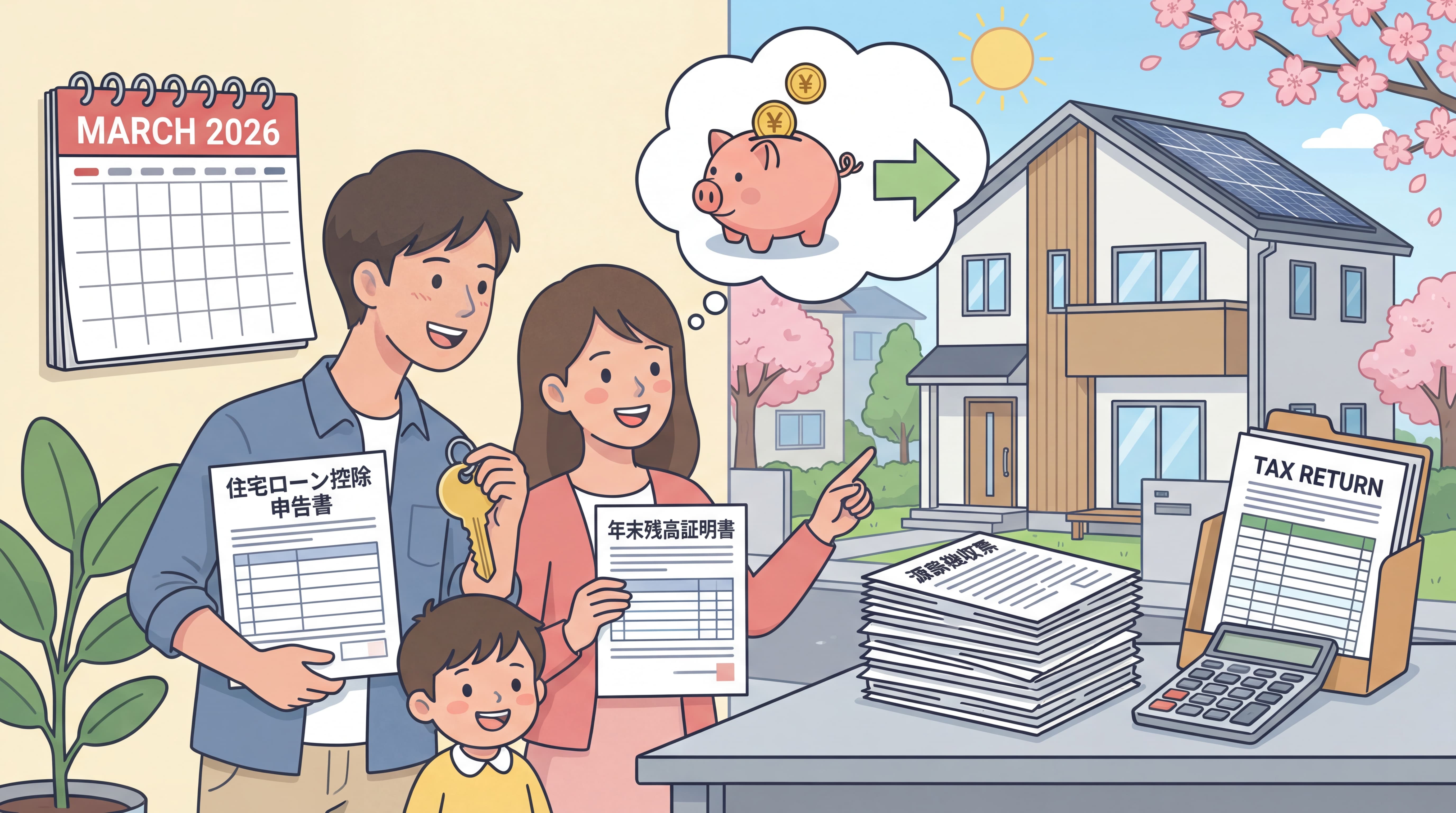
If you're a foreigner who recently purchased property in Japan, you're not alone in feeling confused about the process. The housing loan deduction (jutaku roon koujo / jutaku roon genzei) allows homeowners with a mortgage to receive tax credits against both income tax and residence tax — potentially saving you millions of yen over the years.
The key point to understand:
- Only the first year requires a tax return — You must file a tax return (kakutei shinkoku) yourself
- From the second year onwards, year-end adjustment handles it — Your employer processes it automatically
If you moved into your new home in 2025 and are claiming the deduction for the first time in 2026, this tax return is mandatory.
What you'll learn in this article:
- How the housing loan deduction works and the 2026 system
- How to calculate your deduction amount
- Complete list of required documents and where to get them
- Step-by-step e-Tax filing process
- What happens from the second year onwards
1. What is the Housing Loan Deduction?
1.1 How It Works
The housing loan deduction allows you to directly deduct a percentage of your year-end mortgage balance from your income tax. This is different from an "income deduction" — it's a "tax credit," meaning it reduces your actual tax bill rather than just your taxable income.
Deduction Rate: 0.7% of your year-end loan balance
Deduction Period: Up to 13 years
Example:
- Year-end mortgage balance: 30,000,000 yen
- Annual deduction: 30,000,000 yen x 0.7% = 210,000 yen
- Over 13 years: Total savings of over 2,500,000 yen
This is a significant benefit — 210,000 yen per year is essentially money back in your pocket that would otherwise go to taxes.
1.2 Eligibility Requirements
| Requirement | Details |
|---|---|
| Income Limit | Total annual income must be 20,000,000 yen or less |
| Loan Term | Mortgage must be for 10 years or more |
| Floor Area | 50 square meters or more (40 sqm+ for some qualifying homes) |
| Residence Requirement | Move in within 6 months of acquisition; must be living there as of December 31 |
| Housing Type | Must meet energy efficiency standards (for new construction) |
Source: NTA - Housing Loan Deduction Information
2. Housing Loan Deduction System for 2026
2.1 Borrowing Limits by Housing Type
For homes where you moved in during 2025 (filing in 2026):
| Housing Type | Borrowing Limit | Deduction Period | Maximum Annual Deduction |
|---|---|---|---|
| Certified Housing (Long-term Quality / Low-Carbon) | 45,000,000 yen | 13 years | 315,000 yen |
| ZEH Standard Energy-Efficient Housing | 35,000,000 yen | 13 years | 245,000 yen |
| Energy-Efficient Standard Housing | 30,000,000 yen | 13 years | 210,000 yen |
| Other New Housing (not meeting energy standards) | Not eligible | — | — |
Important: New homes that don't meet energy efficiency standards became ineligible for the housing loan deduction starting in 2024. Make sure your home qualifies before expecting this benefit.
2.2 Enhanced Benefits for Families
Certain households receive increased borrowing limits:
Eligible Households:
- Households with dependents under 19 years old
- Households where either spouse is under 40 years old
| Housing Type | Standard Limit | Child-Rearing / Young Couple Limit |
|---|---|---|
| Certified Housing | 45,000,000 yen | 50,000,000 yen |
| ZEH Standard | 35,000,000 yen | 45,000,000 yen |
| Energy-Efficient Standard | 30,000,000 yen | 40,000,000 yen |
This is a significant benefit for younger families — an extra 5-10 million yen in eligible loan balance can mean tens of thousands of yen more in annual deductions.
2.3 Existing (Used) Homes
| Housing Type | Borrowing Limit | Deduction Period |
|---|---|---|
| Certified Housing | 30,000,000 yen | 10 years |
| Other Housing | 20,000,000 yen | 10 years |
For existing homes to qualify, they must have been built in 1982 or later (meeting new earthquake resistance standards). If the home was built before 1982, you'll need an earthquake resistance certificate to prove compliance.
Source: MLIT - Housing Loan Tax Credit
3. How to Calculate Your Deduction Amount
3.1 Basic Formula
Annual Deduction = Year-End Loan Balance x 0.7%
However, amounts exceeding the borrowing limit for your housing type are not eligible for deduction.
3.2 Calculation Example
Scenario: You purchased certified housing with a 48,000,000 yen mortgage. Your year-end balance is 47,000,000 yen.
| Item | Amount |
|---|---|
| Year-end loan balance | 47,000,000 yen |
| Borrowing limit (Certified Housing) | 45,000,000 yen |
| Eligible amount | 45,000,000 yen (capped at limit) |
| Annual deduction | 45,000,000 yen x 0.7% = 315,000 yen |
Even though your actual loan balance is higher, you can only claim the deduction on the first 45 million yen.
3.3 When Income Tax Doesn't Cover the Full Deduction
If your income tax liability isn't large enough to absorb the full deduction, the remainder is also deducted from your residence tax (juuminzei).
Residence Tax Deduction Limit:
- 5% of your taxable income (up to a maximum of 97,500 yen)
Example:
- Housing loan deduction amount: 250,000 yen
- Your income tax liability: 150,000 yen
- Deducted from income tax: 150,000 yen
- Remaining: 100,000 yen
- Deducted from residence tax: 97,500 yen (capped at limit)
- Actual total deduction: 247,500 yen
In this case, you receive almost all of the deduction, with just 2,500 yen unclaimed due to the residence tax cap.
4. Required Documents and How to Obtain Them
4.1 Essential Documents
| Document | Where to Obtain | Notes |
|---|---|---|
| Tax Return Form | NTA website or tax office | Auto-generated if using e-Tax |
| Withholding Statement (Gensen Choushuu-hyou) | Your employer | For salary earners |
| Housing Loan Deduction Calculation Statement | NTA website | Created alongside your tax return |
| Year-End Balance Certificate | Your bank/lender | Sent automatically in October-November |
| Certificate of Registered Matters (Building) | Legal Affairs Bureau | Available online |
| Certificate of Registered Matters (Land) | Legal Affairs Bureau | If you also purchased the land |
| Copy of Sales or Construction Contract | Received at purchase | Verifies the contract amount |
4.2 Additional Documents by Housing Type
| Housing Type | Additional Documents Required |
|---|---|
| Certified Long-Term Quality Housing | Copy of certification notice |
| Certified Low-Carbon Housing | Copy of certification notice |
| ZEH Standard Energy-Efficient | Energy performance certificate |
| Energy-Efficient Standard | Energy performance certificate |
| Existing Housing (pre-1982) | Earthquake resistance certificate |
4.3 How to Obtain Key Documents
Certificate of Registered Matters (Touki Jikkou Shoumeisho):
- Online Application: Online Registration System — Fee: 500 yen
- In Person at Legal Affairs Bureau: Fee: 600 yen
- By Mail: Fee: 500 yen
The online system is most convenient, though the interface is in Japanese. You can request certificates for both your building and land through this system.
Year-End Balance Certificate (Nenmatsu Zandaka Shoumeisho):
- Your bank or financial institution sends this automatically around October-November
- If you haven't received it by early December, contact your lender
- This document shows your exact loan balance as of December 31
5. e-Tax Filing Procedure
5.1 Preparation
- Prepare your My Number Card — Required for e-Tax authentication
- Gather all required documents — Have them within reach for data entry
- Install the My Number Portal app — Available on iOS and Android
5.2 Filing Steps
Step 1: Go to the Tax Return Preparation Corner
This is the NTA's official online tax filing portal. The interface is in Japanese, but modern browsers can translate it.
Step 2: Click "Start Preparation" and select "e-Tax"
Choose the e-Tax submission method to file electronically.
Step 3: Enter your salary income
Input the details from your withholding statement (gensen choushuu-hyou).
Step 4: Select "Housing Loan Special Deduction"
Navigate to the deductions section and select the housing loan deduction option.
Step 5: Enter your property information
- Acquisition date
- Move-in date
- Floor area
- Acquisition cost
Step 6: Enter your mortgage information
- Amount from year-end balance certificate
- Name of financial institution
Step 7: Select your housing type
- Certified housing
- ZEH standard
- Energy-efficient standard
- Existing housing
Step 8: Choose how to submit attached documents
- Upload document images via e-Tax
- Or mail documents separately to your tax office
Step 9: Review and submit
- Verify the calculated deduction amount
- Apply electronic signature using your My Number Card
- Submit via e-Tax
5.3 Submitting Attached Documents
With e-Tax, you can submit attached documents in several ways:
| Method | Details |
|---|---|
| Image Data Submission | Upload as PDF or JPEG files |
| Mail Documents | Send to tax office after submitting your return |
| Bring Documents In Person | Deliver to the tax office counter |
The image upload method is most convenient and allows you to complete everything online.
6. From the Second Year Onwards
6.1 Year-End Adjustment Takes Over
Starting from the second year, you can receive the housing loan deduction through your employer's year-end adjustment (nenmatsu chousei).
You don't need to file a tax return!
This is a major convenience — just submit the required documents to your HR department, and the deduction is processed automatically.
6.2 Documents Required for Year-End Adjustment
| Document | How to Obtain |
|---|---|
| Housing Loan Deduction Declaration (Juutaku Kariirekin Tokubetsu Koujo Shinkokusho) | Sent by tax office after first-year filing — includes all remaining years at once |
| Year-End Balance Certificate | Sent by your financial institution annually |
Important: After your first year's tax filing, the tax office will send you the Housing Loan Deduction Declaration forms for all 12 remaining years at once. Keep these documents safe — if you lose them, you'll need to request replacements from the tax office, which can be time-consuming.
7. Frequently Asked Questions (FAQ)
Q1: For how many years do I need to file a tax return for the housing loan deduction?
A: Only the first year requires a tax return. From the second year onwards, your employer's year-end adjustment handles it automatically.
Q2: What if my spouse and I both have loans on the same property?
A: Each spouse must file separately. If you have a joint mortgage or separate loans on the same property, each person files their own tax return and receives deductions based on their respective loan amounts.
Q3: What if I lost my year-end balance certificate?
A: Contact your bank or financial institution to request a replacement. There may be a reissuance fee, and processing takes time, so request it as early as possible.
Q4: What if I forgot to file in the first year?
A: Good news — refund claims can be filed retroactively for up to 5 years. However, if you don't complete the first-year tax filing, you cannot use year-end adjustment in subsequent years. File as soon as possible to start receiving your benefits.
Q5: Does making extra mortgage payments reduce my deduction?
A: Yes, since your year-end balance decreases, your deduction amount also decreases. However, the interest savings from prepayment often outweigh the reduced tax benefit. It's worth calculating both scenarios for your specific situation.
Q6: What if I'm transferred and have to relocate?
A: If only you transfer for work while your family continues living in the home, you can continue receiving the deduction. If everyone moves out, you generally lose eligibility — but you may be able to resume the deduction if you move back to the property later.
8. Important Notes and Cautions
8.1 Energy Efficiency Requirements Are Mandatory
Starting from 2024, new homes that don't meet energy efficiency standards are no longer eligible for the housing loan deduction. When purchasing a home, always verify its energy performance classification.
If you're buying from a developer or builder, ask specifically about:
- Whether the home qualifies for the housing loan deduction
- What energy efficiency certification it has
- The appropriate documentation you'll receive
8.2 Continuous Residence Requirement
To continue receiving the housing loan deduction, you must be living in the property as of December 31 each year. If you move out (other than temporary work transfers), you'll lose eligibility.
8.3 Disaster Risk Area Exclusions
Starting from 2028, new homes in designated landslide disaster special warning areas and other high-risk zones will become ineligible for the housing loan deduction. This doesn't affect existing homeowners, but something to be aware of if purchasing in the future.
Summary
Let's recap the key points of the housing loan deduction for first-time filers.
5 Things to Remember:
- Only the first year requires tax filing — From year two, year-end adjustment handles everything automatically
- Deduction rate is 0.7% for up to 13 years — Borrowing limits vary by housing type (certified, ZEH, energy-efficient)
- Prepare documents early — Certificate of registered matters and year-end balance certificate are essential
- Energy efficiency compliance is critical — Non-compliant new homes are ineligible since 2024
- Tax office sends 12 years of forms at once — Keep them safe to avoid hassle in future years
2026 Filing Deadline: March 16 (Monday)
Don't wait until the last minute. The tax office and e-Tax system get very busy in the final weeks of filing season.

Track expenses, maximize deductions
Denpyo scans your receipts and finds tax savings automatically.