
Best Accounting Software for Malaysian Freelancers & SMEs 2026: MyInvois-Ready Options Compared
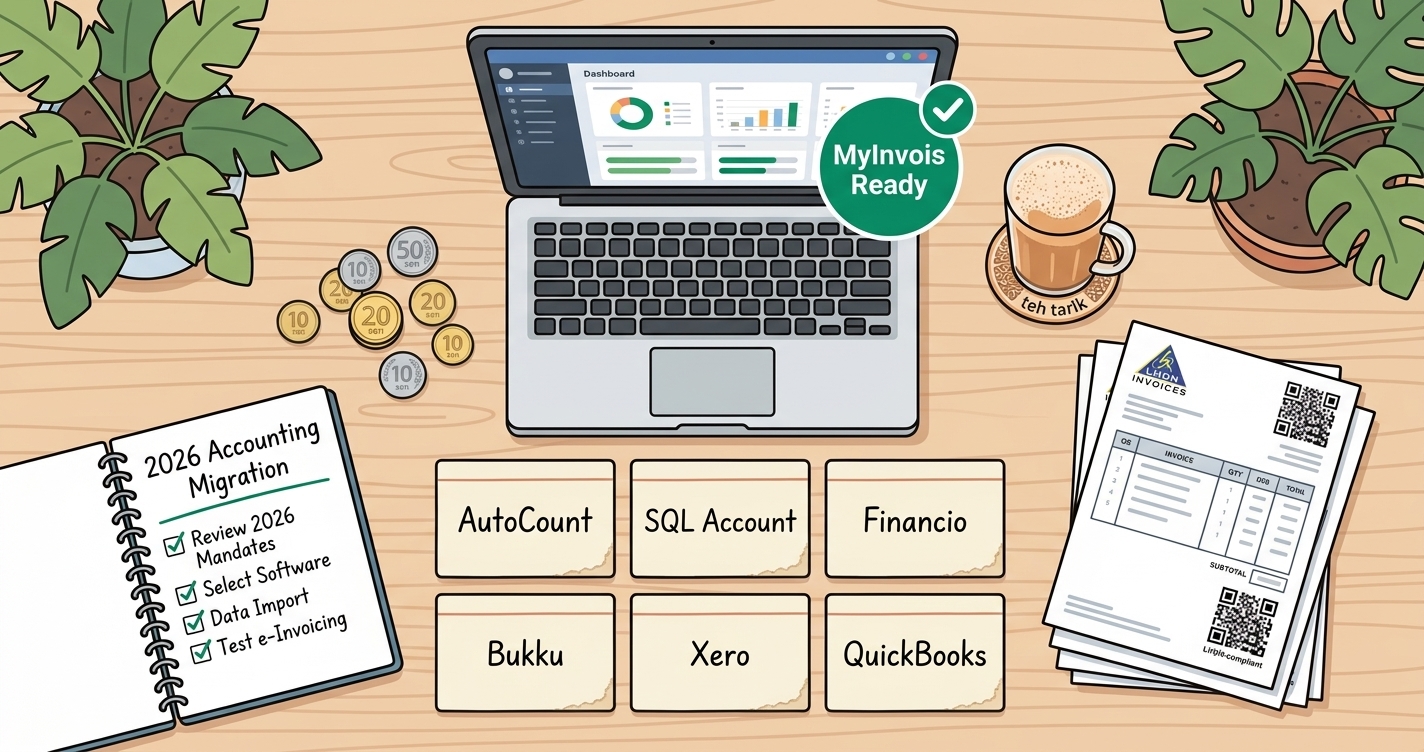
A plain-English comparison of the six accounting tools Malaysian freelancers and SMEs actually use in 2026 — AutoCount, SQL Account, Financio, Bukku, Xero, and QuickBooks — with MyInvois readiness, SST handling, pricing, and a stage-by-stage decision framework for solos, agencies, and inventory-heavy businesses.
Disclaimer: This article is general information for Malaysian freelancers and small business owners, not tax or procurement advice. Software features, prices, and MyInvois certification status change frequently — before committing to a subscription, confirm current capabilities directly with the vendor and verify e-Invoice compliance requirements at the Lembaga Hasil Dalam Negeri (LHDN) official e-Invoice portal.
Why 2026 is the year Malaysian freelancers finally need accounting software
For years, a spreadsheet and a shoebox of receipts was enough to run a small Malaysian business. The LHDN Form B deadline landed on 30 June, you totalled your income and expenses in Excel, and that was that. That model broke in 2024 and is effectively over in 2026. Two forces pushed it off the cliff: MyInvois e-invoicing, which is now mandatory for progressively smaller businesses each phase, and the re-expansion of Sales and Service Tax (SST) scope in 2025, which pulled a wider set of service providers into tax registration.
If you invoice business customers in Malaysia — whether as a sole proprietor, an enterprise (perniagaan), or a Sdn Bhd — you now need software that issues MyInvois-validated e-Invoices, tracks SST where relevant, and keeps a clean audit trail for the seven-year record retention LHDN expects. This article compares the accounting tools Malaysian freelancers and SMEs actually use in 2026, what each is good at, and how a receipt-capture app like Denpyo fills the gap none of them fill well.
The six features that matter most in 2026
Before comparing brands, it helps to fix the evaluation criteria. For a Malaysian solo consultant, freelance designer, tutor, online seller, or SME director, the features worth paying for are:
- MyInvois integration. Can the software submit invoices directly to the LHDN MyInvois portal via API and return a validated UUID and QR code? Or does it just print a PDF that you then key in manually?
- SST handling. If you cross the RM500,000 service tax threshold (or RM500,000 sales tax for taxable goods), the software must compute SST at the right rate, generate SST-03 returns, and keep a compliant tax invoice format.
- Receipt & expense capture. How easy is it to photograph a Grab receipt, a petrol station receipt, or a supplier invoice and have the amount, date, and tax portion extracted without manual typing?
- Multi-currency. If you bill clients in Singapore, Australia, the US, or anywhere else, the software needs to convert, post FX gains/losses, and keep the MYR figures LHDN wants to see.
- Bank feeds. Direct feeds from Maybank, CIMB, Public Bank, Hong Leong, and RHB remove 80% of the data-entry pain.
- Accountant collaboration. A clean "invite my accountant" flow matters enormously when your tax agent files Form B or C for you.
The contenders: six tools Malaysian SMEs actually use
1. AutoCount Accounting
The default choice for traditional Malaysian SMEs with inventory. AutoCount has been the backbone of Johor and Selangor SMEs for two decades — distributors, hardware stores, F&B chains. The desktop version (AutoCount Accounting) is still widely sold; the cloud version (AutoCount Cloud Accounting, AutoCount ECS) is catching up. Strengths: local support network covers every state, MyInvois-ready through the AutoCount MyInvois module, strong inventory and manufacturing modules. Weaknesses: interface feels dated, freelancers without inventory pay for modules they don't need, receipt scanning is basic. Best for: SMEs with inventory, retail, manufacturing, or wholesale.
2. SQL Account (SQL Financial Accounting)
The other big Malaysian desktop incumbent. SQL is known for its customisable reports and solid GST/SST modules (a legacy of GST 2015–2018 that paid off when SST returned). Strengths: very strong accountant ecosystem in KL and Penang, MyInvois submission module, mature SST reporting, bilingual interface (English/Chinese). Weaknesses: primarily on-premise with cloud add-ons, pricing by user seat gets expensive for small teams, mobile experience is limited. Best for: SMEs who want deep reporting and already have an SQL-fluent accountant.
3. Financio
Built in Malaysia for SMEs and freelancers, fully cloud, Bahasa Melayu + English interface. Financio is the local answer to Xero. Strengths: native MyInvois integration, SST built in, affordable starter tiers, clean mobile app, bank feeds with major Malaysian banks, strong templating for local invoice formats. Weaknesses: smaller user base than AutoCount/SQL means fewer third-party integrations, reporting less deep than SQL. Best for: freelancers and small SMEs who want a cloud-first experience without the Xero learning curve.
4. Bukku
Cloud-native, free plan available, targets micro-businesses and freelancers. Bukku has become popular with solo operators — consultants, online sellers, e-commerce dropshippers — because you can genuinely start at RM0. Strengths: free tier covers many solo use cases, clean UX, MyInvois integration, simple SST toggles, easy invitation to accountant. Weaknesses: limited inventory features, customisation thinner than SQL/AutoCount, support largely self-serve. Best for: freelancers, side-hustlers, and very small service businesses.
5. Xero (with a Malaysian partner)
Xero is the global cloud accounting standard, used by millions in AU/NZ/UK. In Malaysia it is increasingly popular with agencies, consulting firms, and tech SMEs. MyInvois compliance typically flows through a certified integrator (for example via a middleware partner) rather than being built into Xero directly. Strengths: best-in-class bank feeds, beautiful UX, enormous app marketplace (Stripe, Shopify, Hubspot, Gusto/Employment Hero integrations), multi-currency is superb. Weaknesses: MyInvois needs a third-party connector and adds cost, SST module less local than Financio/SQL, priced in USD which makes it more expensive than local options. Best for: multi-currency, international-facing service businesses, agencies, tech SMEs.
6. QuickBooks Online
Global brand, strong US/Canada footprint, modest but growing Malaysian presence. Similar profile to Xero but with a slightly different UX. Strengths: mature mobile app, good receipt capture, solid bank feeds, payroll add-on. Weaknesses: MyInvois integration requires a connector, SST handling is less polished for Malaysian specifics, fewer Malaysian accountants use it day-to-day. Best for: businesses already in the Intuit ecosystem or those with US-facing clients.
Honourable mentions: Biztory (cloud, freelancer-friendly, Malaysian-built), Niagawan (very small-business focused, Bahasa-first), and ABSS Premier (formerly MYOB, still used by older SMEs). Each has a niche but the six above cover the majority of serious 2026 decisions.
Quick comparison at a glance
A fair side-by-side has to stay honest about what is "built-in" versus "via a partner". Approximate positioning as of 2026:
- MyInvois native API: AutoCount, SQL, Financio, Bukku. Xero and QuickBooks typically via connector.
- SST ready out of the box: AutoCount, SQL, Financio, Bukku. Xero/QuickBooks require manual configuration.
- Multi-currency depth: Xero > QuickBooks > Financio > SQL > AutoCount > Bukku.
- Starter price: Bukku (free) < Financio < Biztory < QuickBooks < Xero < AutoCount Cloud ≈ SQL Cloud.
- Accountant network: SQL ≈ AutoCount > Financio > Xero > Bukku > QuickBooks.
Where receipt capture still fails — and how Denpyo fits
All six tools above can store a receipt image. Most of them can run some form of OCR on it. But Malaysian business receipts — a Shopee Food bill in Bahasa, a handwritten pasar malam invoice, a petrol station slip with SST line items split across fuel and lubricants, a bilingual hotel folio from Langkawi — still defeat the generic receipt-capture built into most accounting platforms. The software was designed for clean UK or Australian supplier invoices and treats Malaysian edge cases as afterthoughts.
Denpyo is a mobile-first receipt and expense scanner tuned for Asia-Pacific document types. You photograph a receipt, it extracts vendor, date, amount, SST portion, and suggests a chart-of-accounts category (travel, entertainment, utilities, subcontractor, office supplies). At month-end, you export a clean CSV and drop it into AutoCount, SQL, Financio, Bukku, Xero, or QuickBooks as a bill or expense. Denpyo is not trying to replace your accounting system — it's the layer that turns a glove-compartment pile of paper into data your accounting system can actually consume.
For solo freelancers who want to defer choosing a full accounting package, Denpyo alone is often enough for the first year: it produces the expense register and category totals your tax agent needs for Form B. Before you upgrade, it's worth running your numbers through two free calculators so you know what spend actually moves the tax needle:
- Income Tax Calculator — estimate Form B liability from chargeable income and reliefs at 2026 rates.
- Tax Savings Estimator — see how much tax you save per RM of deductible expense at your marginal band.
- Expense Deductibility Checker — quick yes/no on whether a cost is deductible under LHDN rules before you buy.
Decision framework: pick the right tool for your stage
There is no single best answer. The right tool depends on where you are in the freelancer-to-SME journey.
- Solo freelancer, under RM100k revenue, Malaysian clients only: Denpyo (for receipts) plus Bukku free tier or Financio starter. Upgrade to Financio paid when you hit 20+ transactions/month.
- Solo consultant with overseas clients: Denpyo plus Xero Starter or Financio. Xero wins if you invoice in USD/SGD/AUD and want clean FX handling.
- Agency or studio, 2–10 staff: Xero or Financio, plus Denpyo for team receipts. Add a MyInvois connector for Xero.
- Traditional SME with inventory: AutoCount or SQL. Both have a deep Malaysian accountant network and mature stock modules.
- SST-registered service provider: Financio or SQL. Both handle Malaysian SST-03 natively.
- Cross-border e-commerce seller: Xero or QuickBooks (for their Shopify/Amazon apps) plus a Malaysian MyInvois connector.
MyInvois specifics you shouldn't get wrong
Whichever tool you pick, three MyInvois rules matter in 2026:
- Consolidated e-Invoices are allowed only for B2C. For B2B you need to issue a validated e-Invoice per transaction.
- Validated UUID and QR code must appear on the invoice your customer actually receives. A PDF from your software without the UUID is not compliant.
- Self-billed e-Invoices apply to specific transactions (royalties, claim payouts, e-commerce platform payouts, payments to agents). If any of those apply to your business, confirm the software supports self-billed scenarios.
If your accounting tool's MyInvois module is "coming soon" in April 2026, that is a red flag — the phased rollout is well past the early adopters. Ask the vendor for a live demo of a successful submission and validation.
Data migration tips when switching
Most Malaysian SMEs switching tools in 2026 are moving from desktop SQL/AutoCount to a cloud option, or from spreadsheets to Financio/Bukku. A few tips that save months of pain:
- Cut over on 1 January or 1 April (start of Malaysia's quarterly SST period) so you don't have to split a period across two systems.
- Export your current year opening balances, trial balance, chart of accounts, and customer/supplier master files to CSV. Don't try to migrate transaction history — bring in balances instead.
- Keep the old system read-only for seven years (LHDN record retention). Don't cancel the licence the day you switch.
- Import receipts via Denpyo CSV so your new accounting tool has the expense history it needs for P&L comparison.
Summary
The Malaysian accounting software market in 2026 is no longer a two-horse race between AutoCount and SQL. Cloud-native local players like Financio and Bukku have matured, Xero and QuickBooks have serious traction with international-facing businesses, and MyInvois compliance is the new table stakes. Pick the tool that matches your stage — free Bukku for a side hustle, Financio for a growing solo business, Xero for an agency, AutoCount/SQL for inventory-heavy SMEs — and pair it with a dedicated receipt scanner so the data going in is clean. Your tax agent, your future audit, and your 30 June filing will all be better for it.
Track expenses, maximize deductions
Denpyo scans your receipts and finds tax savings automatically.