
Budget 2027 Malaysia Tax: What Changes for Freelancers and SMEs
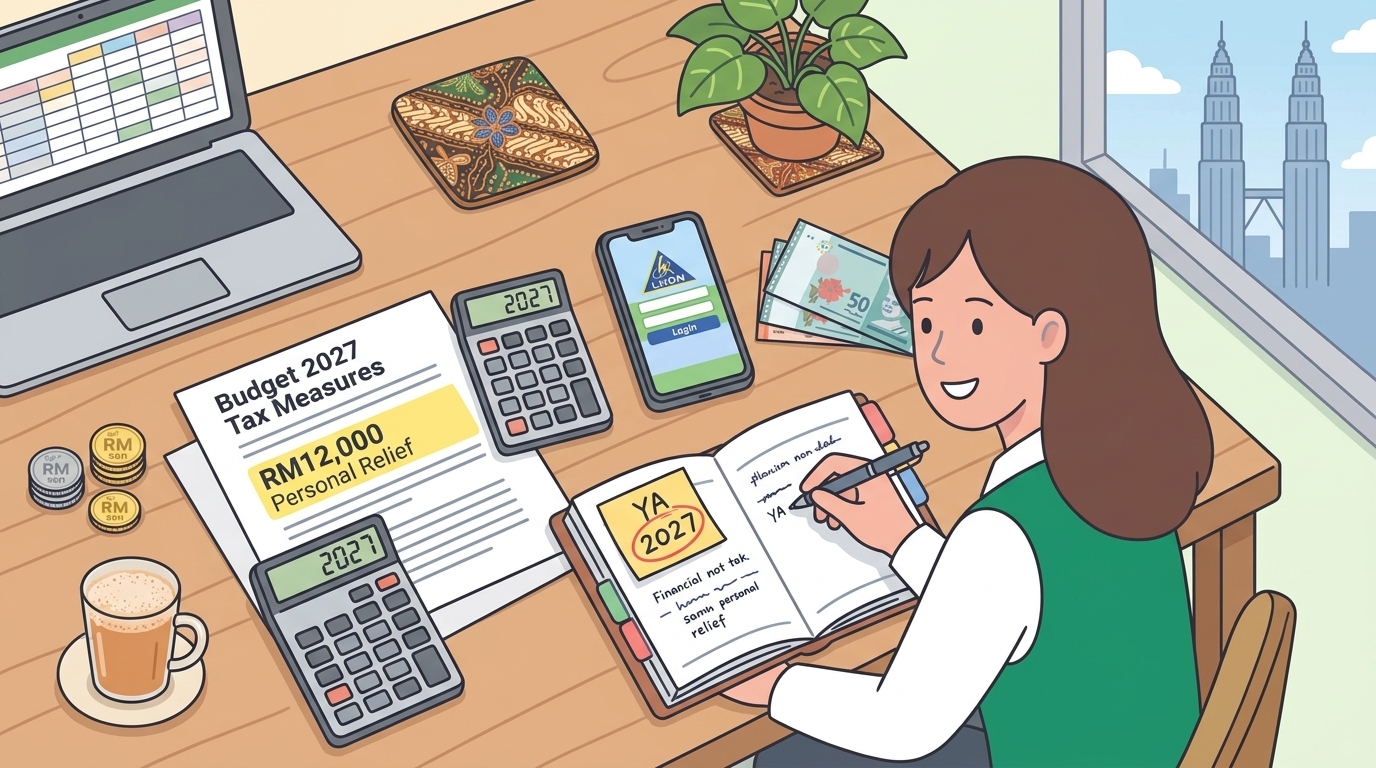
Budget 2027, tabled on 9 October 2026, proposes RM12,000 personal relief, lower individual and MSME tax rates and wider reliefs from YA2027. Here is what reaches sole proprietors and micro-SMEs, and what is still only a proposal.
This article is general information for Malaysian freelancers, sole proprietors and small business owners. It is not tax advice. Budget 2027 measures are proposals until the law that implements them is in force. The authoritative sources are the Ministry of Finance Budget 2027 tax measures and the Inland Revenue Board of Malaysia (LHDN / HASiL). Check your own position with LHDN or a tax agent before you act.
If you freelance, run a one-person business or own a small Sdn Bhd, the Budget 2027 Malaysia tax changes are mostly good news, but they arrive later than the headlines suggest. Prime Minister and Finance Minister Anwar Ibrahim tabled Budget 2027 in the Dewan Rakyat on Friday, 9 October 2026. The individual relief rises for the first time since 2010, two income bands get cheaper, small companies get a lower rate, and several everyday reliefs widen. Almost all of it is proposed from year of assessment (YA) 2027, which means income you earn in 2027 and declare in 2028. This guide reads the measures straight from the Ministry of Finance tax-measures appendix and sorts them by who they actually reach.
Key Takeaways
- The individual and dependent relatives relief is proposed to rise from RM9,000 to RM12,000 from YA2027, the first change since YA2010.
- The resident rate on chargeable income of RM70,001–RM100,000 is proposed to drop from 19% to 18%, and a new RM100,001–RM150,000 band would be taxed at 24% instead of 25%, from YA2027.
- Qualifying small companies and LLPs are proposed to pay 14% on their first RM150,000 and 16% on RM150,001–RM600,000 from YA2027; sole proprietors are taxed as individuals and do not get this rate.
- Budget 2027 contains no new e-invoicing measure; the change that matters is LHDN’s exemption threshold rising from RM1 million to RM3 million from 1 September 2026, announced separately.
- Your 2026 income, filed in 2027, is still assessed with the RM9,000 relief and today’s rates.
Belanjawan 2027 cukai changes are proposals, not law (yet)
A Budget speech announces policy; the tax changes take legal effect only once the implementing legislation is in place, which for income tax means a Finance Bill passed by Parliament. As Baker McKenzie notes, the proposals “are subject to the enactment of the relevant legislation.” At the time of writing (1 November 2026) we have not seen that bill, so treat every figure below as proposed.
The second thing to get right is the year. Most measures say “from the year of assessment 2027”. LHDN’s filing programme shows how the cycle works: the Form B return for YA2025, for resident individuals who carry on business, was due on 30 June 2026. On the same pattern, YA2027 covers the income you earn in 2027 and you claim the new reliefs when you file in 2028. When you file in 2027 for your 2026 income, you still use the RM9,000 relief and the current rate table. Our guide to claiming personal tax relief for 2026 still applies for that return.
Budget 2027 personal relief and income tax rates
Sole proprietors are individuals for tax purposes. LHDN describes Form B as the return for a “resident individual who carry on business”, so your business profit lands on the same progressive scale as a salary. That makes the individual measures the ones that matter most to freelancers.
Personal relief. The individual and dependent relatives relief has been RM9,000 since YA2010. Budget 2027 proposes RM12,000 from YA2027. For a resident individual, that takes an extra RM3,000 off chargeable income before any rate is applied.
Rates. The proposed changes to the resident individual scale, all from YA2027:
| Chargeable income (RM) | Current rate | Proposed from YA2027 |
|---|---|---|
| 70,001 – 100,000 | 19% | 18% |
| 100,001 – 150,000 | 25% | 24% (new band) |
| 150,001 – 400,000 | 25% | 25% (unchanged) |
| 600,001 – 1,000,000 | 28% | 28% |
| Exceeding 1,000,000 | 28% up to RM2,000,000, then 30% | 30% |
Bands not shown (RM0 to RM70,000, and RM400,001 to RM600,000 at 26%) are unchanged. At the top, the 30% rate would start above RM1 million rather than above RM2 million. The government’s own estimate in the Budget speech is that the higher relief and lower rates together give approximately 5 million taxpayers additional disposable income of up to RM1,600.
The expanded reliefs freelancers will actually use
Several existing reliefs keep their limits but cover more spending from YA2027:
- Lifestyle (RM2,500, unchanged limit) — now also covers subscriptions to AI software and applications for personal use, your spouse or your child, plus pet adoption from registered animal shelters and registered vet services for vaccination and spaying or neutering.
- Sports-related lifestyle (RM1,000, unchanged limit) — adds sports shoes, capped at RM300 within the RM1,000.
- Education and skills training fees (RM7,000) — recognised Certificate-to-PhD study in any field (below Masters level it was limited to specific fields), TVET upskilling for you or your spouse up to RM3,000, and up to RM2,000 for non-work courses for you or your spouse, or children’s STEM, arts, language or religious classes and tuition.
- Health and Well-being (RM10,000) — the renamed medical relief adds postnatal care by a confinement centre or qualified individual up to RM3,000, and absorbs breastfeeding equipment (RM1,000).
- Parents and grandparents (RM8,000) — care at home, day care or residential care can be any type of care, not only medical care, and no longer needs a registered medical practitioner’s verification. A carer’s written declaration or work permit plus receipts is required.
- Domestic tourism (up to RM1,000) — entrance fees to attractions and cultural programmes, extended for YA2027.
- SOCSO (RM350, plus a new RM150) — the RM350 relief now covers mandatory LINDUNG Kendiri contributions in the three mandatory sectors (passenger transport, goods or food transport, hawkers), and up to RM150 more covers voluntary LINDUNG 24 contributions and LINDUNG Kendiri in the 17 non-mandatory sectors.
Note that the AI relief is worded for personal use. A subscription incurred wholly and exclusively in producing your business income is a business expense under section 33 of the Income Tax Act 1967, so record the two separately.
Budget 2027 SME Malaysia measures: what reaches micro-businesses
Lower MSME rates, for companies and LLPs. The tax-measures appendix defines MSMEs as companies with paid-up ordinary share capital of RM2.5 million or less, or LLPs with capital contributions of RM2.5 million or less, with annual sales not exceeding RM50 million. Other qualifying conditions in the law still apply. From YA2027 the proposed rates are:
- First RM150,000 of chargeable income: 15% → 14%
- RM150,001 to RM600,000: 17% → 16%
- Above RM600,000: 24%, unchanged
The speech puts the benefit at up to RM6,000 a year for more than 300,000 MSMEs. If you trade as a sole proprietor, this cut does not reach you. You benefit through the individual changes above instead.
Small value assets. From YA2027, the value of each asset that can be fully written off as a small value asset is proposed to rise from RM2,000 to RM3,000. For companies other than MSMEs, the overall annual cap would rise from RM20,000 to RM30,000. Under the current rules in LHDN’s Public Ruling No. 4/2026, only qualifying micro, small and medium companies have no annual limit; other companies and LLPs are capped at RM20,000 a year. The Budget documents describe the new cap in company terms only, so sole proprietors and LLPs should check the final Finance Bill wording for how the cap applies to them.
Accelerated Capital Allowance (ACA) extended. The ACA on qualifying spending, including plant and general machinery bought from local manufacturers, ICT equipment and computer software packages (20% initial plus 40% annual allowance, so the cost is written off within two years), is proposed to be extended to spending incurred from 1 January 2027 to 31 December 2030. The appendix describes it as an incentive for companies.
Cheaper P2P financing paperwork. P2P loan or financing agreements between MSMEs and investors currently enjoy a full stamp duty exemption until 31 December 2026. From 1 January 2027 to 31 December 2030, stamp duty on these agreements is proposed at just RM10.
If you employ staff. From YA2028, the Budget proposes that companies other than MSMEs only get a tax deduction for salaries paid through financial institutions or cashless payment instruments. Outside tax, the minimum wage is set to rise from RM1,700 to RM2,000 from June 2027, with MSMEs with annual sales below RM50 million exempted “to provide room for adjustment”.
SST and e-invoicing: what Budget 2027 did and did not change
SST. The indirect tax items in the tax-measures appendix are narrow. Service tax on elderly care services is set to fall from 8% to 6% from 1 January 2027, with a full exemption for annual care fees of up to RM96,000 per person at centres registered under the relevant care laws. Separately, local traders and distributors that have paid sales tax on machinery, spare parts and equipment supplied to manufacturers (and on certain inputs for pharmaceuticals, animal feed, fertilisers and pesticides) get a refund facility from 1 January 2027. A third item raises the value of goods visitors can take out of Langkawi and Labuan free of import duty and sales tax to RM10,000 from 1 January 2027. Deloitte noted the absence of the much-discussed hybrid SST–GST model. Outside those sectors, your SST position is unchanged. Our SST guide for freelancers covers the basics.
e-Invoicing. Neither the Budget speech nor the tax-measures appendix contains an e-invoicing measure. The change that matters came separately: in a 30 August 2026 media statement following the Prime Minister’s National Day address, LHDN announced that the government had agreed to raise the e-Invoice implementation threshold from RM1 million to RM3 million, effective 1 September 2026. MSMEs with annual income or sales below RM3 million are not required to implement e-Invoice; LHDN counts more than 1.1 million exempted businesses, and the government still encourages voluntary adoption. Check the conditions in LHDN’s e-Invoice guidance before you rely on the exemption; details are on its e-Invoice microsite.
What to do before the end of 2026
- File 2026 on today’s rules. Your 2026 income uses the RM9,000 relief and the current bands.
- Open a 2027 relief folder. Keep receipts for personal AI subscriptions, sports shoes, pet vaccination or adoption, postnatal care, children’s tuition and parents’ care from January.
- Split personal and business subscriptions. Business tools are business expenses; personal ones go under lifestyle relief.
- Sdn Bhd or LLP owners: confirm your MSME status with your tax agent before relying on the 14% rate.
- Check your e-invoice position against the RM3 million threshold, not the old RM1 million one.
- Watch for the Finance Bill and check the measures you are planning around survived unchanged.
Worked example: a freelancer and a small Sdn Bhd
Illustrative figures only, using the current scale and the proposed YA2027 scale with the same income in both years. Rebates, zakat and other reliefs are ignored to keep the arithmetic visible.
Aisyah, sole proprietor. Aisyah is a freelance graphic designer in Penang. After allowable business expenses, her business income is RM110,000. She claims the personal relief and RM2,500 of lifestyle relief.
- Current rules: RM110,000 − RM9,000 − RM2,500 = chargeable income of RM98,500. Tax is RM3,700 on the first RM70,000 plus 19% of RM28,500 (RM5,415) = RM9,115.
- Proposed YA2027 rules: RM110,000 − RM12,000 − RM2,500 = chargeable income of RM95,500. Tax is RM3,700 plus 18% of RM25,500 (RM4,590) = RM8,290.
Same income, RM825 less tax: roughly two-thirds from the bigger relief and one-third from the 18% rate. A personal AI subscription in 2027 would sit inside her RM2,500 lifestyle cap, not on top of it.
Kedai Rimba Sdn Bhd, qualifying MSME. A small online retailer with chargeable income of RM200,000:
- Current rates: 15% of RM150,000 (RM22,500) + 17% of RM50,000 (RM8,500) = RM31,000.
- Proposed YA2027 rates: 14% of RM150,000 (RM21,000) + 16% of RM50,000 (RM8,000) = RM29,000.
That is RM2,000 less tax. The maximum of RM6,000 is only reached at RM600,000 of chargeable income.
Keeping 2027 receipts in order
Most Budget 2027 gains depend on receipts you collect during 2027, long before you file. Denpyo handles that part: photograph a receipt and the AI extracts the date, vendor, amount and tax, shows the estimated tax savings, and exports a clean file for your accountant. To run your own numbers, try the free income tax calculator. If you are unsure whether a purchase is a business expense or a personal relief item, the expense deductibility checker gives you a starting view.
FAQ
When does the RM12,000 personal relief start in Malaysia?
It is proposed from year of assessment 2027, which covers income earned in 2027 and claimed when you file in 2028. When you file in 2027 for your 2026 income, the relief is still RM9,000. It also depends on Parliament passing the Finance Bill that implements Budget 2027.
Do sole proprietors get the 14% SME tax rate under Budget 2027?
No. The MSME rates apply to qualifying companies and limited liability partnerships. A sole proprietor files Form B as a resident individual, so business profit is taxed on the individual scale. Sole proprietors benefit from the RM12,000 relief and the 18% and 24% bands instead.
Can I claim AI app subscriptions as tax relief in 2027?
From YA2027, the lifestyle relief is proposed to cover AI software and application subscriptions for personal use, your spouse or your child. It shares the existing RM2,500 lifestyle limit. Subscriptions used wholly and exclusively for your business are business expenses rather than relief items.
Did Budget 2027 change SST rates?
Only narrowly. Service tax on elderly care services drops from 8% to 6% from 1 January 2027, with an exemption for annual care fees up to RM96,000 per person at registered centres. Traders who paid sales tax on certain supplies to manufacturers get a refund facility, and the duty-free allowance for goods taken out of Langkawi and Labuan rises to RM10,000. No other SST rate changes appear in the tax-measures appendix.
Did Budget 2027 change the e-invoice threshold?
No. The Budget contains no e-invoicing measure. LHDN raised the e-Invoice implementation threshold from RM1 million to RM3 million effective 1 September 2026, in a separate announcement on 30 August 2026. MSMEs with annual income or sales below RM3 million are not required to implement e-Invoice.
Summary
For most freelancers, Budget 2027 is a modest, genuine tax cut: RM12,000 personal relief, an 18% rate on the RM70,001–RM100,000 band, a new 24% band up to RM150,000, and wider reliefs for things the self-employed already pay for. Qualifying small companies and LLPs get 14% and 16% rates and a higher per-asset limit for small assets. SST changes are confined to elderly care, traders supplying manufacturers and duty-free island allowances, and e-invoicing was not in the Budget at all.
None of it is law until the Finance Bill passes, and none of the YA2027 changes touch the return you file in 2027. The useful move now is to collect 2027 receipts by relief category from January, ready for filing in 2028.
Sources
- Ministry of Finance Malaysia — Budget 2027 Tax Measures (Appendices 1–36, PDF)
- Ministry of Finance Malaysia — Budget Speech 2027 (PDF)
- LHDN (HASiL) — Media Statement, 30 August 2026: Ambang Pengecualian Pelaksanaan e-Invois Dinaikkan (PDF)
- LHDN (HASiL) — e-Invoice microsite
- LHDN (HASiL) — Return Form Filing Programme for 2026 (PDF)
- LHDN (HASiL) — Introduction to Individual Income Tax
- LHDN (HASiL) — Individual Tax Rates
- LHDN (HASiL) — Public Ruling No. 4/2026: Special Allowances for Small Value Assets (PDF)
- Baker McKenzie — Malaysia: Budget 2027 Tax Highlights
- Deloitte Southeast Asia — Malaysia Budget 2027 Snapshot
- RinggitPlus — Budget 2027: Individual Tax Relief Raised To RM12,000
Track expenses, maximize deductions
Denpyo scans your receipts and finds tax savings automatically.