
Consolidated e-Invoice for B2C Sales: A MyInvois Guide for Malaysian Freelancers 2026
Malaysia's consolidated e-invoice lets B2C sellers report many small sales in one monthly MyInvois submission. Here is how it works in 2026, the strict RM10,000 rule, and why the RM1 million exemption keeps most freelancers out of scope.
This article is general information as of August 2026 and is not tax advice. Rules change frequently. Always confirm the latest details with the Inland Revenue Board of Malaysia (LHDN e-Invoice) and the MyInvois Portal, or consult a licensed tax agent.
If you sell to individual customers — running an online store, a studio, a cafe, or freelancing for members of the public — you have probably heard about the consolidated e-invoice under Malaysia's MyInvois system. It is the mechanism that stops you from having to issue a separate e-invoice for every single small sale. This guide explains what a consolidated e-invoice is, who needs one, the important RM10,000 rule, and how the RM1 million exemption affects most freelancers and micro-businesses in 2026.
What a consolidated e-invoice is
Under MyInvois, most business-to-business (B2B) transactions require an individual e-invoice validated by LHDN. But for business-to-consumer (B2C) sales — where your buyer is an ordinary member of the public who does not need an e-invoice for their own tax purposes — issuing one e-invoice per sale would be impractical. The consolidated e-invoice solves this.
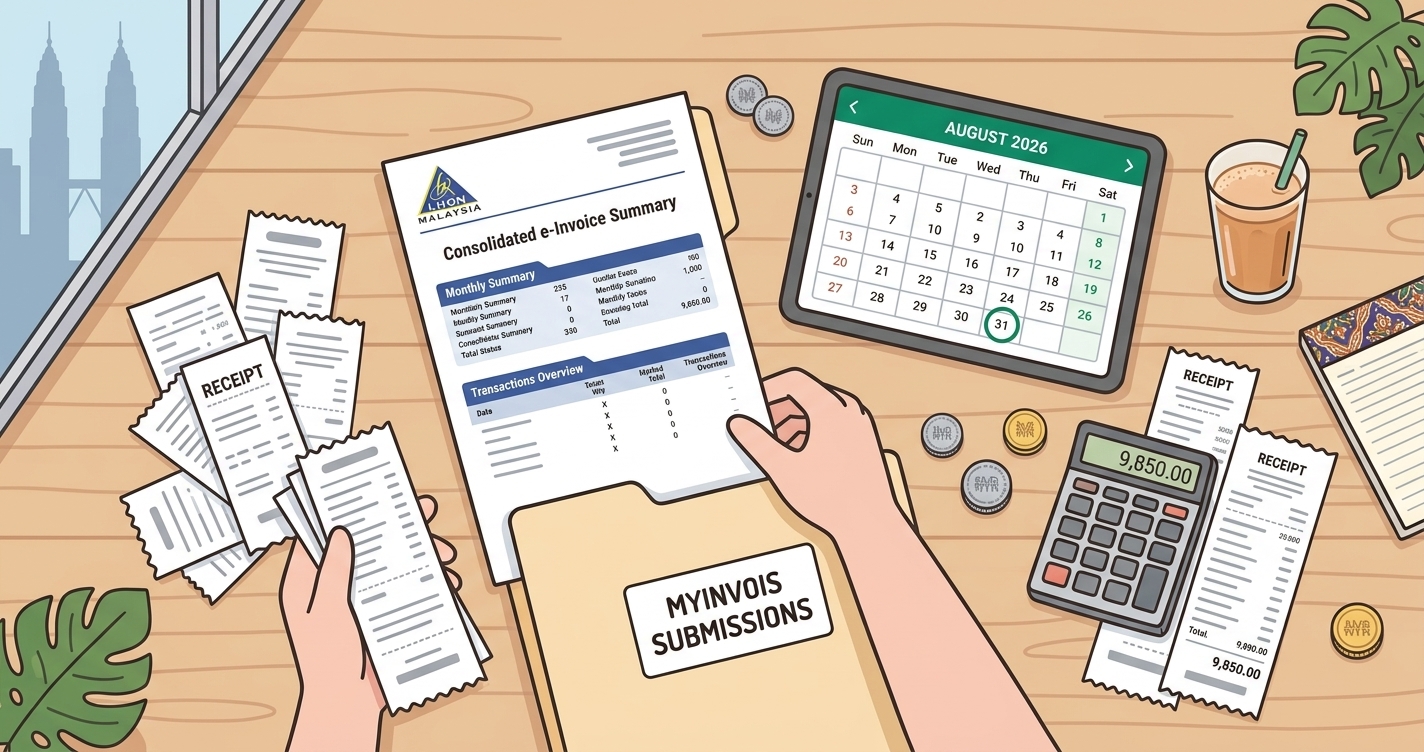
A consolidated e-invoice is a single e-invoice that summarises many B2C transactions over a period (typically a calendar month). Instead of validating a separate e-invoice for each customer, you aggregate the sales and submit one consolidated e-invoice to LHDN. It should be submitted within seven calendar days after the end of the month in which the transactions took place, per LHDN's e-invoice guidelines.
When you can — and cannot — consolidate
You may consolidate a B2C transaction when the buyer does not request an individual e-invoice. If a customer asks for a proper e-invoice (for example, because they want to claim the expense), you must issue an individual e-invoice for that sale instead.
Two important limits apply:
- The RM10,000 rule. Any single transaction of RM10,000 or more cannot be consolidated and must be issued as an individual e-invoice at the time of the sale. This rule is strictly enforced, so a high-value sale to a walk-in customer still needs its own e-invoice.
- Excluded activities. LHDN lists certain industries and activities where consolidation is not allowed and individual e-invoices are always required. Check the current guideline for your sector before relying on consolidation.
During the transition, LHDN has allowed newly-in-scope businesses to use consolidated e-invoices with general descriptions, with a relaxation (grace) period running to 31 December 2027. This gives smaller businesses time to adapt their systems.
The RM1 million exemption — why most freelancers are not caught yet
This is the part that matters most to solo freelancers and micro-businesses. The Government raised the e-invoicing exemption threshold to RM1,000,000 in annual turnover, effective 1 January 2026. In practice:
- If your annual business income is below RM1 million, you are currently fully exempt from MyInvois e-invoicing — including both consolidated e-invoices and self-billed e-invoices.
- Businesses with turnover between RM1 million and RM5 million fall into the smaller-business phase that began in 2026, subject to the relaxation period.
One trap to watch: if you run more than one sole-proprietor business or take side work in your own name, LHDN looks at your combined revenue to test the RM1 million threshold. Several small income streams can add up to more than you think, so total them before assuming you are exempt.
A practical example
Aisyah runs a small online craft store as a sole proprietor. In 2025 her turnover was RM320,000, all from individual customers who pay through her website.
- Exemption: because her turnover is well below RM1 million, Aisyah is currently exempt from MyInvois e-invoicing. She does not have to issue consolidated e-invoices at all yet.
- If she grows past RM1 million: she would enter the e-invoicing scope. Her many small B2C sales could then be reported through a monthly consolidated e-invoice, submitted within seven days after month-end — except any single order of RM10,000 or more, which would need its own individual e-invoice.
- If a customer requests one: even under consolidation, a buyer who asks for an individual e-invoice must receive one for that specific sale.
The lesson: know your turnover, total all your businesses, and understand that consolidation is a convenience for high-volume B2C sellers once they are in scope — not a workaround for the RM10,000 rule.
How to prepare, even if you are exempt today
Exemptions can change, and businesses grow. A little preparation now saves a scramble later:
- Track your annual turnover accurately. Add up income across all your sole-proprietor activities so you know how close you are to RM1 million.
- Keep clean records of every sale. A consolidated e-invoice is only as accurate as the underlying transaction list. You need dates, amounts, and totals you can trust.
- Flag high-value sales. Any sale of RM10,000 or more will always need an individual e-invoice, so identify these as they happen.
- Retain records for seven years. Malaysia requires business records to be kept for seven years, e-invoicing or not.
This is where good day-to-day bookkeeping pays off. Tools like Denpyo let you photograph receipts and invoices, and AI automatically captures the date, amount, and category, building a clean, searchable transaction record. When you do enter e-invoicing scope, that organised list makes preparing a monthly consolidated e-invoice far simpler. To check whether a particular cost is a deductible business expense while you are at it, our expense deductibility checker is a quick reference.
Common mistakes to avoid
- Assuming you are exempt without totalling all businesses. Combined turnover across sole-proprietorships is what counts toward RM1 million.
- Consolidating a RM10,000+ sale. These always need an individual e-invoice — no exceptions.
- Refusing an individual e-invoice on request. If a B2C buyer asks for one, you must issue it.
- Submitting the consolidated e-invoice late. Aim to submit within seven days after month-end.
- Poor sales records. A messy transaction list makes an accurate consolidated e-invoice almost impossible.
Summary
The consolidated e-invoice is MyInvois's way of letting high-volume B2C sellers report many small sales in a single monthly submission, due within seven days of month-end. But single transactions of RM10,000 or more always require an individual e-invoice, and any buyer who requests one must receive it. For now, the RM1 million turnover exemption keeps most solo freelancers and micro-businesses out of scope entirely — provided you total the income across all your sole-proprietor activities. Whether you are exempt today or preparing for growth, accurate sales records are the foundation, so start keeping them cleanly now and you will be ready for whatever phase reaches you next.
Track expenses, maximize deductions
Denpyo scans your receipts and finds tax savings automatically.