
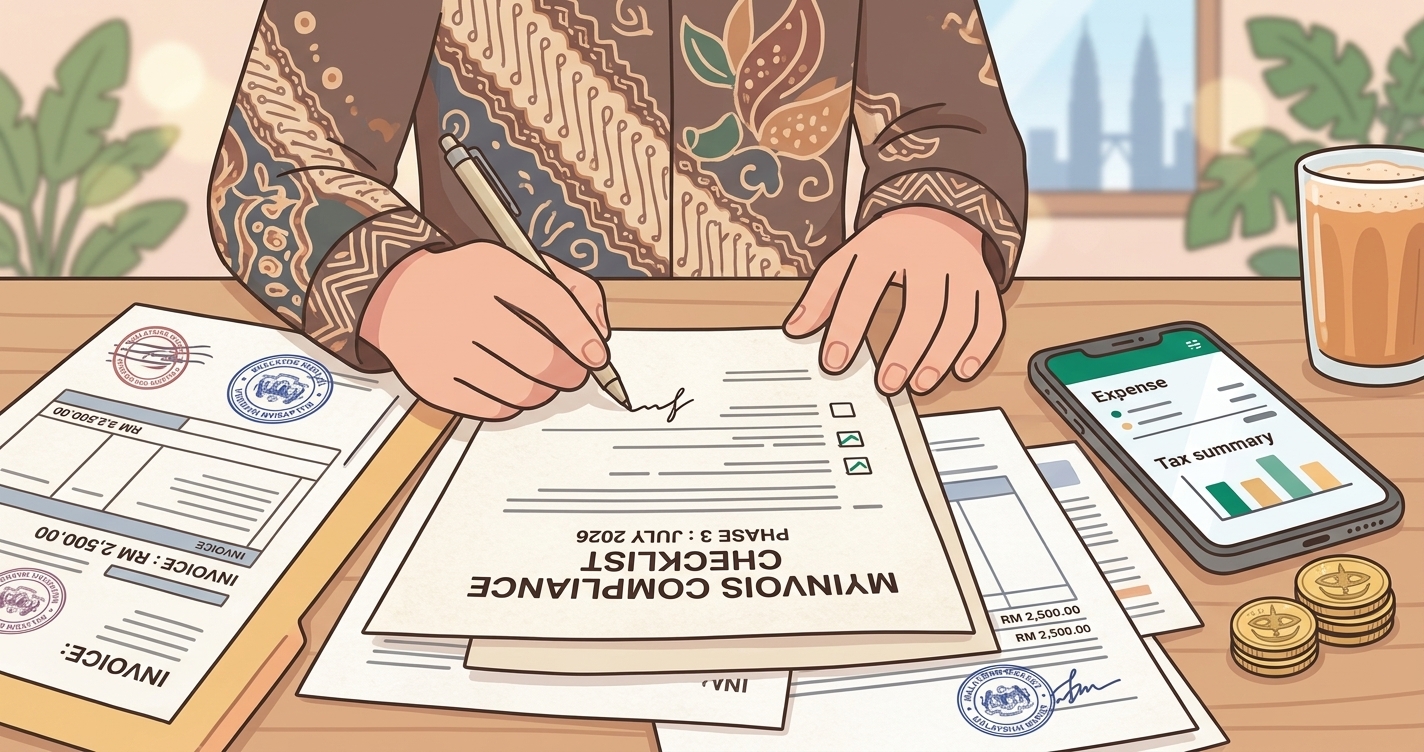
MyInvois Phase 3 (July 2026): Compliance Checklist for RM1M-5M Businesses
Complete compliance checklist for Malaysia's MyInvois Phase 3 e-invoicing mandate starting July 2026. Essential guide for freelancers and SMEs with RM1M-5M annual turnover.
Disclaimer: This article provides general information about Malaysia's MyInvois e-invoicing requirements. It is not professional tax, legal, or financial advice. For your specific situation, please consult a qualified tax advisor or MIA-certified accountant. Disclosure: This article is published on the Denpyo blog. Denpyo provides receipt management and expense tracking services.
Introduction: The July 2026 Deadline Is Approaching Fast
If your business earns between RM1 million and RM5 million annually, you have until 1 July 2026 to comply with Malaysia's MyInvois e-invoicing mandate. Phase 3 of the rollout brings thousands of freelancers and small-to-medium enterprises (SMEs) into the mandatory e-invoicing ecosystem for the first time. Non-compliance can result in fines of up to RM50,000 or imprisonment — so preparation now is critical.
This MyInvois Phase 3 compliance guide walks you through the timeline, who is affected, what you need to prepare, a step-by-step compliance checklist, and how to avoid penalties. Whether you are a freelance consultant, a small retail operator, or an SME owner, this article gives you a practical roadmap to get ready before the deadline.
MyInvois Phase Timeline: How We Got Here
The Lembaga Hasil Dalam Negeri (LHDN) — Malaysia's Inland Revenue Board — rolled out MyInvois in three phases:
| Phase | Start Date | Who Is Affected |
|---|---|---|
| Phase 1 | 1 August 2024 | Businesses with annual turnover above RM100 million |
| Phase 2 | 1 January 2025 | Businesses with annual turnover RM25 million to RM100 million |
| Phase 3 | 1 July 2026 | All remaining taxpayers, including those with turnover RM1 million to RM5 million, and eventually all businesses regardless of size |
Phase 3 is the most significant expansion because it captures the long tail of Malaysian businesses — the hundreds of thousands of freelancers, sole proprietors, partnerships, and small companies that form the backbone of the economy.
Who Is Affected by Phase 3?
Phase 3 applies to all taxpayers not already covered by Phase 1 or Phase 2. Specifically:
- Sole proprietors and freelancers with annual turnover of RM1 million or more
- Partnerships and LLPs in the RM1M-5M revenue range
- Sdn Bhd companies below the RM25M threshold
- Professional service providers: consultants, designers, developers, accountants, lawyers
- E-commerce sellers and platform-based gig workers with qualifying turnover
Important: Even if your turnover is below RM1 million, LHDN has indicated that all remaining taxpayers will eventually be brought into MyInvois. Phase 3 is the final wave, and voluntary early adoption is encouraged.
What You Need to Prepare
1. Tax Identification Number (TIN)
Every taxpayer must have a valid TIN registered with LHDN. If you have been filing Form B (individual tax returns), you already have one. Verify your TIN via the MyTax portal.
2. MyInvois Portal Access
Register for and test your access to the MyInvois portal. You will need your TIN and MyTax login credentials. The portal allows you to manually create, submit, and view e-invoices if you are not using API integration.
3. Digital Certificate
For API-based submission, you need a digital certificate issued by a LHDN-recognized Certificate Authority. This authenticates your system when transmitting e-invoices programmatically.
4. System Readiness
Your invoicing system — whether it is accounting software, an ERP, or a manual process — must be capable of generating e-invoices in the LHDN-prescribed format. This includes structured data fields like buyer/seller TIN, invoice line items with tax codes, and proper classification codes.
Step-by-Step Compliance Checklist
Follow this checklist to ensure you are ready before 1 July 2026:
- By March 2026: Verify your TIN and register for MyInvois portal access
- By April 2026: Test your invoicing system's e-invoice generation capability
- By May 2026: Implement API integration or configure manual e-invoice submission workflows
- By June 2026: Conduct full end-to-end testing with sample invoices
- By 1 July 2026: Begin submitting all invoices as e-invoices to LHDN
MyInvois Technical Requirements
The LHDN requires e-invoices to conform to the UBL 2.1 standard (Universal Business Language). Key required fields include:
- Document metadata: Invoice number, date, currency
- Seller information: Name, TIN, business address
- Buyer information: Name, TIN (if registered), address
- Line items: Description, quantity, unit price, tax rate, tax amount
- Totals: Subtotal, service tax (SST), total amount due
Penalties for Non-Compliance
LHDN enforces MyInvois compliance strictly. Penalties include:
- Administrative penalties: RM500 to RM5,000 per late or missing e-invoice
- Criminal penalties: Fines up to RM50,000 and/or imprisonment up to 2 years
- Compound interest: Interest accrues on overdue tax liabilities
Proactive compliance significantly reduces your audit risk and avoids costly penalties.
Conclusion
MyInvois Phase 3 is a mandatory transformation of how businesses issue invoices in Malaysia. The July 2026 deadline applies to freelancers and SMEs with turnover above RM1 million. Start your preparations now—verify your TIN, register for the MyInvois portal, test your invoicing system, and plan your API integration if you issue high volumes of invoices. The LHDN is committed to supporting businesses, so do not hesitate to reach out to their support channels if you need assistance.
Track expenses, maximize deductions
Denpyo scans your receipts and finds tax savings automatically.