
SSM Business Registration for Malaysian Freelancers: Do You Need It, and How (2026)
Most Malaysian freelancers running a real business must register with SSM within 30 days — and it costs as little as RM30 a year. Here's who needs to register, how to do it on EzBiz, the fees, and what to do afterwards.
This article is general information based on Companies Commission of Malaysia (SSM) and Inland Revenue Board (LHDN) guidance as of August 2026. It is not legal or tax advice. Rules and fees change, and Sabah and Sarawak have their own registration bodies, so confirm your position with SSM or a qualified professional before acting.
Plenty of Malaysian freelancers start earning — designing, coding, tutoring, driving, selling online — long before they think about paperwork. Then a client asks for an invoice under a business name, a bank wants proof of business to open an account, or an e-invoicing rule appears, and suddenly the question is unavoidable: do I need to register my business with SSM? For most freelancers running a genuine trade, the answer is yes, and the law gives you only 30 days to do it. The good news is that registering a sole proprietorship is cheap, fast and entirely online. This guide explains who must register, how to do it, what it costs, and what to do afterwards.
What is SSM (ROB) registration?
In Peninsular Malaysia, sole proprietorships and partnerships are registered with the Companies Commission of Malaysia (Suruhanjaya Syarikat Malaysia, or SSM) under the Registration of Businesses Act 1956 — often shortened to "ROB" registration. It is the simplest, cheapest way to formalise a small business, and it is different from incorporating a private limited company (Sdn Bhd). A sole proprietorship is not a separate legal entity: you and the business are the same for legal and tax purposes, which keeps things simple but means you are personally responsible for the business's debts.
Registration is separate from your tax file. SSM registers the business; the Inland Revenue Board (LHDN) handles your income tax number (registered through e-Daftar). Many new freelancers need to do both — register the business with SSM, then ensure they have an income tax file with LHDN so they can file Form B each year.
Do freelancers actually need to register?
If you are carrying on a business or trade in Malaysia — providing services or selling goods with a view to profit — the Registration of Businesses Act generally requires you to register, and to do so within 30 days of commencing the business. This applies whether you work under your own name or a business name, and whether the work is full-time or a side hustle. Only Malaysian citizens and permanent residents aged 18 or above may register a sole proprietorship.
You choose one of two structures when you register:
- Personal name (trading under your name as per your IC) — the cheapest option and common for freelancers who invoice under their own name.
- Trade name (a business name of your choice) — needed if you want to operate under a brand like "Aiman Design Studio," and subject to name approval.
Some people who are effectively employees rather than business owners may not need ROB registration, but the line can be blurry, and registering brings practical benefits regardless — a business bank account, credibility with clients, eligibility for grants and financing, and the ability to onboard smoothly to systems like e-invoicing. When in doubt, check with SSM or a professional.
How to register: steps, documents and fees
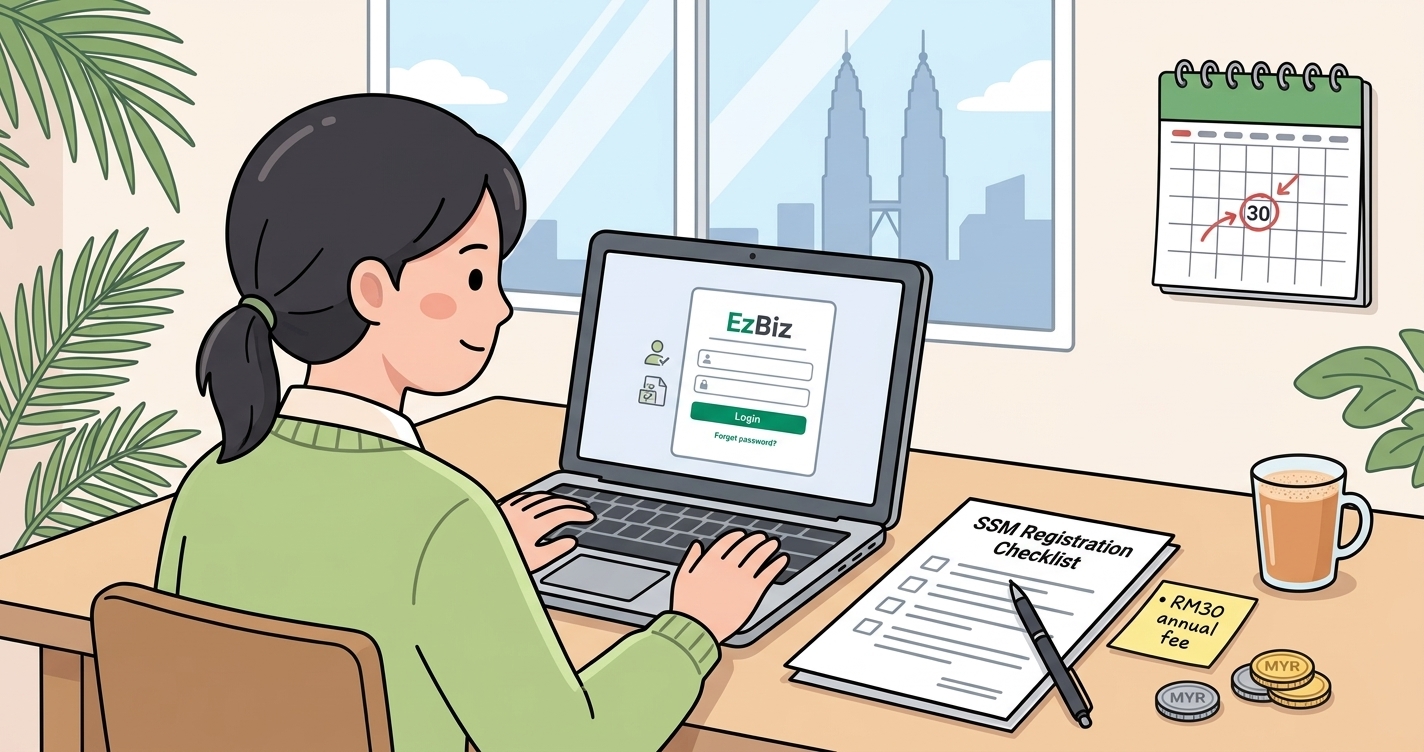
The whole process can be completed online through SSM's EzBiz portal (ezbiz.ssm.com.my), and the Business Registration Certificate is typically issued within about one hour to one working day. The essentials:
- Create an EzBiz account and verify your identity (a one-time in-person or online verification may be required).
- Choose your structure — personal name or trade name — and, if using a trade name, apply for name approval.
- Enter your business details: nature of business, business address, and start date.
- Pay the fee by FPX or card and download your certificate.
The standard fees are modest: RM30 per year to register under your personal name, or RM60 per year to register a trade name, plus around RM5 per branch and a separate trade-name application fee where applicable. You register for a period of one to five years and must renew before expiry — renewal uses the same low annual rate. Keep your certificate handy; banks, platforms and grant bodies will ask for it (SSM, ssm.com.my).
A note for Sabah and Sarawak
The Registration of Businesses Act 1956 and SSM's ROB process apply to Peninsular Malaysia and the Federal Territory of Labuan. Sabah and Sarawak operate their own business registration systems and rules, so if your business is based in East Malaysia, register through the relevant state authority rather than assuming the Peninsular process applies.
What to do after you register
Registration is the start, not the finish. Once you have your SSM certificate, a few things follow naturally. Make sure you have an income tax file with LHDN and understand your Form B filing obligation for business income (the filing deadline for individuals with business income is generally 30 June via e-filing). Open a dedicated business bank account so personal and business money do not mix — it makes bookkeeping and any future audit far easier. Understand how e-invoicing (MyInvois) applies to you as your income grows, since a registered business is the unit that onboards to it. And start keeping proper records of income and expenses from day one, because those records are what let you claim deductions and prove your numbers. Our income tax calculator helps you estimate what you will owe once your business income is declared, and the expense deductibility checker shows which of your costs can reduce that bill (LHDN, hasil.gov.my).
Penalties for not registering or not renewing
Operating an unregistered business, or letting your registration lapse, is an offence under the Registration of Businesses Act. The penalties are serious — a fine of up to RM50,000, imprisonment, or both. Beyond the legal risk, an unregistered freelancer hits practical walls: no business bank account, difficulty issuing proper invoices, and problems onboarding to tax and e-invoicing systems. Registering promptly and renewing on time is far cheaper than the alternative, and it takes minutes.
Keep clean records from day one with Denpyo
Registering your business is step one; running it in a way that keeps you compliant and minimises tax is the ongoing work. The habit that pays off most is capturing every business expense as it happens. With Denpyo you photograph each receipt or invoice — for equipment, software, travel, supplies — and it extracts the vendor, date, amount and category automatically, building an organised, searchable record of your deductible spending. When Form B season arrives, your expenses are already totalled and ready to support your claims, and the same digital records help you meet Malaysia's requirement to keep business records for seven years. Because the app also shows your running deductible total, you get a clear picture of your business's finances well before the filing deadline.
Summary
If you are running a genuine freelance business in Peninsular Malaysia, SSM (ROB) registration is usually required — within 30 days of starting — and it is inexpensive, at RM30 a year under your own name or RM60 for a trade name, done entirely through the EzBiz portal. Registering unlocks a business bank account, credibility, and smooth onboarding to tax and e-invoicing systems, while operating unregistered risks a fine of up to RM50,000. After you register, set up your LHDN tax file, keep personal and business money apart, and start recording income and expenses from day one so filing your Form B is simple and your deductions are fully supported.
Track expenses, maximize deductions
Denpyo scans your receipts and finds tax savings automatically.