
Capital Allowances in Singapore: Writing Off Equipment as a Freelancer (2026)
Bought a laptop, camera or office furniture for your business? You usually can't expense it all at once, but you can claim capital allowances. Here's how Section 19 and 19A work, the S$5,000 low-value asset rule, and the one-year write-off for computers.
Disclaimer: This article is general information as of June 2026 and is not tax advice. Capital allowance rules are set by the Inland Revenue Authority of Singapore (IRAS) and can change. Confirm the current rules and your eligibility with IRAS (iras.gov.sg) or a qualified tax professional.
You buy a S$2,500 laptop, a S$1,200 camera, or a desk and chair for your home studio. Naturally you'd like to deduct the cost — but when you sit down to file, you discover that you can't simply throw these into your ordinary business expenses. Instead, Singapore treats equipment as a capital asset, and you claim the cost back over time (or sometimes in one year) through capital allowances. This guide explains how that works for self-employed people and freelancers, with the rules that matter most.
Expenses vs capital allowances: what's the difference?
Day-to-day running costs — software subscriptions, transport, stationery, internet — are revenue expenses, deducted in full in the year you incur them. Equipment that lasts more than a year — computers, machinery, furniture, fittings — is treated as a capital asset. You can't expense the full amount immediately; instead you claim capital allowances on the qualifying cost. The good news: the total deduction is the same, the timing just differs, and several options let you claim it quickly.
The three ways to claim (Section 19 and 19A)
Singapore's Income Tax Act gives you a choice of methods for plant and machinery used in your trade:
- Over the working life of the asset (Section 19): spread the allowance across the prescribed working life (for example 5, 6, 8, 12 or 16 years), with an initial allowance plus annual allowances.
- Over three years (Section 19A): claim one-third of the cost in each of three consecutive years — simple and popular for most equipment.
- In one year (Section 19A): a full 100% write-off in the year of purchase for computers, prescribed automation equipment (which includes laptops, printers and many software-linked items) and certain other prescribed assets.
For a freelancer buying a laptop, the one-year write-off usually makes the most sense: you claim the entire cost against your trade income in the same year. You choose the method per asset, so you can mix and match.
The S$5,000 low-value asset rule
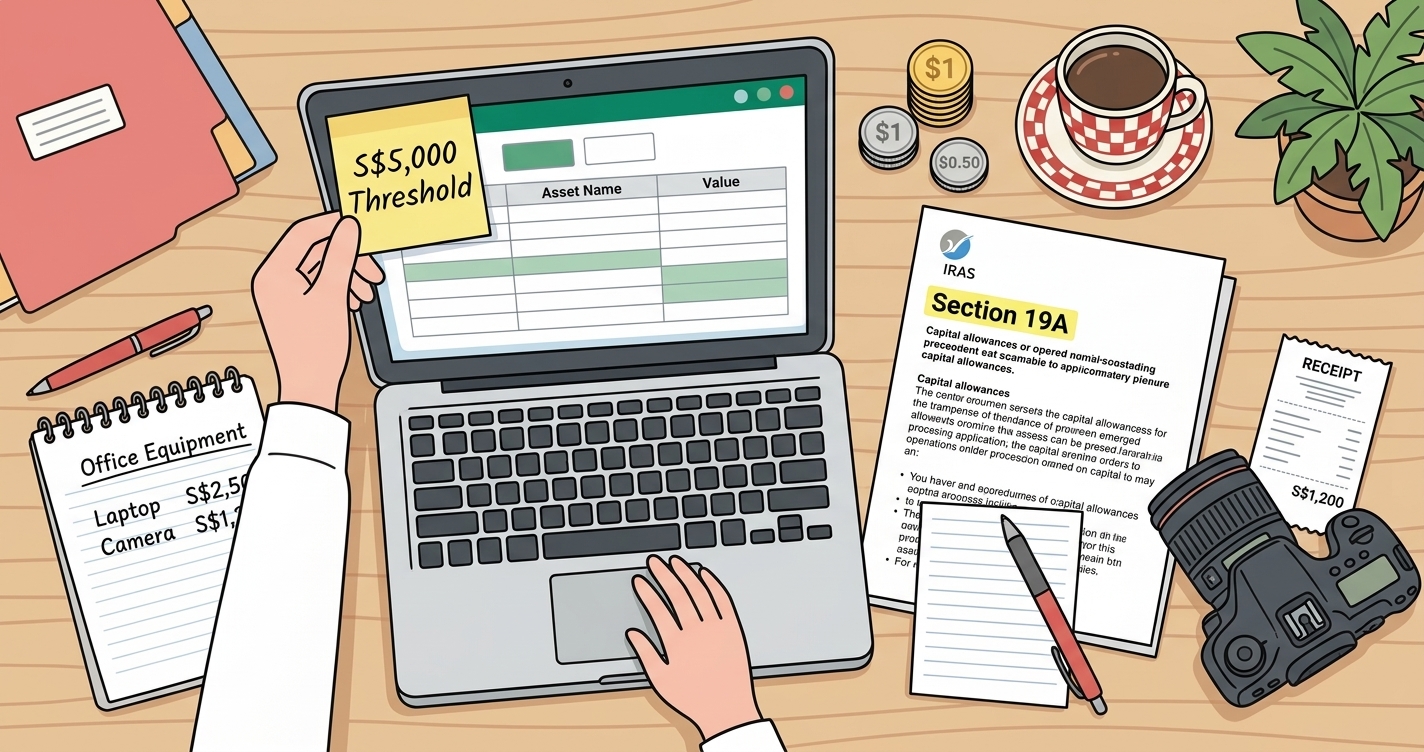
There is an even simpler shortcut for inexpensive items. Under Section 19A, you can claim a full write-off in one year for any low-value asset costing no more than S$5,000 each, as long as the total of all such low-value assets does not exceed S$30,000 in that Year of Assessment. This covers most freelance kit: a S$1,200 camera, a S$900 monitor, a S$600 office chair, a S$400 microphone — each under S$5,000, each fully claimable in the year of purchase.
If your low-value purchases exceed the S$30,000 cap in a year, the excess assets are simply claimed under the normal capital allowance methods (three years or working life) instead. You can read the official details on the IRAS Capital Allowances page.
What qualifies — and what doesn't
Capital allowances apply to plant and machinery used in your trade: computers and laptops, cameras and recording gear, office furniture and fittings, tools, and machinery. They do not apply to things like the cost of the property itself, residential renovations unrelated to your trade, private motor cars (S-plate), or personal-use items. If an asset is used partly for private purposes, you can only claim the business-use portion. As a self-employed person, you claim these allowances against your trade income on your individual income tax return.
Worked example
Priya is a freelance videographer. In the year she buys a S$2,800 laptop, a S$1,500 camera and a S$700 tripod — S$5,000 in total, each item under the S$5,000 limit and well within the S$30,000 cap.
Using the low-value asset rule, she claims the full S$5,000 as capital allowances in that year, reducing her chargeable income by S$5,000. If her marginal tax rate is, say, 11.5%, that's roughly S$575 less tax — for purchases she was going to make anyway. Estimate the impact on your own bill with our income tax calculator.
Why your records make or break the claim
To claim capital allowances, you need to show what you bought, when, and for how much — and IRAS requires self-employed individuals to keep proper records for five years. A faded thermal receipt for that camera, lost two years before an IRAS query, can cost you the entire allowance.
This is exactly where Denpyo helps. Photograph the receipt or tax invoice the moment you buy the equipment, and its AI captures the date, amount, vendor and category, storing a clean digital copy that won't fade. When filing season arrives, you have an organised list of every asset ready to hand to your accountant. Try the expense checker to see which purchases are claimable, and the tax savings estimator to gauge the impact.
Summary
In Singapore, business equipment isn't an ordinary expense — it's a capital asset you claim through capital allowances. You can spread the claim over the asset's working life (Section 19), over three years (Section 19A), or take a one-year write-off for computers and prescribed automation equipment. Best of all, low-value assets costing S$5,000 or less each (capped at S$30,000 per Year of Assessment) can be written off in full in the year of purchase. Keep every receipt and tax invoice for five years, and your equipment purchases can meaningfully reduce your tax bill.

Track expenses, maximize deductions
Denpyo scans your receipts and finds tax savings automatically.