
Course Fees Relief Discontinued from YA 2026: What Singapore Freelancers Should Do
Singapore's Course Fees Relief ended from YA 2026, with YA 2025 the last claim year. Here is what changed, the YA 2027 review, direct support like SkillsFuture, and when self-employed people can still deduct course fees as a business expense.
This article is general information as of August 2026 and is not tax advice. Rules can change. Always confirm the latest details with the Inland Revenue Authority of Singapore (Course Fees Relief) and the Ministry of Finance, or consult a tax professional.
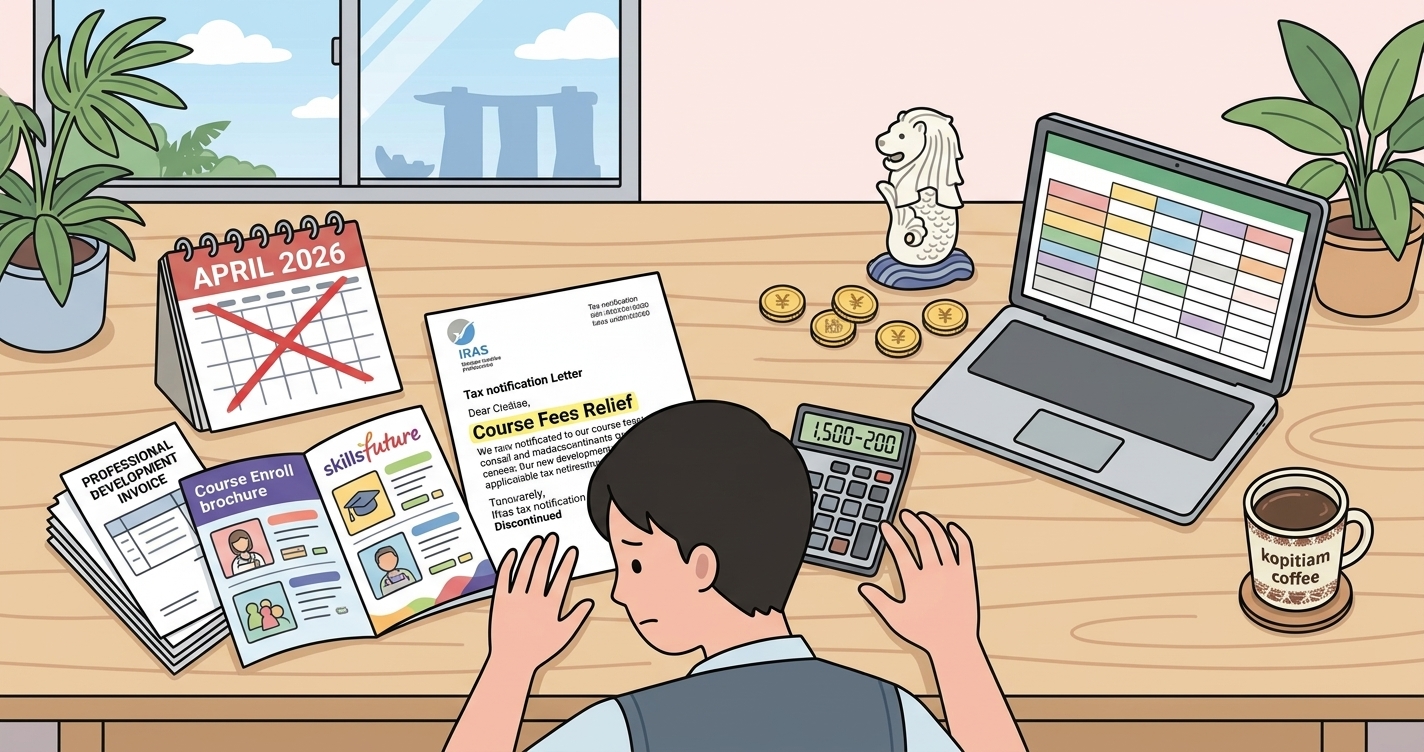
If you are a Singapore freelancer or run your own business and you have been claiming Course Fees Relief on your income tax return, there is an important change you need to know: Course Fees Relief has been discontinued with effect from Year of Assessment (YA) 2026. The last year you could claim it was YA 2025. This guide explains what changed, what the Government is putting in its place, and what self-employed people can do to keep the tax benefit of upskilling.
What Course Fees Relief used to offer
Course Fees Relief let individual taxpayers claim up to S$5,500 each year for fees paid on courses, seminars, or conferences that led to an approved academic or professional qualification, or that were relevant to their current employment or trade. For freelancers and the self-employed, it was a simple way to reduce chargeable income when investing in their own skills.
Crucially, you could not claim relief for any amount that was paid or reimbursed by an employer or another organisation, including amounts covered by SkillsFuture Credit. The relief only covered fees you personally bore.
What changed for YA 2026
Course Fees Relief has been discontinued from YA 2026 onwards. In practical terms:
- YA 2025 (income earned in 2024) was the final year the relief could be claimed.
- YA 2026 (income earned in 2025) and later: the relief is no longer available on your individual income tax return.
The Government's rationale is that support for lifelong learning has shifted towards more direct, targeted assistance — subsidies and allowances paid at the point of training — rather than a tax relief claimed after the fact. Direct support reaches more people, including those who pay little or no income tax and therefore never benefited much from a relief.
Will it come back? The YA 2027 review
The Ministry of Finance has indicated that it will reintroduce Course Fees Relief from YA 2027, or introduce an alternative personal income tax relief for skills upgrading. In other words, the discontinuation from YA 2026 may be a one-year gap rather than a permanent removal. Because the final design has not been confirmed at the time of writing, treat YA 2026 as a year without this relief, and watch for the Government's announcement on the YA 2027 arrangement before planning large course commitments.
Direct support you can use instead
Even without the tax relief, Singapore offers direct funding for skills upgrading that freelancers can tap:
- SkillsFuture Credit: an opening credit that offsets fees for eligible courses, topped up periodically.
- SkillsFuture Level-Up Programme: for Singaporeans aged 40 and above, a substantial credit top-up for selected longer-form and higher-value training, plus a training allowance for eligible full-time courses.
- Course subsidies: many SSG-supported courses are subsidised at the point of enrolment, reducing the fee you pay directly.
These reduce your out-of-pocket cost immediately, which for many freelancers is more valuable than a relief claimed months later.
Can self-employed people deduct course fees as a business expense?
This is the key question for freelancers, and it is separate from Course Fees Relief. Course Fees Relief was a personal relief available to employees and the self-employed alike. As a business owner, you may separately be able to treat training costs as a deductible business expense against your trade income — but only in specific circumstances:
- Maintaining or updating existing skills for the trade you already carry on is generally treated as a revenue expense and may be deductible. Example: a freelance web developer taking a course on a newer version of a framework they already use.
- Acquiring new skills or knowledge for a new trade or a new capability is generally regarded as capital in nature and is not deductible. Example: the same developer taking a course to move into a completely different profession.
The line between "maintaining" and "acquiring new" can be fine, so confirm your specific case against IRAS guidance or with a tax agent before claiming. Where a course genuinely refreshes or deepens the skills you already sell to clients, keeping the invoice and a note of its business purpose supports the deduction.
A worked example
Priya is a freelance graphic designer. In 2025 she paid S$2,000 for an advanced course in a design tool she uses daily for client work.
- Course Fees Relief: not available — the relief is discontinued from YA 2026, so she cannot claim the S$2,000 as a personal relief.
- Business expense: because the course updates skills for her existing trade, she may be able to deduct the S$2,000 as a business expense against her design income, provided she keeps the invoice and can show the business purpose.
- Direct funding: if the course was SSG-supported, part of the fee may already have been subsidised, and any SkillsFuture Credit used would not have been a personal cost.
The practical takeaway: the personal relief is gone for now, but the business-expense route may still recognise genuine, work-related training — and the records you keep decide whether you can rely on it.
Keep clean records either way
Whether you are claiming a business deduction now or preparing for whatever replaces Course Fees Relief in YA 2027, good records matter. Keep the course invoice, proof of payment, and a short note explaining how the training relates to your trade. IRAS requires records to be kept for five years. Tools like Denpyo let you photograph a course invoice and automatically capture the date, provider, and amount, filing it with your other business expenses so it is ready at filing time. To see how deductions affect your bill, try the income tax calculator and the tax savings estimator.
Summary
Course Fees Relief is discontinued from YA 2026, with YA 2025 the last year it could be claimed. The Government has signalled it will reintroduce the relief from YA 2027 or offer an alternative skills-upgrading relief, so this may be a temporary gap — watch for the confirmed design. In the meantime, freelancers can lean on direct support such as SkillsFuture, and, where a course maintains or updates skills for their existing trade, may be able to deduct the fees as a business expense. Keep every invoice and a note of the business purpose, hold records for five years, and you will be ready for whichever route applies.

Track expenses, maximize deductions
Denpyo scans your receipts and finds tax savings automatically.