
FEDR vs Actual Expenses: Which Saves Singapore Gig Workers More Tax? (2026)
Singapore's Fixed Expense Deduction Ratio gives drivers a 60% deemed deduction with no records — but if your real costs are higher, claiming actual expenses saves more. Here's how to decide each year, with worked numbers.
This article is general information based on Inland Revenue Authority of Singapore (IRAS) guidance as of August 2026. It is not tax advice. Rates and rules change, so confirm your position on the IRAS website or with a tax professional before filing.
If you drive for a ride-hailing platform, deliver food, or earn commission, you have a choice at tax time that can quietly cost — or save — you money: claim a fixed, deemed percentage of your income as business expenses, or add up your actual receipts. Singapore's Fixed Expense Deduction Ratio (FEDR) makes filing simple by giving you a set deduction without any record-keeping. But "simple" is not always "cheapest." If your real business costs run higher than the deemed ratio, claiming actual expenses puts more money back in your pocket. This guide explains how FEDR works, who qualifies, and how to decide — with numbers — whether to take the deemed ratio or claim what you actually spent.
What is the Fixed Expense Deduction Ratio?
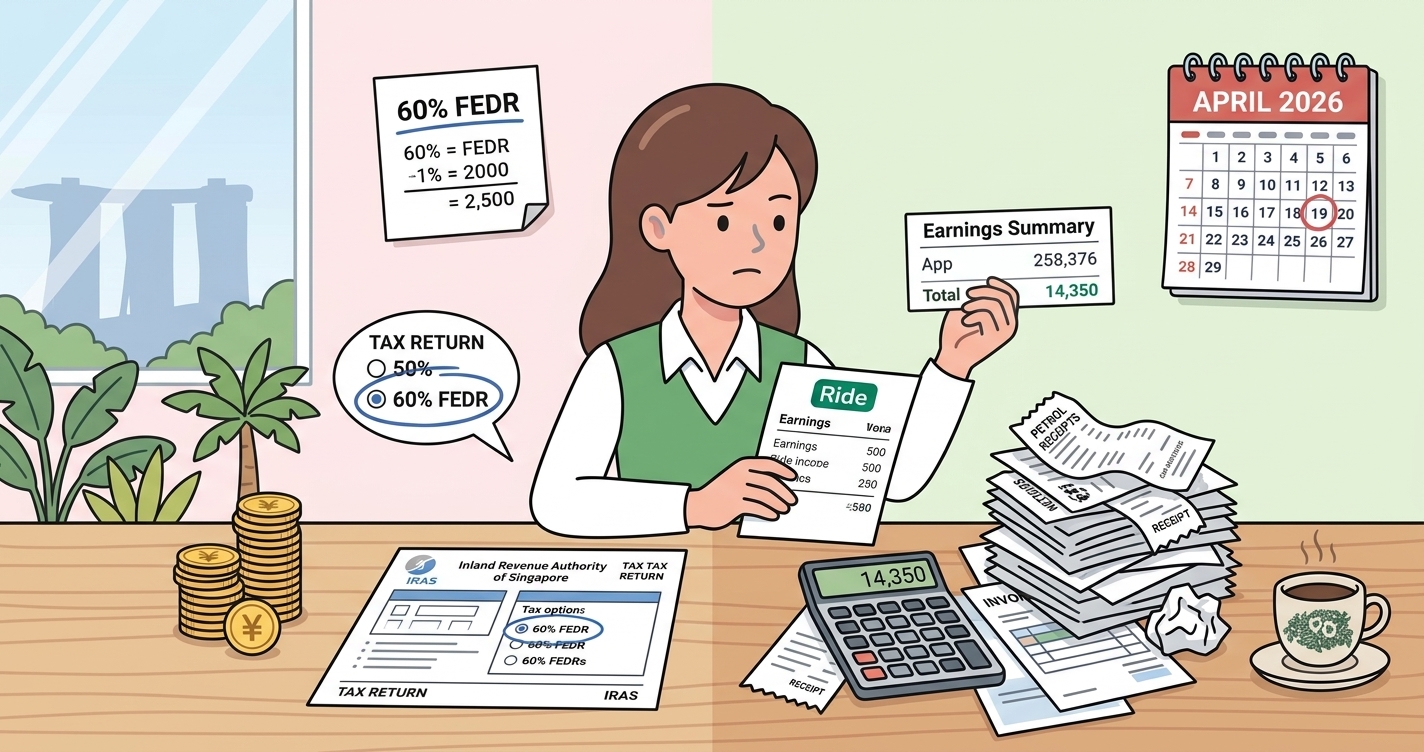
The Fixed Expense Deduction Ratio is a simplified way for qualifying self-employed persons (SEPs) and platform workers to claim business expenses. Instead of tracking every cost, you deduct a fixed percentage of your gross income, and IRAS treats that deemed amount as the sum of all your allowable business expenses in earning that income (IRAS, "Fixed Expense Deduction Ratio for self-employed persons and platform workers"). Your net trade income — the figure that gets taxed — is simply gross income minus the FEDR amount.
The appeal is obvious: no shoebox of receipts, no spreadsheets, no worry about which costs are deductible. For someone with modest expenses, FEDR can be both easier and perfectly fair.
Who qualifies, and the ratios
FEDR applies to specific categories of self-employed and platform work, each with its own prescribed percentage. The most widely used is for drivers: private-hire car and taxi drivers can claim a FEDR of 60% of gross driving income. That 60% is deemed to cover the usual costs of driving — car or vehicle rental, repairs and maintenance, fuel or energy charges, parking, and service fees paid to the booking platform.
Other categories, such as delivery workers and certain commission agents, have their own prescribed FEDR percentages, which differ from the driver rate. Because these figures are set by IRAS and can be updated, check the current ratio for your exact category on the IRAS FEDR page before you rely on it. The key point is the same across categories: FEDR gives you a deemed, no-records deduction — but you are always free to claim your actual expenses instead if they are higher.
FEDR vs actual expenses: which saves more?
Here is the decision in one sentence: if your actual allowable business expenses are higher than the FEDR amount, claiming actual saves you tax; if they are lower, FEDR is both simpler and better. The only way to know which side you are on is to know your real numbers.
Consider a private-hire driver, Wei, with S$60,000 of gross driving income in the year.
- Claiming FEDR (60%): deemed expenses are S$36,000, so net trade income is S$24,000. No records required.
- Actual expenses of S$30,000: net trade income would be S$30,000 — worse than FEDR. Wei should take the 60% ratio and skip the paperwork.
- Actual expenses of S$42,000 (heavy rental, high fuel, major repairs): net trade income would be S$18,000 — S$6,000 lower than under FEDR. Claiming actual saves tax, provided Wei kept the receipts.
The lesson is not "FEDR good" or "actual good" — it is that you cannot make a smart choice without tracking what you actually spend. Even if you ultimately claim FEDR, knowing your real total tells you that you did not leave money on the table. Use our expense deductibility checker to see which of your costs would count as actual business expenses, and the income tax calculator to compare your taxable income under each method.
When actual wins, and when FEDR wins
Actual expenses tend to win when your costs are genuinely high relative to income — for example, a driver with an expensive vehicle rental and long hours, or a worker who invested in equipment during the year. FEDR tends to win when your expenses are low, when your time is worth more than the tax saved from record-keeping, or when you simply want a clean, audit-resistant return. Neither is "cheating": FEDR is an IRAS-sanctioned simplification, and claiming actual is the standard method. The right answer is whichever gives you the lower net trade income for that year, weighed against the effort involved.
Records, pre-filling, and the 5-year rule
If you claim actual expenses, you must keep proper records — receipts, invoices, and payment records — for at least five years, and be able to produce them if IRAS asks. If you claim FEDR, you do not need to keep expense records for the deemed portion, which is a real time saving. Either way, keep records of your gross income.
IRAS increasingly pre-fills income for platform workers and many self-employed persons using data from platform operators, so your gross earnings may already appear in your return. What is not decided for you is the expense side — that choice between FEDR and actual is yours to make each year. Because it is an annual decision, a year with unusually high costs can justify switching to actual, while a quiet year can go back to FEDR.
How to decide each year
A simple routine keeps you on the winning side. First, track your deductible costs through the year even if you expect to claim FEDR — it costs little and tells you where you stand. Second, at filing time, compare your actual allowable total against the FEDR amount for your category. Third, claim whichever is higher, and keep the receipts if you go with actual. This takes minutes when your expenses are already captured, and it ensures you never overpay simply because tracking felt like too much work.
Know your real number with Denpyo
The whole FEDR-versus-actual decision rests on one thing: knowing what you actually spent. That is exactly what Denpyo makes effortless. Snap a photo of each fuel receipt, rental invoice, parking slip, or equipment purchase, and the app extracts the vendor, date, amount and category automatically, building a running total of your deductible spending. At filing time you can see in seconds whether your actual expenses beat the 60% deemed ratio — and if they do, you already have the digital records to back the claim for five years. If they do not, you can confidently take FEDR knowing you checked. Either way, you decide with numbers, not guesswork.
Summary
Singapore's Fixed Expense Deduction Ratio lets qualifying drivers, delivery workers and commission earners deduct a fixed percentage of gross income — 60% for private-hire and taxi drivers — with no expense records required. It is simple and often fair, but it is not automatically the cheapest option: when your actual allowable expenses are higher than the deemed ratio, claiming actual lowers your taxable income further. Because it is an annual choice, the smart move is to track your real costs, compare the two methods at filing time, and claim whichever wins. Keep records for five years if you go with actual — and let a receipt scanner do the tracking so the decision is always informed.

Track expenses, maximize deductions
Denpyo scans your receipts and finds tax savings automatically.