
Do Singapore Freelancers Pay Tax on Overseas Client Income? 2026
"My clients are overseas, so I don't pay tax" is a costly myth. This 2026 guide explains how IRAS treats foreign-sourced income for individuals, the trap that catches freelancers with overseas clients, and how to report and record it correctly.
This article provides general information based on Inland Revenue Authority of Singapore (IRAS) guidance as of July 2026 and is not tax advice. Your situation may differ — check the official IRAS website or consult a tax professional before filing.
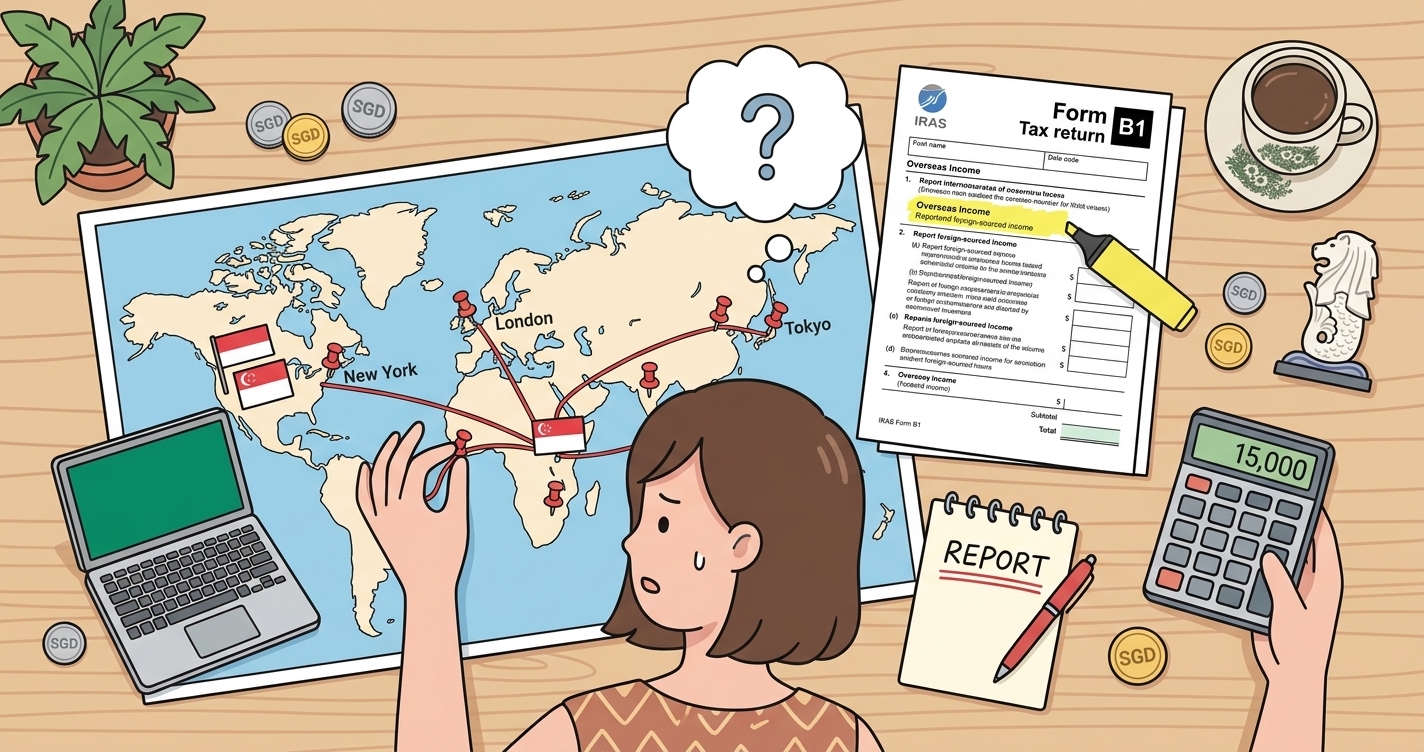
"My clients are overseas, so my income isn't taxable in Singapore, right?" It is one of the most common — and most costly — misconceptions among Singapore freelancers and SME owners. The reality is more nuanced: whether income from overseas clients is taxable depends far less on where the client sits and far more on where the work is done. This 2026 guide explains how IRAS treats foreign-sourced income for individuals, the trap that catches freelancers with overseas clients, and how to keep clean records so you report the right amount.
The starting point: foreign-sourced income is usually exempt
Under Singapore's territorial tax system, individuals are generally taxed on income sourced in Singapore. According to IRAS, foreign-sourced income received in Singapore by individuals is generally exempt from tax — with one main exception: income received through a partnership in Singapore.
So if you genuinely earn income abroad and later receive it in Singapore as an individual, it is usually not taxable here. That sounds like great news for freelancers with overseas clients — but there is a catch.
The freelancer trap: "overseas client" does not mean "foreign-sourced"
Here is the point that trips people up. If you are physically in Singapore doing the work — designing, coding, consulting, writing — then your income is Singapore-sourced, even if the client is in New York, London, or Sydney and pays into a foreign account. The source of income from a trade or profession is generally where the services are performed, not where the customer is located.
In other words: a Singapore-based freelancer serving 100% overseas clients is, in most cases, earning Singapore-sourced income that is taxable. The "foreign-sourced exemption" applies to income that is genuinely earned abroad — not to local work that merely happens to be billed to a foreign client.
When could overseas income actually be foreign-sourced?
Foreign-sourced income for an individual typically arises when the income-producing activity itself takes place outside Singapore. Examples might include work you physically perform while living or based overseas, or certain passive income arising abroad. Even then, exceptions apply — for instance, if the overseas activity is incidental to a trade or business you carry on in Singapore, or the income is received through a Singapore partnership, it may still be taxable.
Because the line between Singapore-sourced and foreign-sourced income can be fact-specific, IRAS encourages taxpayers to review the guidance and, where unclear, seek a ruling or professional advice rather than assume.
Tax residency and the year of assessment
Two more pieces of the puzzle:
- Tax residency: Your residency status affects your tax rates and reliefs. Singapore assesses residency based on your presence and circumstances in the year; IRAS' residency guidance explains the tests.
- Preceding-year basis: Singapore taxes on a preceding-year basis. Income earned in calendar year 2025 is assessed in the Year of Assessment (YA) 2026, which you file between 1 March and 18 April 2026.
How to report income from overseas clients
If you are a self-employed Singapore resident earning Singapore-sourced income from overseas clients, you generally report it as trade or business income:
- Track every invoice — including those paid in foreign currency or into overseas accounts. All of it counts as your revenue.
- Convert foreign currency to Singapore dollars using an acceptable exchange rate for the relevant period.
- Deduct allowable business expenses incurred to earn that income (software, equipment, a portion of home-office costs, and so on).
- Report net profit in your individual income tax return (Form B), using the 2-line or 4-line statement depending on your revenue.
- Keep records for 5 years, as IRAS requires, so you can substantiate both income and expenses if reviewed.
A worked example
Wei Ling is a freelance UX designer based in Singapore. In 2025 she earned S$40,000 from a US startup and S$20,000 from an Australian agency, all paid into her Wise account in USD and AUD. She did all the work from her home in Singapore. Although both clients are overseas, the work was performed in Singapore, so the S$60,000 is Singapore-sourced and taxable in YA 2026. She converts each payment to SGD, deducts her allowable expenses, and reports the net profit as trade income. Assuming she had believed the "overseas client = tax-free" myth, she would have under-reported and risked penalties.
Why clean multi-currency records matter
Freelancers with overseas clients face a paperwork challenge most local-only businesses do not: invoices and receipts in multiple currencies, foreign payment platforms, and expenses spread across accounts. If you leave this until filing season, converting and reconciling a year of mixed-currency transactions is a headache — and mistakes here directly affect the tax you owe.
Tools like Denpyo can auto-extract the date, amount, and category from a receipt photo and help keep expense records tidy as you go, so your deductible costs are captured the moment they happen rather than reconstructed months later. Pair that with a simple habit of logging each invoice in SGD, and your YA 2026 return becomes a matter of totalling numbers you already have.
To picture your position, Denpyo's free tax-savings estimator lets you enter expenses and see an estimated effect, while the expense checker helps when you are unsure whether a cost is deductible against your business income.
Common mistakes to avoid
- Assuming overseas clients mean tax-free income. Source depends on where you work, not where the client is.
- Ignoring income paid into foreign accounts. Money in a Wise, PayPal, or overseas bank account is still your revenue.
- Not converting to SGD consistently. Use an acceptable exchange rate and keep the basis you used.
- Discarding foreign receipts. Expenses reduce your taxable profit — but only if you can prove them.
Summary
For Singapore freelancers and SME owners, the key question is not "where is my client?" but "where do I do the work?" Income from overseas clients earned while you are based in Singapore is generally Singapore-sourced and taxable in the relevant Year of Assessment, while genuinely foreign-sourced income received by an individual is usually exempt (subject to exceptions). Track every invoice in SGD, keep tidy multi-currency records for five years, and when the source of a particular stream is unclear, check IRAS' guidance or get professional advice rather than rely on the "overseas equals tax-free" myth.
Sources and official references
The following official and reputable sources were used to prepare and verify this article:

Track expenses, maximize deductions
Denpyo scans your receipts and finds tax savings automatically.