
MediSave Relief Changes 2026: What Self-Employed Singaporeans Need to Know
Complete guide to the 2026 MediSave relief ceiling removal for self-employed persons in Singapore. Learn contribution rates, tax benefits, and CPF strategies.
Disclaimer: This article is for informational purposes only and should not be considered tax advice. MediSave contribution rules and tax relief ceilings are set by the Central Provident Fund (CPF) Board and the Inland Revenue Authority of Singapore (IRAS). For personalised advice on your MediSave contributions and tax filing, consult a qualified tax professional or visit iras.gov.sg or cpf.gov.sg.
Introduction: The 2026 MediSave Relief Milestone
If you're self-employed in Singapore, your MediSave contributions have always been an important part of your CPF obligations and tax planning. But 2026 brings a significant change: the MediSave relief ceiling has been removed.
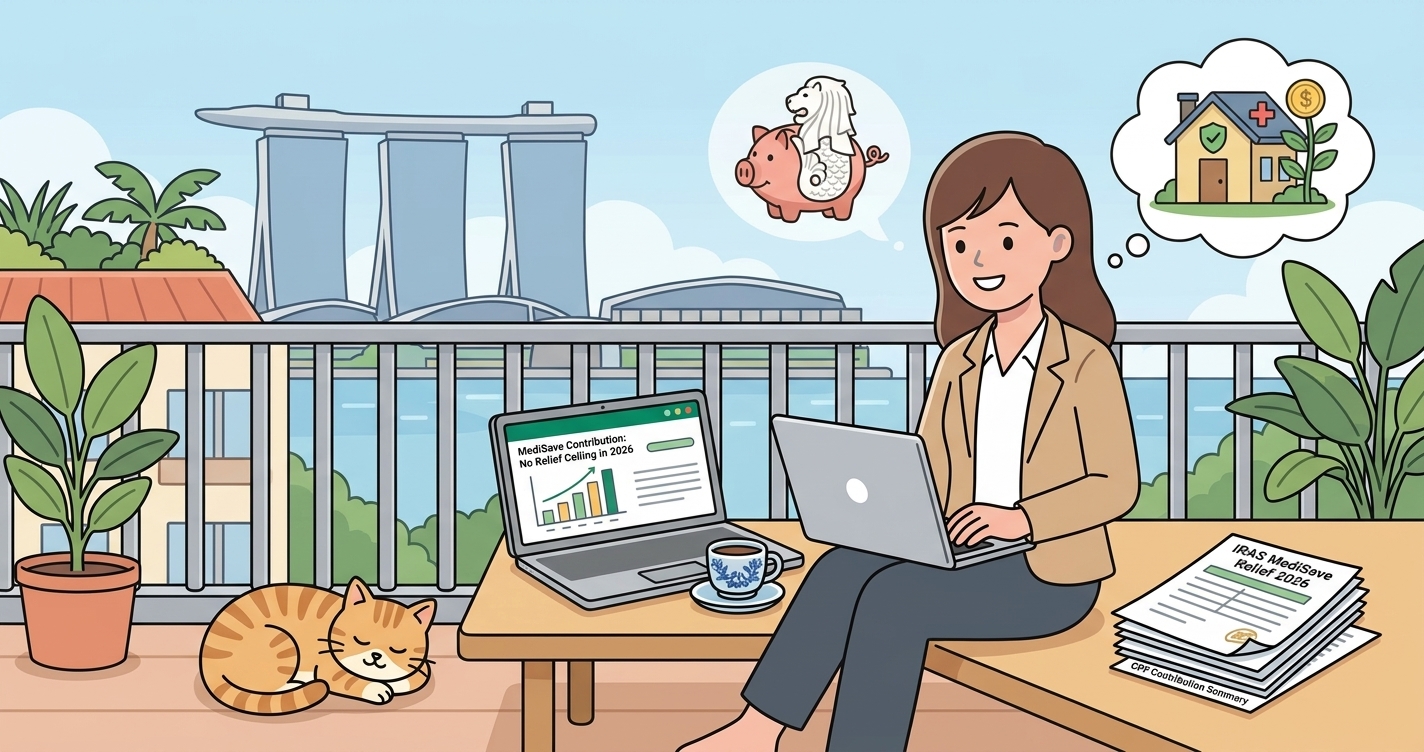
This means self-employed persons (SEPs) can now claim full tax relief on all mandatory MediSave contributions, up to the Basic Healthcare Sum (BHS) limit of S$71,500 for 2026. This is a substantial shift from previous years when relief was capped.
For freelancers and SME owners managing their own tax planning, understanding this change is essential. Let's break down how MediSave relief works and how it impacts your 2026 tax assessment.
Who Must Contribute to MediSave?
Self-employed persons in Singapore are required to contribute to MediSave if their net trade income (NTI) exceeds S$6,000 per year.
This includes:
- Sole proprietors and partners in partnerships
- Freelancers and independent contractors
- SME owners with registered businesses
- Platform workers (mandatory from January 2025)
If your annual NTI falls below S$6,000, you are not required to contribute. However, you may choose to make voluntary contributions for additional CPF benefits.
How Much Do You Need to Contribute?
MediSave contributions for self-employed persons are calculated as a percentage of your net trade income. The rate depends on your age at the end of the year of assessment:
- Below 35 years: Approximately 8%
- 35–44 years: Approximately 9%
- 45–49 years: Approximately 9.5%
- 50 years and above: Approximately 10.5%
Annual Contribution Cap (2026): Your MediSave contribution is capped at the Basic Healthcare Sum (BHS) of S$71,500 for the year.
Worked Example
Let's say you're a 40-year-old freelancer with a net trade income of S$80,000 in 2026:
- Contribution rate: 9% (age bracket 35–44)
- MediSave contribution: S$80,000 x 9% = S$7,200
- This is below the S$71,500 cap, so you contribute S$7,200
The Major 2026 Change: No More Relief Ceiling
Previously, MediSave relief was subject to an overall cap on personal tax deductions. This meant that even if you contributed more to MediSave, not all of it would generate a tax deduction.
From Year of Assessment 2026 onwards, this ceiling has been removed. Now, every dollar you contribute to mandatory MediSave can be claimed as a tax deduction, up to the BHS limit of S$71,500.
What This Means for Your Taxes
If your MediSave contribution is S$7,200, you can now claim the full S$7,200 as a tax deduction without worrying about hitting a personal relief ceiling.
Assuming a marginal tax rate of 8%, this could save you approximately S$576 in taxes from that single deduction alone.
Other CPF Tax Relief Available to Self-Employed Persons
Beyond MediSave, you have additional tax relief options:
CPF Cash Top-Up Relief
You can contribute voluntarily to your own CPF account and claim tax relief:
- For yourself: Up to S$8,000 per year
- For a spouse or parent: Up to S$8,000 per person
- Total household limit: S$16,000
These contributions boost your Ordinary Account (OA) or Special Account (SA) while generating immediate tax relief.
Overall Personal Tax Relief Cap
While MediSave relief is now uncapped, your total personal tax reliefs across all categories are subject to an overall cap of S$80,000 per Year of Assessment.
This cap includes:
- MediSave contributions
- CPF Cash Top-Up contributions
- Life insurance and health insurance reliefs
- Other eligible personal deductions
Step-by-Step: How to Claim MediSave Relief in 2026
Step 1: Calculate Your Net Trade Income
Start with your total business revenue and subtract all allowable business expenses (rent, utilities, supplies, professional fees, etc.). The result is your NTI.
Tools like Denpyo can auto-extract receipt details from photos, making it easier to track and categorize business expenses throughout the year.
Step 2: Verify Your MediSave Contribution
The CPF Board will notify you of your required MediSave contribution based on your NTI. Payment is due within 30 days of receiving the notice.
Check your CPF e-statement at cpf.gov.sg to see your contribution history and confirm the amount deducted.
Step 3: Report in Your Tax Return
When filing your 2026 income tax return with IRAS, your MediSave contribution will be automatically included in your assessment. You don't need to manually claim it — IRAS receives the information directly from the CPF Board.
Step 4: Check Your Tax Relief Statement
After submitting your tax return, IRAS will send you a Notice of Assessment showing all your allowable deductions, including your MediSave relief. Verify that the full amount is reflected.
Platform Workers: Special Considerations
The Platform Workers Bill, which took effect in January 2025, mandates CPF contributions (including MediSave) for platform workers on eligible platforms. If you earn income through ride-sharing, food delivery, or other platform work, the same tax relief rules apply.
Common Mistakes to Avoid
- Missing the payment deadline: If you don't pay within 30 days of the CPF Board's notice, you'll incur late payment interest and surcharges.
- Forgetting to claim other CPF reliefs: If you've made voluntary CPF contributions or top-ups, make sure these are claimed in your tax return.
- Assuming all personal expenses are deductible: MediSave relief is specifically for mandatory CPF contributions. Personal health insurance has separate tax relief caps.
- Not keeping business records: Accurate expense documentation is crucial for calculating your NTI correctly.
Maximizing Your Tax Savings in 2026
- Calculate your projected NTI early so you know your MediSave obligation and can budget for it.
- Track every business expense throughout the year. Use receipt scanning tools to stay organized.
- Consider voluntary CPF contributions to top up to the S$8,000 per-person relief limit.
- Combine reliefs strategically to stay just under the S$80,000 overall cap.
- File early to detect any discrepancies between your records and IRAS's assessment.
A Practical Tool for Self-Employed Tax Planning
Managing MediSave obligations alongside income tax can be complex. Denpyo's income tax calculator tool allows you to explore different income and expense scenarios, helping you understand how changes to your NTI affect your MediSave contribution and overall tax liability.
Summary
- Confirm your business NTI is above S$6,000 (you'll have a MediSave obligation).
- MediSave relief is now uncapped up to the S$71,500 BHS limit.
- Calculate your age-based contribution rate and budget for the payment due within 30 days.
- Keep thorough business expense records to maximize your NTI deductions.
- Review voluntary CPF contribution opportunities for additional tax relief.
- File your 2026 tax return on time and verify all MediSave contributions are reflected.
Need Help?
For official guidance, visit the CPF Board at cpf.gov.sg or IRAS at iras.gov.sg.
Track expenses, maximize deductions
Denpyo scans your receipts and finds tax savings automatically.