
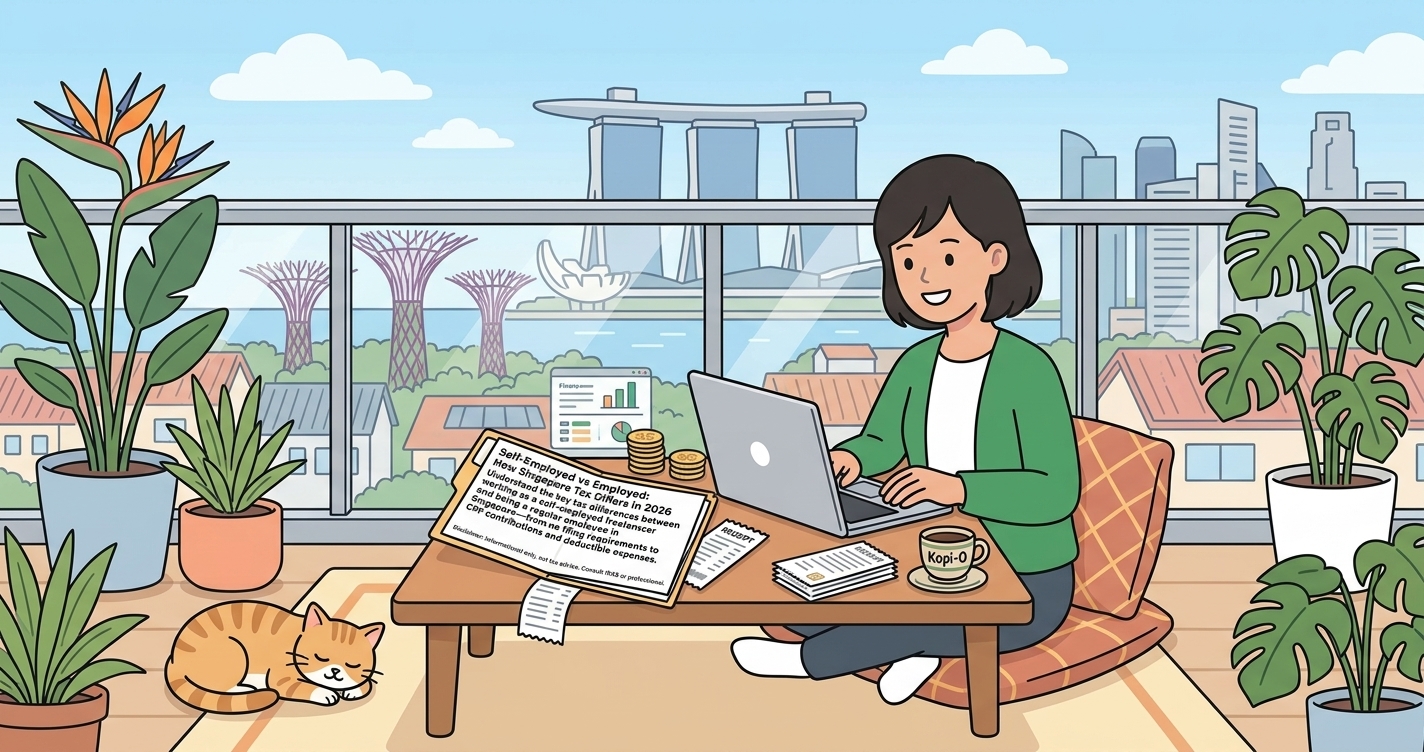
Self-Employed vs Employed: How Singapore Tax Differs in 2026
Understand the key tax differences between working as a self-employed freelancer and being a regular employee in Singapore—from filing requirements to CPF contributions and deductible expenses.
Disclaimer: This article is for informational purposes only and does not constitute tax advice. For specific tax guidance, consult the Inland Revenue Authority of Singapore (IRAS) or a qualified tax professional. Tax laws change regularly—always verify current rates and rules with official sources.
Introduction
Singapore's tax system treats self-employed individuals and employees very differently. Whether you're a freelancer considering going full-time, an employee thinking about striking out alone, or juggling both income streams, understanding these differences is critical to tax compliance and financial planning.
This guide breaks down self-employed vs employed taxation in Singapore, covering filing requirements, CPF/MediSave obligations, deductible expenses, GST thresholds, and what happens when you earn both employment and freelance income.
Side-by-Side Overview: Self-Employed vs Employed
| Aspect | Self-Employed | Employed |
|---|---|---|
| Filing Form | Form B (Self-Employed Person) | Form B1 (Employee) or IR8A from employer |
| Filing Timeline | Self-assessment by 18 April | Employer files IR8A by 1 March |
| Tax Rate | Progressive (0–22% on chargeable income) | Progressive (0–22% on chargeable income) |
| CPF Contribution | Self-employed MediSave only (~6% of net earnings) | Employer + employee combined (~20% total) |
| Deductible Expenses | Broad Section 14 business deductions | Limited personal reliefs and deductions |
| GST Registration | Mandatory at SGD 1M turnover, optional below | N/A (employer handles) |
| Tax Payment | Lump sum or installments based on assessment | Monthly PAYE deduction by employer |
| Estimated Chargeable Income (ECI) | Self-reported, required for provisional taxes | Not applicable |
Filing Requirements: Form B vs Form B1
Self-Employed: Form B (Self-Assessment)
If you're self-employed or a sole proprietor in Singapore, you file Form B directly with IRAS. Key points:
- Self-Assessment Model: You calculate your own chargeable income, claim deductions, and file by 18 April of the following year.
- Chargeable Income: Gross business income minus allowable deductions (rent, salaries, utilities, equipment, insurance, professional fees, etc.).
- Statutory Deduction: If you don't keep detailed records, you can claim a statutory deduction of 3% of gross income (up to SGD 10,000).
- Estimated Chargeable Income (ECI): If your expected income is above SGD 120,000, you may need to file ECI by 21 November and pay provisional taxes in two installments.
- Record Keeping: Keep all receipts, invoices, and business expense documentation for 5 years.
Source: IRAS Self-Employed Guide
Employed: Form B1 or IR8A
Regular employees rely on employer-filed documents:
- IR8A Filed by Employer: Your employer files Form IR8A by 1 March, reporting your salary, CPF contributions, and other benefits.
- Form B1: You file Form B1 only if you have investment income, rental income, or other non-employment earnings alongside your job.
- PAYE (Pay-As-You-Earn): Your employer deducts income tax monthly from your salary.
- Automatic Assessment: IRAS may assess you based on IR8A without requiring you to file, unless you have other income sources.
CPF and MediSave: A Critical Difference
Employed: Employer + Employee CPF
As an employee, both you and your employer contribute to your CPF account:
- Employee Contribution: Approximately 11% of monthly salary (up to SGD 6,800 monthly ceiling).
- Employer Contribution: Approximately 17% of monthly salary (up to the same ceiling).
- Total: Combined ~28% of salary, split across Ordinary Account (OA), Special Account (SA), and MediSave Account (MA).
- Employer Obligation: Employer must contribute even if you resign; contributions are credited to your account.
Self-Employed: MediSave Only
Self-employed individuals contribute only to MediSave (no CPF OA/SA retirement savings):
- MediSave Contribution: Approximately 6.5% of net profit from self-employment (no minimum or maximum).
- No Employer Match: You fund 100% yourself; there is no employer counterpart.
- Voluntary CPF: You can voluntarily contribute to CPF as a self-employed person, but contributions are capped and not matched.
- Retirement Planning: You must plan retirement savings independently via voluntary investments.
Source: CPF Singapore: Self-Employed Savings
Tax Implication: MediSave contributions are tax-deductible, reducing your taxable chargeable income. However, the absence of employer CPF contributions means self-employed individuals must save more for retirement independently.
Deductible Expenses: Where Self-Employed Win
Self-Employed: Section 14 Business Deductions
Self-employed individuals enjoy broad deductions under Section 14 of the Income Tax Act. Allowable expenses include:
- Rent and property costs (office, workspace)
- Salaries and wages for employees (if applicable)
- Professional fees (accounting, legal, consulting)
- Office supplies and consumables
- Equipment and tools (subject to depreciation rules)
- Internet, phone, and utilities
- Insurance (professional liability, business)
- Vehicle running costs (fuel, maintenance, road tax) if business-related
- Training and professional development
- Advertising and marketing
- Travel (conferences, client meetings, business trips)
- Interest on business loans
- Bad debts (unpaid client invoices)
The key criterion: expenses must be wholly and exclusively incurred in the production of income. If you have a home office, you can apportion rent and utilities.
Denpyo Tip: Freelancers can use tools like Denpyo to automatically scan and categorize business receipts, ensuring no deductible expense is missed when filing Form B. By tracking expenses throughout the year, you maximize your deductions and reduce tax liability.
Employed: Limited Personal Reliefs
Employees have much narrower deduction opportunities:
- Personal Reliefs: Marriage relief, child relief, parent relief, self-education relief (capped at SGD 5,500).
- Investment Losses: Can only offset investment income, not salary.
- No Business Deductions: Costs of doing your job (e.g., work clothes, commute) are not deductible.
- Employee Share Scheme Deductions: Limited relief if you participate in approved share purchase plans.
Employees cannot deduct work-related expenses, making the self-employed structure significantly more tax-efficient for business owners with substantial operating costs.
GST Considerations for Self-Employed
GST Registration Threshold
GST (Goods and Services Tax) applies to self-employed individuals and businesses:
- Mandatory Registration: If your annual taxable turnover exceeds SGD 1 million, you must register for GST.
- Optional Registration: Below SGD 1M, you can voluntarily register to claim input tax recovery (useful if you make B2B sales).
- GST Rate: Current rate is 9% (as of 2024–2026).
Tax Impact
Once registered, you must:
- Charge GST on sales to GST-taxable customers.
- Reclaim GST paid on business supplies and expenses.
- File GST returns (typically quarterly).
Employees: Not subject to GST; their employer handles GST compliance.
Tax Payment Timing and Provisional Taxes
Self-Employed: Lumpy, Plannable
Self-employed tax is paid in two scenarios:
- Provisional Tax (if ECI > SGD 120,000): Two installments (typically January and July) based on the prior year's income.
- Final Assessment: Paid after IRAS assesses your filed Form B. If provisional payments exceed the final bill, you get a refund.
This allows self-employed individuals to forecast and budget for tax, but also means a large lump-sum liability if income spikes.
Employed: Steady Monthly Deductions
Employers deduct income tax monthly via PAYE, smoothing the tax burden. Employees typically don't pay lump sums unless they have additional income that wasn't taxed at source.
When You Have Both Employment AND Self-Employment Income
Singapore allows and taxes mixed income, but the filing rules are complex:
- File Form B: Report all self-employment income on Form B.
- Employer Files IR8A: Your employer still files IR8A for employment income.
- IRAS Combines Income: IRAS aggregates both sources and assesses you on total chargeable income (progressive tax applied).
- ECI Threshold Applies to Self-Employed Portion: If self-employment income is above SGD 120,000, you must file ECI and pay provisional taxes on that portion.
- CPF on Salary: Your employment income still attracts full CPF employer+employee contributions.
- MediSave on Self-Employment: Self-employment profit contributes to MediSave separately.
Example: If you earn SGD 80,000 salary + SGD 60,000 freelance income (total SGD 140,000 chargeable), you'll pay progressive tax on the combined amount. The freelance portion also triggers MediSave contributions and possible provisional tax filing.
Advantages and Disadvantages: A Quick Summary
Self-Employed: Pros
- Broad business expense deductions (reduces taxable income significantly).
- Flexibility to structure income (sole proprietor, partnerships, companies).
- Control over timing of income and expense recognition.
- Can invest in business growth and claim depreciation.
Self-Employed: Cons
- Only MediSave CPF contributions (must save for retirement independently).
- No employer-matched retirement savings (28% employer+employee vs 6.5% MediSave).
- Self-assessment filing responsibility (if missed, penalties apply).
- Provisional tax payments (cash flow impact).
- No mandatory paid leave, sick leave, or leave encashment.
- Full self-employment tax even if income is irregular.
Employed: Pros
- Employer covers 17% CPF contributions + benefits (retirement savings guaranteed).
- Employer files IR8A (minimal tax filing burden).
- Smooth monthly PAYE deductions (no lump-sum surprises).
- Statutory leave, medical benefits, insurance.
- Predictable income and tax burden.
Employed: Cons
- Limited deductible expenses (work costs not claimable).
- Higher marginal tax on bonuses (no income smoothing).
- Less financial flexibility (employer determines salary and benefits).
- No control over business investment or timing of income recognition.
Making the Decision: Tools to Help
Deciding between self-employment and employment depends on your income level, lifestyle, and risk tolerance. Use Denpyo's free tax tools to model your scenarios:
- Income Tax Calculator: Estimate tax liability for different income levels and filing statuses.
- Expense Checker: Verify which costs are deductible and optimize your deductions.
Summary
Singapore's tax system rewards self-employed individuals with broad deductibility and flexibility, but demands higher personal retirement savings contributions. Employees enjoy employer-matched CPF and simplicity, but sacrifice deduction breadth and tax-planning control.
The choice isn't purely financial—it's about lifestyle, risk, and long-term planning. If you're self-employed, maximize deductions and plan for retirement. If employed, ensure you're saving enough outside CPF for future security.
For the most current tax rules and rates, consult the IRAS Individual Income Tax Rates page or speak with a qualified tax advisor.
Track expenses, maximize deductions
Denpyo scans your receipts and finds tax savings automatically.