
Singapore Tax Filing Guide for Freelancers and Small Businesses 2026
Singapore's gig economy is booming. Whether freelance or SME, understand tax obligations, claim every deduction, and file correctly. Expert guide with worked examples.
Disclaimer: This article provides general information about Singapore tax obligations. It is not professional tax, legal, or financial advice. For your specific situation, please consult a qualified tax advisor or accredited tax practitioner. Disclosure: This article is published on the Denpyo blog. Denpyo provides receipt management and expense tracking services.
Singapore's gig economy is booming. Whether you're a freelance developer juggling three clients, a solo consultant, or a small design studio with a growing team, understanding tax obligations isn't optional—it's essential. Miss a deadline? You could face penalties. Miscalculate deductions? You're leaving money on the table. But here's the good news: filing taxes in Singapore is straightforward when you know the rules.
This guide walks you through everything you need to file correctly, claim every deduction you're entitled to, and keep more of what you earn.
Understanding Singapore's Tax System
Singapore operates a progressive income tax system. As a self-employed person or SME owner, you're taxed on your net chargeable income—that's your revenue minus allowable deductions. The tax year runs from January 1 to December 31, and you typically file the following year (by April 18).
Tax rates for the 2026 assessment year range from 2% on the first S$20,000 to 22% on income above S$320,000. For SMEs, the corporate tax rate is a flat 17% (with partial exemption for the first S$100,000 of taxable income).
Singapore also has no capital gains tax, no inheritance tax, and no GST on professional services—perks that make it attractive for independent professionals. But don't let that make you complacent. The Inland Revenue Authority of Singapore (IRAS) is strict about compliance, and they've increasingly used data analytics to flag inconsistencies.
Who Must File a Tax Return?
Freelancers and self-employed individuals: If your gross income exceeds S$22,000 in a year, you must file. Even if you're below that threshold, filing is still advisable to claim refunds or earn tax credits.
Small businesses (SMEs): If your revenue exceeds S$100,000 or you have employees, you're required to file. Sole proprietors and partnerships file as individuals; companies file corporate returns.
As outlined on the IRAS self-employed guide, you're considered self-employed if you earn income from running a business, trade, profession, or vocation—regardless of how many hours you work.
Deductible Expenses: Freelancers vs. SMEs
The cardinal rule of tax deductions: expenses must be incurred wholly and exclusively in the production of income. Let's break down what's deductible for each group.
For Freelancers
- Home office allowance: If you work from home, claim a proportion of rent, utilities, and internet based on the percentage of your home used for work. Keep invoices and a simple calculation record.
- Equipment and software: Laptop, design tools (Adobe Creative Cloud, Figma, etc.), project management apps (Slack, Asana), accounting software—all deductible in the year of purchase or depreciated over their useful life.
- Professional development: Online courses, certifications, conference fees, books, workshops.
- Client entertainment: Meals with clients (within reason). Documentation is key—note the client and business purpose.
- Travel: Commuting to client meetings, industry conferences, training trips. Personal commuting to a fixed office doesn't count.
- Professional fees: Accountant fees, legal advice, insurance (professional indemnity, public liability).
- Marketing and advertising: Website hosting, social media ads, business cards, email newsletters.
Use our expense deductibility checker to verify whether specific expenses qualify.
For SMEs
SMEs can claim everything freelancers can, plus:
- Salaries and employee benefits: Wages, bonuses, CPF contributions (employer's portion is deductible), staff meals, training.
- Premises costs: Full rent, rates, property tax (if owner-occupied), building maintenance, cleaning.
- Bad debts: If a customer refuses to pay or goes insolvent, you can claim the amount as a deduction (with supporting evidence).
- Depreciation: Office furniture, machinery, vehicles (claiming capital allowance). A S$50,000 piece of equipment is claimed over years, not immediately.
- Inventory: Cost of goods sold if you resell products.
- Financing costs: Interest on business loans (not principal repayment).
The key difference: SMEs have more complex deductions because they operate at scale. Keep detailed records of every expense category.
Worked Example 1: Freelance Web Developer
Profile: Sarah, a freelance web developer in Singapore, earns S$120,000 annually from three long-term clients. She works from her 3-bedroom apartment.
| Income and Deductions | Amount (S$) |
| Gross income | 120,000 |
| Home office (30% of rent + utilities) | 7,200 |
| Software subscriptions | 3,600 |
| Equipment (laptop depreciation) | 1,500 |
| Professional development | 2,000 |
| Client entertainment and travel | 2,400 |
| Professional fees | 1,200 |
| Insurance and miscellaneous | 800 |
| Total deductions | 18,700 |
| Net chargeable income | 101,300 |
| Estimated tax (~11%) | 11,143 |
Key takeaway: By claiming S$18,700 in deductions, Sarah saves roughly S$2,050 in taxes. Use our income tax calculator to estimate your own liability.
Worked Example 2: Small Design Studio
Profile: Pulse Design, a 4-person studio generating S$800,000 annually.
| Income and Deductions | Amount (S$) |
| Gross revenue | 800,000 |
| Staff salaries | 320,000 |
| Employer CPF | 35,200 |
| Studio rent | 96,000 |
| Utilities + maintenance | 14,400 |
| Software licenses | 9,600 |
| Equipment depreciation | 8,000 |
| Professional fees | 12,000 |
| Insurance | 6,000 |
| Marketing | 18,000 |
| Entertainment + misc | 10,800 |
| Total deductions | 530,000 |
| Net profit | 270,000 |
| Corporate tax (17%) | 45,900 |
Key takeaway: Effective tax rate of 5.7% of gross revenue thanks to legitimate deductions. Proper expense documentation is critical at this scale.
GST Registration and InvoiceNow 2026
If your annual turnover exceeds S$1 million, you must register for GST. Below that, registration is optional but often beneficial if you invoice other GST-registered businesses. GST is 9% on most supplies.
From January 1, 2026, InvoiceNow becomes mandatory for all GST-registered businesses. Invoices must be transmitted electronically through approved intermediaries. Learn more on the IRAS GST page.
Filing Your Taxes via myTax Portal
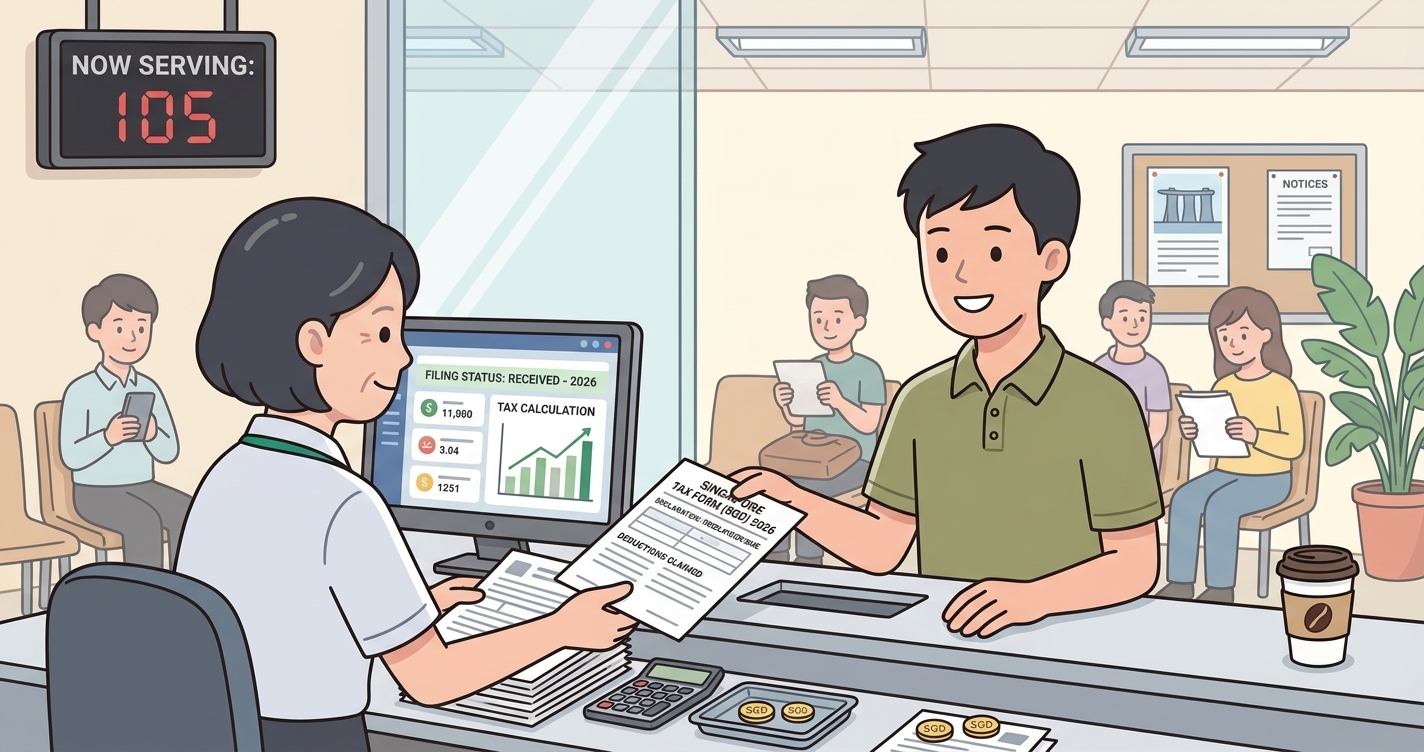
File through the myTax Portal using your SingPass. Tax returns are due by April 18 of the following year. For complex tax situations, firms like PwC Singapore tax advisory and Deloitte Singapore tax services offer Singapore-specific advisory. Find a qualified practitioner through the Institute of Singapore Chartered Accountants (ISCA).
CPF and MediSave Contributions
Self-employed can make voluntary CPF contributions (tax-deductible up to 37.5% of income or S$37,740/year). If 35+, you're automatically enrolled in MediSave.
Record Keeping: The Unsexy But Essential Part
IRAS requires five years of records: receipts, invoices, bank statements, expense logs, and mileage records. Categorize as you go—don't dump a shoebox on your accountant in March.
How Denpyo Helps You Win at Tax Time
Denpyo makes expense management painless: snap receipts, auto-categorize expenses, see real-time tax savings, and generate organized reports for filing. Use our tax savings estimator to understand the impact of each deduction. Whether you're solo or managing a team, less time chasing receipts means more time earning.
Key Takeaways
- Freelancers earning over S$22,000 and SMEs with revenue over S$100,000 must file by April 18.
- Claim every deduction: home office, software, equipment, professional development. Use our expense deductibility checker.
- GST registration is mandatory at S$1M+ turnover. InvoiceNow is mandatory from 2026.
- Keep five years of records. Digital copies are your friend.
- Voluntary CPF contributions are tax-deductible and build retirement savings.
- Automate expense tracking with Denpyo and focus on growing your business.
Singapore's tax system rewards diligence. File on time, claim what you're entitled to, and keep clean records.

Track expenses, maximize deductions
Denpyo scans your receipts and finds tax savings automatically.