
How to File Taxes for Side Jobs Without Your Employer Knowing (Japan 2026)
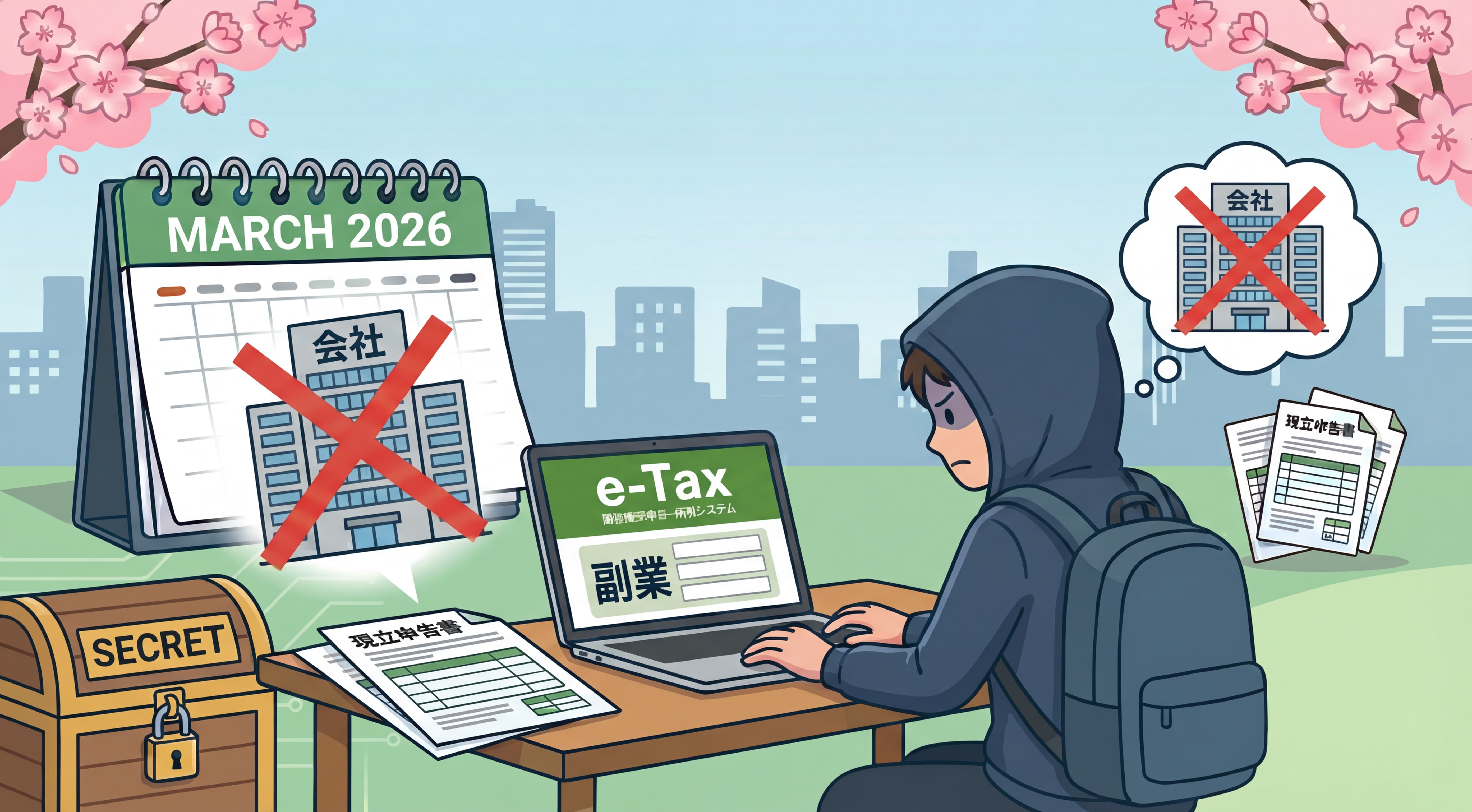
"I want to start a side job, but what if my company finds out?" The main reason side jobs get discovered is residence tax. By selecting "ordinary collection" on your tax return, your company won't be notified. A thorough guide to correct filing methods for 2026.
Disclaimer: This article provides general information and does not constitute tax or legal advice. Please consult a qualified tax professional for your specific situation. Information is current as of January 2026. Disclosure: This article is published on the Denpyo blog. Denpyo provides receipt management and expense tracking services. Important Note: This article does not recommend side jobs that violate your company's employment rules. Always check your employer's policies before starting a side job.
Introduction: Addressing Side Job Privacy Concerns
"I want to start a side job, but I'm worried about my company finding out..."
According to Ministry of Health, Labour and Welfare surveys, the number of workers interested in side jobs continues to grow each year, with approximately 15% of workers now engaged in some form of secondary employment. However, many people share a common concern: "Will my employer find out?"
The good news is that by understanding the proper tax filing methods, you can significantly reduce the risk of your employer discovering your side income.
This guide explains how side jobs get discovered, how to choose the right tax filing options, and how to maintain your privacy while properly reporting your income.
3 Reasons Side Jobs Get Discovered
First, let's understand the mechanisms by which employers typically discover side income.
Reason 1: Residence Tax Amount (Most Common)
The primary way side jobs are discovered is through residence tax (juuminzei).
Normally, employees' residence tax is collected through "special collection" (tokubetsu choushuu), meaning it's automatically deducted from monthly salary. The company's accounting department sees each employee's residence tax amount.
The problem is that side income increases your residence tax. For example:
- Main job annual income: ¥5,000,000 → Residence tax: approximately ¥250,000
- Add ¥1,000,000 side income → Residence tax: approximately ¥350,000
If the accounting staff notices that someone's residence tax seems too high for their salary, they may suspect side income.
Key Point: Residence tax is calculated based on the previous year's income, so changes appear in June of the following year. This timing is when many side jobs get discovered.
Reason 2: Side Jobs Paid as Salary Income
Part-time jobs and other work paid as "salary income" (kyuuyo shotoku) require extra caution.
Salary income is generally processed through special collection, meaning information about your secondary employer's payments may be sent to your main employer. This is difficult to avoid even when choosing "ordinary collection" (explained below).
Reason 3: Social Media, Word of Mouth, and Colleagues
Surprisingly common is discovery through personal channels:
- Social media posts (YouTube channels, blogs, Twitter/X)
- Confiding in or bragging to colleagues
- Contact with clients or customers
- Slip-ups at drinking parties
Even with perfect tax strategies, getting discovered through social media or word of mouth defeats the purpose.
3 Steps to File Without Discovery
Now, let's look at the specific steps to file taxes on side income while minimizing discovery risk.
Step 1: Choose "Ordinary Collection" (Most Important)
The second page of the tax return form has a section for choosing your residence tax collection method. Selecting "Pay yourself" (futsuu choushuu / jibun de noufu) is the most critical step.
| Collection Method | Description | Employer Notification |
|---|---|---|
| Special Collection (Tokubetsu Choushuu) | Deducted from salary | Yes (tax amount is reported) |
| Ordinary Collection (Futsuu Choushuu) | Pay via payment slip | No (side income tax is paid separately) |
When you choose ordinary collection, the residence tax on your side income is paid through payment slips sent to your home, and your main employer is not notified.
Important: The form section is labeled "Collection method for residence tax on income other than salary and public pensions." Make sure to check "Pay yourself" (自分で納付).
Step 2: Verify Your Side Job Type
Whether you can choose ordinary collection depends on the type of side income.
| Side Job Type | Income Category | Ordinary Collection | Notes |
|---|---|---|---|
| Freelance / Contract Work | Business or Miscellaneous Income | Available | Lowest discovery risk |
| Affiliate / YouTube | Miscellaneous or Business Income | Available | Can also deduct expenses |
| Reselling (Mercari, etc.) | Miscellaneous or Business Income | Available | Track purchase costs carefully |
| Real Estate Investment | Real Estate Income | Available | Caution with loss offsets |
| Stocks / FX / Crypto | Capital Gains / Miscellaneous | Available | Special accounts may not require filing |
| Part-time / Arubaito | Salary Income | Difficult | Special collection is standard |
Step 3: Confirm with Your Municipality
Handling of ordinary collection can vary by municipality. Before filing, contact your local residence tax department to confirm:
- Whether ordinary collection requests will definitely be honored
- Whether ordinary collection is available for non-salary income
- Whether any special procedures are required
A quick phone call can provide peace of mind, especially if you're filing for the first time.
Tax Filing Tips by Side Job Type
Freelance / Contract Work
Work like web development, writing, or consulting under contract agreements is reported as "business income" or "miscellaneous income."
Deductible Expenses:
- Computer and peripherals (full deduction under ¥100,000; depreciation for higher amounts)
- Communication costs (business portion of internet, phone)
- Books, seminar fees
- Transportation, meeting expenses
- Proportional home office rent
YouTube / Affiliate Marketing
YouTube ad revenue and affiliate income is typically reported as "miscellaneous income." If you have substantial ongoing revenue, it may qualify as "business income."
Deductible Expenses:
- Filming equipment (camera, microphone, lighting)
- Editing software, subscriptions
- Research and location costs
- Server and domain fees
- Outsourcing (editing, thumbnail creation)
Reselling (Mercari, etc.)
Profits from reselling are reported as "miscellaneous income."
Deductible Expenses:
- Purchase costs
- Shipping and packaging materials
- Platform fees
- Transportation for sourcing
- Storage shelving, warehouse costs
Key Point: Sales of personal belongings (clothes you no longer wear, etc.) are generally tax-exempt. However, continuous profit-making activities are taxable.
Real Estate Investment
Rental income is reported as "real estate income."
Deductible Expenses:
- Depreciation
- Repair costs
- Management fees, property management company fees
- Property tax
- Loan interest
Caution: If real estate income shows a loss, it offsets against salary income. This can lower your residence tax, which might raise questions about why your tax is unusually low.
Stocks / FX / Cryptocurrency
Investment profits are reported differently by type:
| Investment Type | Income Category | Filing Requirement |
|---|---|---|
| Stocks (Special account with withholding) | Capital Gains | Filing optional |
| Stocks (General account) | Capital Gains | Filing required |
| FX | Miscellaneous (Separate taxation) | Filing required |
| Cryptocurrency | Miscellaneous (Aggregate taxation) | Filing required |
If you use a special account with withholding (tokutei kouza / gensenari), you don't need to file and your employer won't know. However, filing is required if you want to carry forward losses or claim dividend credits.
Income Under 200,000 Yen: Still Important
You may have heard that "you don't need to file if side income is under ¥200,000." This is true for income tax, but residence tax is different.
Important: Even if side income is under ¥200,000, you still need to file for residence tax. Failing to do so may result in back taxes later.
Residence tax filing is done at your municipal office. Remember to choose "ordinary collection" when filing.
| Side Income Amount | Income Tax Return | Residence Tax Filing |
|---|---|---|
| Under ¥200,000 | Not required | Required |
| Over ¥200,000 | Required | Covered by income tax return |
Risks If Discovered and How to Respond
Let's understand the potential consequences if your employer does discover your side job.
Possible Disciplinary Actions
| Situation | Likely Consequence | Notes |
|---|---|---|
| Side jobs prohibited by rules | Verbal warning to disciplinary action | Depends on severity |
| Working for competitor | Possible termination | Non-compete violation |
| Main job performance affected | Serious warning to discipline | Decreased productivity, etc. |
| Company reputation damaged | Possible termination | Side jobs against public morals |
When Termination May Be Legal
Termination for side jobs is legally valid mainly in these cases:
- Working for a competitor (non-compete violation)
- Significant impact on main job duties
- Actions damaging company reputation
- Confidentiality breaches
Simple violation of "no side jobs" rules alone often doesn't justify legal termination.
How to Respond If Discovered
- Stay calm and assess: Understand what they know and how they found out
- Review company rules: Check the scope of restrictions and disciplinary provisions
- Explain honestly: Don't lie; explain the facts
- Propose next steps: Indicate whether you'll continue or stop the side job
- Seek expert advice if needed: Labor law attorneys can help
2026 Tax Reform Updates
The 2026 tax reforms include changes relevant to side jobs.
Basic Deduction Increase
Starting in 2026, the basic deduction is scheduled to increase. This will reduce taxable income and lower income and residence tax burdens.
| Item | Through 2025 | From 2026 |
|---|---|---|
| Basic Deduction | ¥480,000 | ¥580,000 (planned) |
| Employment Income Deduction (minimum) | ¥550,000 | ¥650,000 (planned) |
Impact on Side Jobs
The increased basic deduction may have these effects:
- Further reduced tax burden on smaller side income amounts
- Possible changes to residence tax thresholds
- The ¥200,000 filing exemption threshold is not expected to change
Check the National Tax Agency website for the latest tax reform information.
Frequently Asked Questions
Q1. Can I choose ordinary collection if side income is under ¥200,000?
A. Yes, you can choose ordinary collection when filing residence tax. Even though income tax filing isn't required, residence tax filing is necessary, and you can select ordinary collection at that time.
Q2. Is ordinary collection 100% foolproof?
A. Unfortunately, there's no 100% guarantee. Municipal processing errors or salary-type side jobs may still result in special collection. Social media and word-of-mouth risks also remain.
Q3. Is it illegal to file taxes without telling my employer about side income?
A. Choosing ordinary collection and properly filing taxes is completely legal. However, not reporting income (tax evasion) is illegal. Additionally, violating company employment rules may create contractual issues.
Q4. Is tax filing difficult?
A. Using the NTA's online filing system (Kakutei Shinkoku Shosaku Corner), you can create your return by following on-screen instructions. First-timers can typically complete it in 2-3 hours. Tax office consultation services are also available.
Q5. Can I deduct expenses without receipts?
A. Generally, you need documentation (receipts, invoices, statements) to prove expenses. However, credit card statements and bank records may be accepted in some cases. Keeping daily records is essential.
Side Job Tax Filing Checklist
Before Filing
- Calculated total side income for the year
- Organized expense receipts and records
- Obtained withholding certificate from main employer
- Prepared My Number card (or notification card)
- Reviewed payment statements from side job sources
During Filing
- Selected correct income category (business/miscellaneous)
- Deducted all eligible expenses
- Selected "Pay yourself" (ordinary collection)
- Double-checked all entries
- Saved a copy of the return
After Filing
- Pay residence tax by deadline when payment slips arrive
- Keep receipts and records for 7 years
- Continue expense management for next year
Recommended Expense Management Tools
Smooth tax filing for side jobs requires consistent expense tracking. Using tools that automatically digitize receipts from photos makes the process much easier.
Streamline Expense Management with Denpyo
Denpyo uses AI to automatically extract amounts, dates, and expense categories from receipt photos, organizing the data you need for tax filing.
- Automatic receipt digitization from photos
- Automatic expense categorization
- Tax savings visualization
- Export data for tax filing
Summary: 3 Key Points
Point 1: Always Choose Ordinary Collection
Checking "Pay yourself" (ordinary collection) on the second page of your tax return is the most important step. This prevents residence tax on side income from being reported to your employer.
Point 2: Avoid Salary-Type Side Jobs
Part-time jobs and other work paid as salary generally use special collection, making employer discovery more likely. If possible, work as a contractor or freelancer instead.
Point 3: Be Careful with Social Media and Word of Mouth
Even with perfect tax strategies, discovery through social media posts or conversations with colleagues happens. Keep your side job private as much as possible.
Consider Discussing with Your Employer
Finally, consider the option of discussing your side job with your company rather than keeping it completely hidden.
More companies are allowing side jobs. As of 2024, approximately 70% of listed companies permit some form of secondary employment.
Getting official approval for your side job means:
- Freedom from discovery worries
- Ability to pursue your side job openly
- Potential synergies with your main job
- Positive impact on future career
Consider reviewing your company rules and consulting with your supervisor or HR department.

Track expenses, maximize deductions
Denpyo scans your receipts and finds tax savings automatically.