
Taiwan Freelancer Business Expense Deductions 2026: Complete Guide to Reducing Your Tax Bill
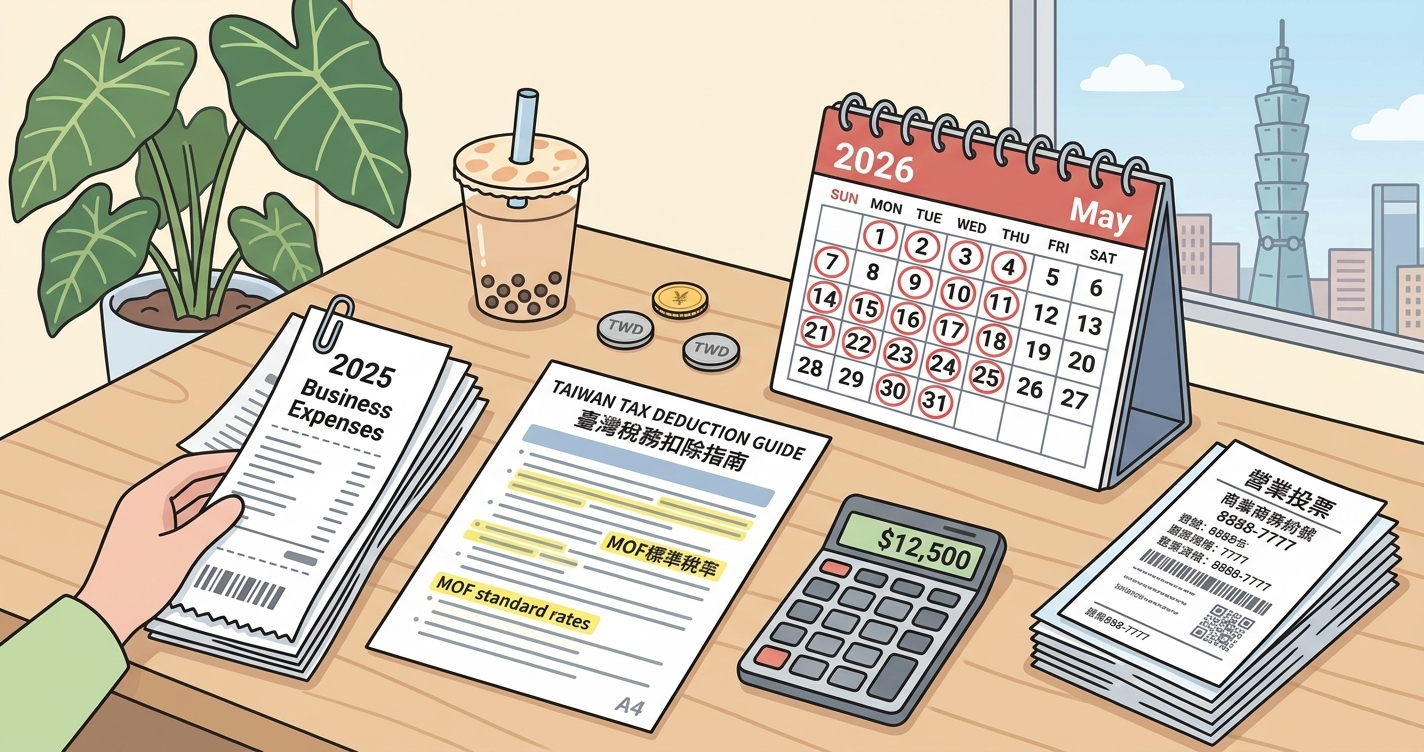
Disclaimer: This article provides general information only and is not individual tax advice. Tax rules change frequently. Always verify requirements with the National Taxation Bureau of Taipei or a licensed tax accountant in Taiwan. Filing deadlines are typically May 1–31 for the prior-year return.
For freelancers and self-employed professionals in Taiwan, understanding which business expenses you can deduct is one of the most powerful ways to reduce your tax bill legally. Unlike salaried employees who receive a fixed salary special deduction, self-employed individuals must navigate Taiwan's business income rules — where the right deductions can make a significant difference to your taxable income.
This guide covers the key expense categories Taiwan freelancers can deduct, how business income differs from salary income for tax purposes, the important 10% withholding tax credit, and practical steps for maximizing your annual return filed in May.
Business Income vs Salary Income: A Critical Distinction
In Taiwan, the tax treatment of your freelance income depends entirely on how it is classified:
- Salary income (薪資所得): Subject to a special salary deduction (NT$218,000 for 2025 returns; NT$227,000 for 2026 returns), regardless of actual expenses. Applies when you receive a regular monthly salary from an employer.
- Business income (執行業務所得 / 營業所得): Freelancers, consultants, lawyers, architects, accountants, doctors, artists, and other self-employed professionals fall here. You may deduct actual business expenses, or use the Ministry of Finance (MOF) standard cost rate for your profession.
If your income is classified as business income, you cannot use the salary special deduction. However, the ability to deduct real expenses often more than compensates — especially if you have substantial costs.
The 10% Withholding Tax: Your Advance Credit
When Taiwanese clients pay freelancers, they are legally required to withhold 10% of the payment as advance income tax. This is not a final tax — it is a credit against your annual tax liability.
- Your clients issue a withholding certificate in February each year
- Collect all withholding certificates before filing your May tax return
- Claim them on your individual income tax return to reduce or eliminate tax owed
- If withheld tax exceeds your final liability, you receive a refund
This is one of the most commonly missed benefits by freelancers new to Taiwan's tax system — especially foreign freelancers on the Gold Card.
Two Ways to Calculate Your Deductible Expenses
Method 1: MOF Standard Cost Rate (成本率)
The Ministry of Finance publishes standard cost rates for each profession. If your actual costs are lower than the standard rate, using the standard rate is more advantageous. You don't need receipts to claim it.
Examples of MOF standard rates for professional income:
- Writers, authors, editors: typically 30% standard cost rate
- Performing artists, musicians: 30%
- Lawyers, accountants, architects: varies by case (consult the NTB Taipei guide)
- Other freelance professionals: typically 20–30%
The MOF updates these rates periodically. Check the latest rates at the eTax Portal of the Ministry of Finance.
Method 2: Actual Expense Deduction
If your real business expenses exceed the standard rate, you can deduct them directly — but you must keep all supporting receipts and documentation. The following categories are deductible:
- Office costs: Rent for a dedicated office space or proportional home-office rent; electricity and utilities apportioned to business use
- Equipment and technology: Computers, cameras, audio equipment, software licenses, and other tools used for business. Large purchases may need to be depreciated over their useful life.
- Communication: Business phone plans, internet service, video conferencing subscriptions (Zoom, Teams, etc.)
- Professional development: Courses, certifications, books, seminars, and industry memberships directly related to your work
- Subcontractor costs: Payments to other freelancers or contractors for work on your projects
- Marketing and advertising: Website hosting, domain names, paid advertising, business cards
- Travel: Transportation for client meetings, site visits, or business-related travel (keep detailed records)
- Professional fees: Accountant fees, legal costs for business contracts
- Bank and transaction fees: Wire transfer fees, currency conversion costs for international payments
Special Deductions and Personal Exemptions
Beyond business expenses, Taiwan residents can claim several personal deductions on their annual return:
- Personal exemption: NT$97,000 per person (2025 figures)
- Standard deduction: NT$131,000 for single filers; NT$262,000 for married couples
- Special deductions: Savings interest (up to NT$270,000), disability deduction (NT$218,000), pre-school children deduction (NT$120,000 per child under 5), and long-term care deduction (NT$120,000)
- National Health Insurance premiums: Fully deductible
- Charitable donations: Up to 20% of net consolidated income
These deductions apply on top of your business expense deductions and can substantially reduce your taxable income.
Filing Your Annual Return: Key Steps
Taiwan's individual income tax filing window runs May 1–31 each year for the prior calendar year's income. Late filing results in penalties.
- Gather income documents: Withholding certificates from all clients (issued February), bank statements showing PayPal or wire transfer receipts for foreign clients, and any other income records
- Collect expense receipts: If using actual deductions, organize all business receipts and invoices
- File online: Use the Ministry of Finance eTax Portal or mobile app, or visit your National Taxation Bureau branch
- Choose your deduction method: Compare MOF standard rate vs actual expenses and pick the larger deduction
- Claim your withholding credits: Enter all withholding certificate amounts to reduce your liability
Special Considerations for Foreign Clients and Overseas Income
If you earn income from foreign clients (e.g., US, EU companies) who do not withhold Taiwan taxes, you must still declare that income on your Taiwan return. Foreign clients typically do not issue Taiwan withholding certificates, so you are responsible for the full tax calculation yourself.
Practical advice: maintain a spreadsheet or use a tool like Denpyo to track all income and expenses throughout the year, with currency conversions noted at the time of receipt. This makes the May return process far less stressful.
Digital Record-Keeping Best Practices
The NTS (National Taxation Service) requires freelancers to retain supporting documents for 5 years. For digital invoices and receipts:
- Screenshot or download PDF copies of all digital invoices immediately upon receipt
- Use cloud storage with date-stamped folders organized by month
- For paper receipts, photograph them promptly — ink fades quickly
Receipt management apps like Denpyo automate the capture and categorization process, making year-end accounting much smoother. Use our expense checker tool to verify which of your spending categories are likely deductible under Taiwan's tax rules.
Common Mistakes Taiwan Freelancers Make
- Not collecting withholding certificates: Forgetting to collect these from clients means losing a significant tax credit
- Choosing the wrong income category: If your income should be classified as business income but gets reported as salary income (or vice versa), your deductions change significantly
- Missing the May 31 deadline: Even a day late can trigger a surcharge
- Not keeping receipts: Without documentation, the NTS may disallow your actual expense claims
Taiwan's freelancer tax system rewards those who keep careful records throughout the year. Whether you use the MOF standard rate or itemize actual expenses, plan your expense tracking from January — it pays dividends in May.

Track expenses, maximize deductions
Denpyo scans your receipts and finds tax savings automatically.