
Hong Kong Budget 2026/27 Tax Measures for Sole Proprietors: The HK$3,000 Reduction
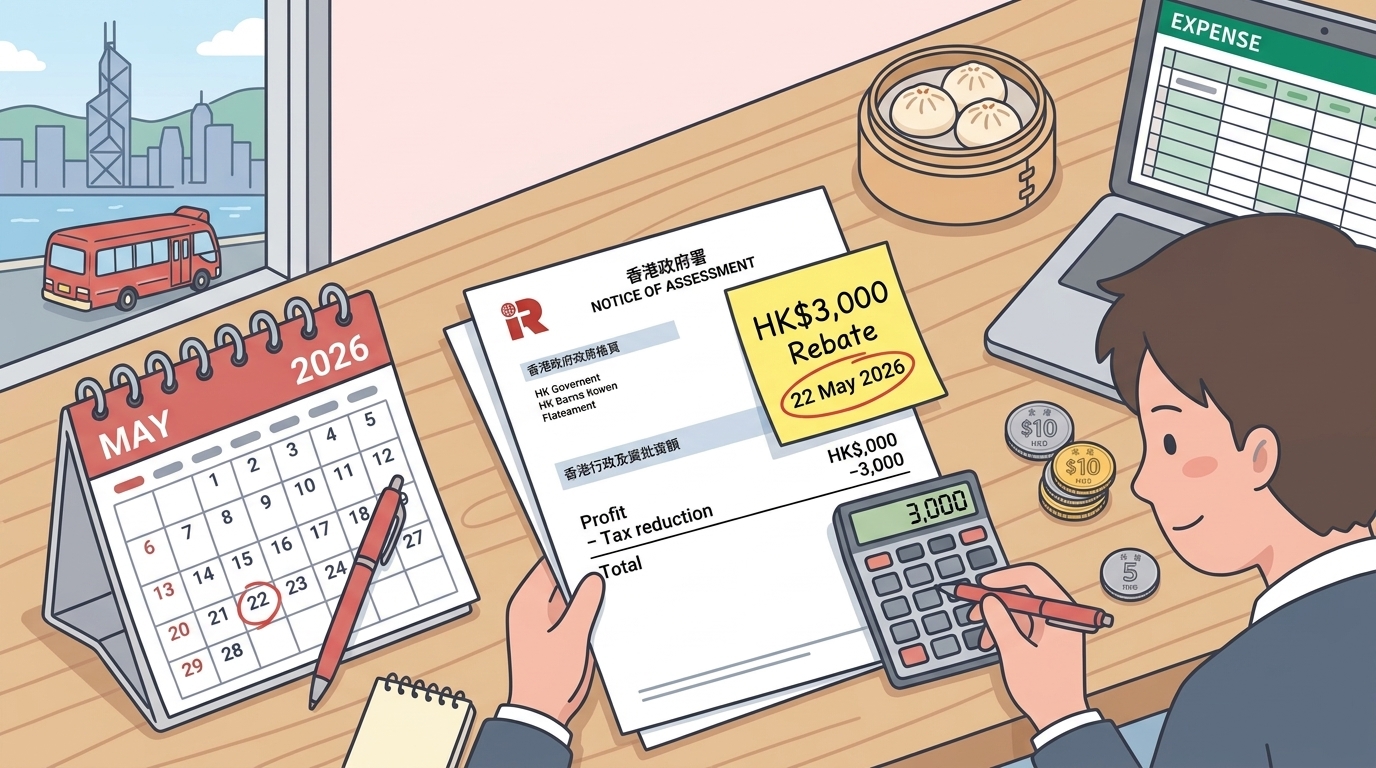
The one-off 100% tax reduction for YA 2025/26, capped at HK$3,000, was gazetted on 22 May 2026. What sole proprietors need to do (just file as usual), why provisional tax is untouched, and how the per-business cap works with personal assessment.
This article is general information for Hong Kong freelancers, sole proprietors and small business owners. It is not tax advice. The authoritative sources are the Inland Revenue Department (IRD) page on the 2026-27 Budget tax measures and the IRD's FAQ on those measures. Your position depends on your profits, other income and any personal assessment election, so check your notice of assessment and ask the IRD or a tax adviser if anything looks wrong.
For most people running a business in their own name, the Hong Kong Budget 2026/27 tax measures come down to one line on a tax demand note: a one-off reduction of 100% of your 2025/26 final tax, capped at HK$3,000. If you are a sole proprietor, the useful questions are not whether the relief exists — it is now law — but whether you must do anything, why your provisional tax ignores it, and how the cap works with two businesses or personal assessment. This guide answers all three for the year of assessment (YA) 2025/26.
Key Takeaways
- The one-off reduction of 100% of profits tax, salaries tax and tax under personal assessment for YA 2025/26, capped at HK$3,000 per case, was passed by the Legislative Council on 13 May 2026 and gazetted on 22 May 2026.
- You do not apply for it: you file your 2025/26 return as usual and the IRD applies the reduction in your final assessment, reassessing any 2025/26 assessment issued before the law was enacted.
- The reduction applies only to 2025/26 final tax, not provisional tax, so provisional tax must still be paid on time; what you paid is set against your final tax and your 2026/27 provisional tax, and any excess is refunded.
- For profits tax the HK$3,000 ceiling applies to each business, so a sole proprietor with two businesses can get up to HK$3,000 on each — but under personal assessment all your income is aggregated and a single HK$3,000 ceiling applies.
- You can still elect personal assessment for 2025/26 until the later of 31 March 2028 or two months after your notice of assessment is issued.
What the 2026-27 Budget proposed, and what was actually enacted
The Financial Secretary delivered the 2026-27 Budget on 25 February 2026. Paragraph 279 of the Budget Speech proposed to reduce profits tax for YA 2025/26 by 100%, subject to a ceiling of HK$3,000, estimating that this would benefit about 171,000 businesses and reduce government revenue by about HK$500 million. A parallel reduction with the same ceiling covered salaries tax and tax under personal assessment.
A Budget proposal is not law until the Legislative Council passes it. When the IRD issued 2025/26 individual returns on 4 May 2026, the Inland Revenue (Amendment) (Tax Concessions, Concessionary Deductions and Allowances) Bill 2026 had been introduced but not yet passed. The IRD confirms it was passed on 13 May 2026 and gazetted on 22 May 2026. Where the measures that matter to an unincorporated business stand:
| Measure | Applies to | Status |
|---|---|---|
| One-off 100% reduction of final tax, capped at HK$3,000 per case | Profits tax, salaries tax and tax under personal assessment, YA 2025/26 | Enacted, gazetted 22 May 2026 |
| Higher personal allowances (basic allowance from HK$132,000 to HK$145,000; married person's allowance from HK$264,000 to HK$290,000) | YA 2026/27 onwards; reaches business profits only if you elect personal assessment | Enacted, gazetted 22 May 2026 |
| Deduction ceiling for elderly residential care expenses raised from HK$100,000 to HK$110,000 | YA 2026/27 onwards | Enacted, gazetted 22 May 2026 |
| Stamp duty changes (residential property above HK$100 million, intra-group transfers, transfers into REITs) | Property and group transactions, not profits tax | Handled by separate stamp duty legislation; the rate rise for residential property above HK$100 million was passed on 20 May 2026 |
Profits tax rates did not change. Under the two-tiered regime, an unincorporated business still pays 7.5% on the first HK$2 million of assessable profits and 15% on the rest, and KPMG's Budget summary confirms the Budget proposed no change to those rates.
This is not last year's HK$1,500 reduction
The ceiling moves every Budget. GovHK's table of tax reductions shows HK$6,000 per case for 2022/23, HK$3,000 for 2023/24, HK$1,500 for 2024/25 and HK$3,000 for 2025/26. For a general walkthrough of how the reduction shows up on a notice of assessment, see our earlier guide to the 100% tax reduction; for 2025/26, your notice should reflect the HK$3,000 ceiling, not 2024/25's HK$1,500.
Who the profits tax reduction actually reaches
The Budget's supplementary table estimates 170,800 businesses benefiting, including 130,300 corporations and 40,500 unincorporated businesses — against about 261,000 unincorporated businesses in Hong Kong at the end of 2025. The 57,900 businesses with assessable profits of HK$100,000 or less get an estimated average reduction of HK$2,000, which removes about 52% of their tax on average. In every band above HK$100,000, the average is the full HK$3,000. At the 7.5% rate, the ceiling covers all the tax on assessable profits of up to HK$40,000.
Do sole proprietors need to do anything to get the one-off tax reduction?
No application is needed. The IRD's FAQ says you only need to file your Tax Return – Individuals (BIR60) for 2025/26 as usual; the IRD applies the reduction in the final assessment and revises any 2025/26 assessment issued before the amendment. Sole proprietors report the profits or loss of all their businesses in Part 5 of the BIR60, and this year's deadline for sole proprietors was 4 August 2026, or 4 September 2026 for returns filed electronically.
What is left to do between now and your payment dates:
- Make sure your 2025/26 return is in. The reduction is applied in the final assessment; it does not excuse a missing return.
- Read the computation on your notice of assessment. The reduction should appear against your 2025/26 final tax, not your 2026/27 provisional tax.
- Check it is applied per business. Unless you elected personal assessment, each sole proprietorship's profits tax should carry its own reduction of up to HK$3,000.
- Pay provisional tax as demanded. The reduction is not a ground for holding over provisional tax, though the usual grounds still apply, such as profits likely to fall below 90% of the previous year's.
- Revisit personal assessment if you did not elect it in Part 7 of the BIR60. You can still elect in writing until the later of 31 March 2028 or two months after your notice of assessment.
- Object within one month if the figures are wrong. GovHK says the IRD must receive your notice of objection within one month after the date of issue of the notice of assessment.
Why the tax reduction cuts final tax but not provisional tax
Profits tax is collected in two layers. The IRD's Brief Guide to Taxes 2025-2026 explains that during a year of assessment, provisional tax is paid based on the profits assessed for the preceding year. When the actual profits are assessed the following year, the provisional tax paid is applied first against that year's profits tax, and any excess goes against the next year's provisional tax.
The one-off measure reduces 2025/26 final tax. Your 2025/26 provisional tax had already been charged, so the IRD's FAQ is blunt: pay it on time, or recovery action will be taken. The relief reaches you through the credit — what you paid is set against a smaller final bill, any surplus goes towards 2026/27 provisional tax, and anything left is refunded. Your 2026/27 provisional tax gets no reduction: in the IRD's illustrative examples, which use salaries tax, the reduction appears only in the 2025/26 final column, never in the 2026/27 provisional column. For more on the two-layer system itself, see our guide to Hong Kong provisional tax.
Worked example: one business (illustrative figures)
Kelvin is a freelance videographer with one sole proprietorship and no other income. His 2025/26 assessable profits are HK$260,000, and he paid HK$15,000 of 2025/26 provisional profits tax during the year. With no other business, he is charged at the two-tiered rates.
| Item | Without the reduction (HK$) | With the reduction (HK$) |
|---|---|---|
| 2025/26 profits tax (HK$260,000 × 7.5%) | 19,500 | 19,500 |
| Less: 100% tax reduction, capped | — | (3,000) |
| 2025/26 final tax | 19,500 | 16,500 |
| Less: 2025/26 provisional tax already paid | (15,000) | (15,000) |
| Balance of 2025/26 tax | 4,500 | 1,500 |
| 2026/27 provisional tax (based on 2025/26 profits) | 19,500 | 19,500 |
| Total on the demand note | 24,000 | 21,000 |
Kelvin is HK$3,000 better off, all of it on the final-tax line. Now suppose his profits had collapsed to HK$40,000. His 2025/26 tax of HK$3,000 is wiped out, so none of the HK$15,000 he paid is needed for 2025/26: it first covers his 2026/27 provisional tax of HK$3,000, and the remaining HK$12,000 is refunded. A fall that steep would also have been a ground to apply in time to hold over provisional tax, but simply withholding the payment would only have triggered recovery action.
How the HK$3,000 cap works: per business, per taxpayer, per couple
The ceiling is "per case", and a case depends on the tax:
- Profits tax: per business. The IRD's FAQ confirms that with two businesses in 2025/26 you get a reduction of up to HK$3,000 on the profits tax of each. A partnership business is its own case, with one reduction of up to HK$3,000.
- Salaries tax: per individual. Married couples who are jointly assessed share one HK$3,000 ceiling.
- Job plus business: if you are separately chargeable to salaries tax and profits tax, you get the reduction under each tax type.
- Personal assessment: per elector. All your income, including business profits, is aggregated, and the reduction is 100% of the tax under personal assessment, capped at HK$3,000 — not separate reductions per tax type. If you elect jointly with your spouse, the couple shares one HK$3,000 ceiling; if you elect separately, each of you has your own.
Two business registrations bring a second rule. The IRD's FAQ on two-tiered profits tax rates treats each of your sole proprietorships as a separate, connected entity. Only one can elect the two-tiered rates; the other pays 15% on all its assessable profits. So the second business earns its own HK$3,000 ceiling but loses the 7.5% rate.
Worked example: two businesses versus personal assessment (illustrative figures)
Ada is single and runs two sole proprietorships with no salary: a photography studio with 2025/26 assessable profits of HK$300,000, and an online print shop with HK$120,000. She nominates the studio for the two-tiered rates.
| Item | Profits tax on each business (HK$) | Personal assessment (HK$) |
|---|---|---|
| Studio: HK$300,000 × 7.5% | 22,500 | — |
| Print shop: HK$120,000 × 15% | 18,000 | — |
| Aggregated income less basic allowance of HK$132,000 | — | 288,000 |
| Tax before reduction | 40,500 | 30,960 |
| Less: 100% tax reduction | (6,000) — HK$3,000 per business | (3,000) — one case |
| Tax payable | 34,500 | 27,960 |
The personal assessment figure uses the salaries tax progressive rates (2%, 6%, 10% and 14% on successive HK$50,000 bands, then 17%), which come to HK$16,000 on the first HK$200,000 and HK$14,960 on the remaining HK$88,000. Before the reductions, personal assessment saves Ada HK$9,540. After them, the saving narrows to HK$6,540, because she gives up one HK$3,000 ceiling by aggregating. Personal assessment still wins here, but the lesson is general: compare the two routes after the reductions, not before, because each extra business adds up to HK$3,000 of reduction that personal assessment cannot match. As the IRD's Brief Guide to Personal Assessment notes, electing may not be advantageous for larger earners, because the marginal progressive rate is higher than the standard rate. Our personal assessment guide covers eligibility.
Keep the records that make the numbers stand up
None of these comparisons helps if your assessable profits are wrong. The IRD's guide to profits tax for unincorporated businesses says every business owner must keep business records, prepare annual accounts and retain them for at least 7 years, even when gross income is small. Two businesses means two clean sets of figures.
That is the part Denpyo is built for: photograph a receipt or supplier invoice and the AI extracts the date, vendor and amount, shows an estimated tax saving for each expense, and exports the records in a format your accountant can use. If you are not sure whether a purchase counts as a business expense at all, the free expense deductibility checker gives you a general starting view.
FAQ
Do I need to apply for the HK$3,000 tax reduction in Hong Kong?
No. You file your 2025/26 BIR60 or profits tax return as usual and the IRD applies the reduction in your final assessment, reassessing any 2025/26 assessment issued before the law was enacted. There is no separate form.
Why is my provisional tax not reduced by the 2025/26 tax reduction?
Because the reduction applies only to 2025/26 final tax. The IRD's FAQ says you must still pay 2025/26 provisional tax on time; the amount paid is then set against your 2025/26 final tax and your 2026/27 provisional tax, and any excess is refunded.
I have two business registrations. Do I get HK$3,000 for each?
Under profits tax, yes: the IRD's FAQ gives a reduction of 100% of the profits tax payable for each business, capped at HK$3,000. But only one of your sole proprietorships can use the two-tiered rates, and under personal assessment a single HK$3,000 ceiling applies.
Does the one-off tax reduction apply if I elect personal assessment?
Yes, but it is calculated on your tax under personal assessment, capped at HK$3,000, instead of separately on your salaries tax and profits tax. A married couple electing jointly shares one HK$3,000 ceiling; spouses electing separately get one each.
Is the 2025/26 tax reduction the same as last year's rebate?
It works the same way but is a separate measure. GovHK lists the ceiling as HK$1,500 for YA 2024/25 and HK$3,000 for YA 2025/26, the year covered by the 2026-27 Budget.
Summary
The headline Hong Kong Budget 2026/27 tax measure for sole proprietors is enacted and automatic: a 100% reduction of 2025/26 final tax, capped at HK$3,000, applied by the IRD in your final assessment. It does not touch provisional tax, so the money arrives as a smaller balance or a refund once your provisional payments are credited. The cap is per business for profits tax but per elector under personal assessment, so if you run two businesses, compare both routes after the reductions — you have until at least 31 March 2028 to elect personal assessment for 2025/26.
Sources
- Inland Revenue Department — 2026-27 Budget: Tax Measures
- Inland Revenue Department — FAQ: 2026-27 Budget Tax Measures
- Inland Revenue Department — Illustrative examples of the 2026-27 Budget measures (PDF)
- HKSAR Government — The 2026-27 Budget Speech (paragraphs 279 to 280)
- HKSAR Government — 2026-27 Budget Supplement: Effect of the proposed one-off tax reduction (PDF)
- HKSAR Government press release — Tax measures proposed in 2026-27 Budget (25 February 2026)
- HKSAR Government press release — Inland Revenue Department issues tax returns for individuals (4 May 2026)
- Inland Revenue Department — FAQ: Two-tiered Profits Tax Rates Regime
- Inland Revenue Department — A Brief Guide to Personal Assessment (PDF)
- Inland Revenue Department — A Brief Guide to Taxes Administered by the IRD 2025-2026 (PDF)
- Inland Revenue Department — A guide to Profits Tax for unincorporated businesses (1) (PDF)
- GovHK — Tax Rates of Salaries Tax and Personal Assessment
- GovHK — Holding Over of Provisional Tax
- GovHK — Objections
- Inland Revenue Department — Government welcomes passage of Stamp Duty (Amendment) Bill 2026 (20 May 2026)
- KPMG TaxNewsFlash — Hong Kong: Tax proposals in 2026-2027 budget

Track expenses, maximize deductions
Denpyo scans your receipts and finds tax savings automatically.