
Year-End Closing Checklist for Sole Proprietors in Japan: Stocktake, Depreciation and the ¥650,000 Deduction by 31 December (2026 Tax Year)
For sole proprietors in Japan, 31 December is the closing date. Following National Tax Agency materials, this December checklist covers the stocktake and the last-purchase-price method, December deliveries, accrued and prepaid expenses, depreciation, business/personal apportionment and the requirements for the 2026 ¥650,000 Blue Return Special Deduction. It also explains what changes from the 2027 tax year.
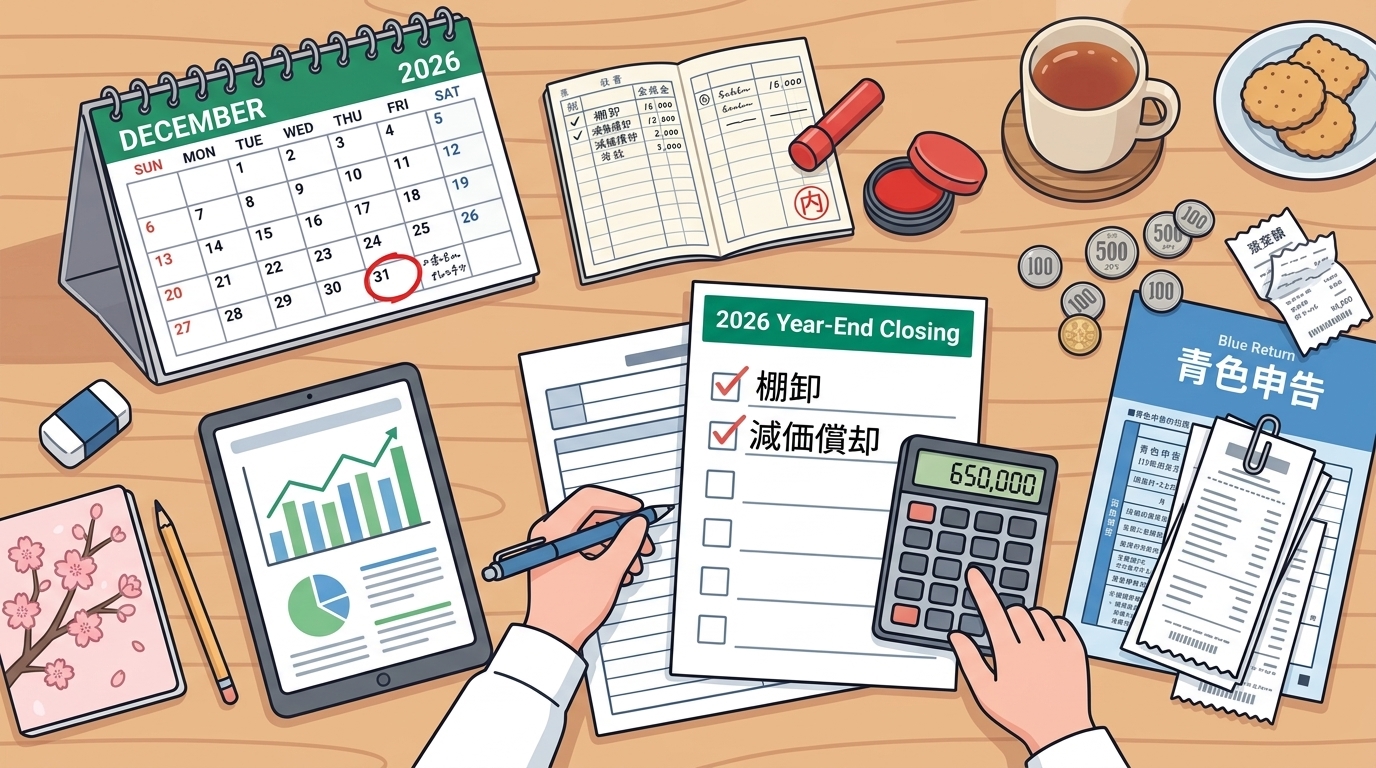
This article sets out general information on preparing the year-end closing for the 2026 tax year (令和8年分) for sole proprietors and freelancers in Japan. It is not tax advice. For the official rules, check sources such as the National Tax Agency's Tax Answer No. 2072, “Blue Return Special Deduction” and the National Tax Agency's guide “How to Close Your Books (Blue Return Edition)”. For decisions about your own situation, consult your local tax office or a licensed tax accountant (税理士).
For a sole proprietor, year-end closing preparation really happens in December, not in February when the filing season opens. Income tax is calculated on your income for the year from 1 January to 31 December. Inventory is, in principle, counted on 31 December, and whether something counts as an expense depends on whether the liability became fixed by 31 December. Recounting last year's stock accurately after New Year, or reconstructing a whole year of transactions to sort revenue from expenses, is hard work. The more you prepare in December, the easier February and March become.
What's more, the 2026 tax year is the last year in which a paper return can still get the ¥550,000 Blue Return Special Deduction (青色申告特別控除). Following National Tax Agency (NTA) materials, this article works through what to finish by 31 December, in this order: closing revenue and expenses, the stocktake, depreciation, business/personal apportionment, and checking the requirements for the ¥650,000 deduction. For how the February–March filing period runs, see our final tax return deadline calendar.
Key takeaways
- Inventory is, in principle, physically counted on 31 December. If you have not notified the tax office of a valuation method, it is valued using the last-purchase-price method (最終仕入原価法), i.e. the unit price of the purchase closest to year-end × quantity.
- Work delivered in December is 2026 revenue even if you invoice in January. Conversely, an expense whose liability became fixed by 31 December is a 2026 expense even if it is still unpaid.
- For blue-return filers, the special rule for small-value depreciable assets now covers items costing under ¥400,000 (up to ¥3,000,000 in total) for acquisitions on or after 1 April 2026, but the expense falls in the year you start using the asset in your business.
- For the 2026 tax year, the Blue Return Special Deduction stays at the current ¥650,000, ¥550,000 and ¥100,000. The ¥650,000 tier requires either filing on time via e-Tax (by 15 March 2027) or keeping qualifying “superior” electronic books.
- From the 2027 tax year (令和9年分), the cap for paper returns becomes ¥100,000. If you are aiming for the ¥750,000 deduction through superior electronic books, the requirements must be met “from the start of the tax period”, so decide in December how you will keep your books from 1 January 2027.
Why 31 December is the closing date for sole proprietors
The NTA guide “How to Close Your Books (Blue Return Edition)” lays out the process as “day-to-day bookkeeping → year-end closing → final tax return (February–March)”. What you do in February and March is prepare and submit the return. The year-end closing that feeds into it is year-end work. 31 December is the reference point in three main areas.
- Inventory: the stocktake is, in principle, done on 31 December.
- Expenses: an amount is a deductible expense if, by 31 December of that year, (1) the liability has arisen, (2) the event that requires specific performance has occurred, and (3) the amount can be reasonably calculated (NTA No. 2210). Whether you have paid is not the test.
- Assets: depreciable assets such as a computer are expensed from the year you put them into service in the business (start using them), not the year you buy them.
The filing period normally runs from 16 February to 15 March of the following year (NTA No. 2020). For the 2026 tax year, that is Tuesday 16 February to Monday 15 March 2027. Because the deduction depends on whether you file via e-Tax or on paper, it is worth settling your filing method in December as well.
Year-end closing checklist for the 31 December close (revenue, expenses, stocktake, depreciation, apportionment)
1. Reconcile your books with your receipts and total each account
Check the entries in your books against the source records (delivery notes, invoices, receipts and so on) and correct any errors. Then total each account from January to December. If you get this done in the first half of December, year-end is just a matter of adjusting the differences.
2. Close revenue: don't miss work delivered in December and invoiced in January
Everything you sold during the year is that year's revenue, even if you have not yet been paid. The NTA material gives the example of a business that closes its books on the 20th of each month, invoices on the 25th and is paid on the 10th of the following month: work delivered from 21 to 31 December is recorded as accounts receivable (revenue) dated 31 December, even though it has not been invoiced. Freelancers who close at month-end and invoice the following month need to watch most closely for December revenue slipping through. Conversely, advance payments received for something you have not yet delivered are excluded from that year's revenue.
3. Close expenses: sort out accrued and prepaid expenses
- Accrued expenses: anything such as December's rent that was not paid within the year is recorded as an unpaid expense and deducted in that year. For small expenses, you may skip this step and simply deduct what you actually paid.
- Prepaid expenses: if an expense paid within the year includes amounts for the following year or later, that part is, in principle, an expense of the following year or later. However, the cost of services to be received within 1 year of the payment date can be deducted in the year paid, provided you consistently deduct such costs in the year of payment every year (Basic Circular on Income Tax 37-30-2).
- The 4th instalment of fixed asset tax: the 4th instalment, due in February of the following year, may be treated either as an unpaid expense of the current year or as an expense of the following year (only the business-use portion is deductible).
4. Count your inventory on 31 December (stocktake basics for sole proprietors)
Cost of goods sold is not simply the year's purchases. It is calculated with the formula below, and the same logic applies to consumables.
Cost of goods sold = opening inventory (start of year) + purchases for the year − closing inventory (end of year)
- What to count: besides goods, finished products and raw materials, inventory includes consumables such as packaging, petrol and office supplies, and small items of equipment, such as those costing under ¥100,000, that you have not yet used. Consumables that have not built up noticeably compared with a normal year can be left out of the count.
- When: in principle on 31 December. If that is not possible, count on the nearest practicable day before or after, calculate the inventory as at 31 December from the transactions between that day and 31 December, and keep a clear record of how you calculated it.
- How: physically count the quantity by type, quality, model and so on, and record the quantity, unit price and amount on an inventory sheet.
- Valuation: if you have not notified a valuation method, use the last-purchase-price method (the unit price of the purchase made closest to year-end × the year-end quantity). Damaged or shop-soiled stock may be valued at what it could be sold for as at 31 December.
To change the valuation method you have chosen, you need an application for approval of the change, not a notification (NTA A1-17). December is not the time to change methods. It is the time to count correctly using the method you have.
5. Check your depreciation
Business assets such as computers and cars are expensed by spreading the acquisition cost over their statutory useful life and deducting a share each year (NTA No. 2100). In December, open your fixed asset register and check the following.
- Assets bought mid-year are prorated by month: divide a full year's depreciation by 12 and multiply by the number of months the asset was used in the business that year (NTA No. 2106).
- Under ¥100,000, or a useful life of less than 1 year: the full amount is deductible in the year you start using it in the business.
- ¥100,000 or more but under ¥200,000: you can choose to treat it as a lump-sum depreciable asset (一括償却資産) and deduct one third of the total each year over 3 years.
- Special rule for small-value depreciable assets (blue-return filers): blue-return filers who meet certain requirements can deduct the full cost, up to ¥3,000,000 in total, in the year the assets are put to business use. For acquisitions on or after 1 April 2026, the rule widened to items costing ¥100,000 or more but under ¥400,000 (for acquisitions up to 31 March 2026: ¥100,000 or more but under ¥300,000). So the same ¥350,000 computer is not eligible if bought in March 2026, but is eligible if bought in May.
- Tax-inclusive or tax-exclusive: the amount is tested according to your accounting method. Consumption-tax-exempt businesses test the tax-inclusive amount.
If you are buying equipment in a year-end rush, make sure it has arrived and you have actually started using it by 31 December.
6. Total a full year of business/personal apportionment
For mixed personal and business expenses (家事関連費), such as rent and utilities for a home that doubles as your office, only the business share is deductible. The NTA says this is limited to amounts that, based on transaction records and the like, can be clearly separated as directly necessary for the business (No. 2210). Basic Circular on Income Tax 45-2 tests whether the portion needed for the business exceeds 50%, but adds that even at 50% or below, a portion that can be clearly separated may be deducted.
You do not have to apportion every month. The NTA's bookkeeping example deducts the personal share in one go at year-end, with a 31 December entry such as “Water charges, personal share excluded (60,000 × 80% personal) △48,000” (△ marks a deduction). Apportion using an appropriate basis such as floor area, insured value or hours of lighting. Use December to gather a full year's totals for rent, electricity and phone and internet, together with the evidence for your ratios. We explain how to set the ratios in how to calculate business/personal apportionment (家事按分).
Check the requirements for the ¥650,000 Blue Return deduction (2026 tax year)
For the 2026 tax year, the Blue Return Special Deduction keeps its current three tiers (NTA No. 2072).
| Deduction | Main requirements |
|---|---|
| ¥650,000 | The ¥550,000 requirements, plus either (1) submitting the final return, balance sheet, profit and loss statement and other documents via e-Tax by the deadline, or (2) keeping that year's journal and general ledger in a way that meets the requirements for superior electronic books, and submitting the notification by the deadline |
| ¥550,000 | Running a business that generates business income or real estate income, keeping books under the principle of regular bookkeeping (generally double-entry bookkeeping), and submitting the final return with the balance sheet, profit and loss statement and other documents attached by the deadline (15 March of the following year) |
| ¥100,000 | Blue-return filers who do not meet the requirements above |
- Miss the deadline and it drops to ¥100,000: the ¥550,000 and ¥650,000 tiers require filing on time, and even a refund return must be submitted by 15 March of the following year.
- No image data via e-Tax: you cannot submit the financial statements as image data. The NTA's online return preparation service can also prepare and transmit the data for your blue-return financial statements.
- If you have elected the cash-basis special rule, you cannot claim the ¥550,000 or ¥650,000 deduction.
- Superior electronic books apply to “that year's” books: you must keep that year's journal and general ledger in a way that meets requirements such as a history of corrections, deletions and additions, cross-referencing between books, and search by date, amount and counterparty. As of December, the realistic route to ¥650,000 is e-Tax.
What changes from the 2027 tax year: decide in December how you will keep your books from 1 January
Under the FY2026 tax reform (令和8年度税制改正), the NTA says the Blue Return Special Deduction will change as follows from the 2027 tax year (NTA leaflet).
- ¥750,000: double-entry bookkeeping and e-Tax, plus either keeping superior electronic books or using “digital seamless storage” (storing electronic transaction data in a system that meets standards set by the Commissioner of the NTA), and submitting the notification by the deadline.
- ¥650,000: double-entry bookkeeping and e-Tax.
- ¥100,000: double-entry bookkeeping but filing on paper. The ¥100,000 deduction with simplified bookkeeping is limited to people such as those whose revenue from business or real estate income two years earlier was ¥10,000,000 or less.
The point that is easy to miss is that, for the ¥750,000 superior electronic books route, the NTA requires the books to be kept and stored in line with the requirements “from the start of the tax period”. If you are aiming for ¥750,000 through superior electronic books for the 2027 tax year, you will need to keep your books, from the very first entry on 1 January 2027, in accounting software that meets the requirements. Get any software switch or setup done in December.
Worked example: A, who sells homewares online, in December (figures are fictional)
All the figures below are a fictional example for illustration. A is a blue-return sole proprietor who sells homewares online, using a room at home as a workspace and stockroom. A is exempt from consumption tax and keeps double-entry books in accounting software.
| Item | Situation in December (fictional) | Treatment for the 2026 tax year |
|---|---|---|
| Stocktake | 40 mugs × last purchase unit price ¥900 = ¥36,000; 25 tote bags × ¥1,600 = ¥40,000; 3 chipped mugs at a sale value of ¥200 each = ¥600 | Closing inventory ¥76,600 |
| Cost of goods sold | Opening inventory ¥52,000 + purchases for the year ¥1,380,000 − closing inventory ¥76,600 | ¥1,355,400 |
| Closing revenue | ¥85,000 for orders shipped 26–31 December is paid in January | 2026 revenue (accrued receivable) |
| Accrued expenses | The ¥18,000 bill for shipping on orders sent in December arrives in January | 2026 expense (unpaid expense) |
| Prepaid expenses | Paid ¥39,600 for an online shop's annual plan in December, and handles it the same way every year | Can be deducted in the year paid |
| Business/personal apportionment | Rent ¥1,200,000 a year × 25% business floor area = ¥300,000; electricity ¥150,000 a year × 30% usage time = ¥45,000 | On 31 December, deduct the personal shares of ¥900,000 and ¥105,000 |
| Depreciation | Bought a ¥360,000 laptop in November and started using it for work that month | The full ¥360,000 can be deducted under the special rule for small-value depreciable assets |
| Blue Return Special Deduction | Plans to file via e-Tax by 15 March 2027 | ¥650,000 (¥550,000 on paper) |
Three points stand out. First, if A skipped the year-end stocktake, the ¥76,600 closing inventory would not be subtracted from cost of goods sold (which would become ¥1,432,000), and income would be understated by ¥76,600. Second, the ¥85,000 of revenue and the ¥18,000 of shipping for late-December orders belong to 2026, even though the money comes in or goes out in January. Finally, without the special rule, the laptop would be depreciated over the statutory useful life of 4 years (for computers), and only 2 months, November and December, would be deductible for 2026. If it had arrived and been put to use in January, it would fall in the 2027 tax year.
Note that the difference between the ¥650,000 and ¥550,000 deductions is ¥100,000 taken off your income. How much that changes your tax depends on your income and tax rate.
Bring your receipt sorting forward to December
The most time-consuming part of year-end closing is not the calculations but hunting down where a year's worth of receipts went. With Denpyo, you just photograph receipts and invoices with your phone, and AI reads the date, vendor, amount and account category, then shows an estimate of the tax saving for each expense. You can export the data for your tax accountant or accounting software, so it works directly for your year-end reconciliation. For spending you are unsure about, try the free expense deductibility checker, and to compare the ¥650,000 and ¥550,000 deductions, run the income tax calculator twice with your income ¥100,000 apart.
Frequently asked questions (FAQ)
Do freelancers who hold no stock still need to do a stocktake?
If you have no goods for sale, there is no stock of goods to count. However, consumables such as packaging and office supplies, and unused equipment costing under ¥100,000, are also inventory. That said, consumables that have not built up noticeably compared with a normal year can be left out of the count.
What if I can't do the stocktake on 31 December?
Count on the nearest practicable day before or after 31 December, then calculate the inventory as at 31 December from the transactions between that day and 31 December. You also need to keep a clear record of how you calculated it.
If I deliver in December and invoice in January, which year does the revenue belong to?
If you delivered within the year, it is that year's revenue, even before you invoice. The NTA material also gives the example of recording work delivered from 21 to 31 December as accounts receivable dated 31 December. This holds even if the payment arrives the following year.
For the 2026 tax year, can I still get the ¥550,000 Blue Return Special Deduction with a paper return?
Yes. If you keep double-entry books, attach the balance sheet, profit and loss statement and other documents, and file by 15 March 2027, you get ¥550,000 even on paper. Transmitting via e-Tax, or keeping superior electronic books and submitting the notification by the deadline, takes it to ¥650,000. From the 2027 tax year onward, the cap for paper returns becomes ¥100,000.
Do I have to calculate business/personal apportionment every month?
No. The NTA's bookkeeping example deducts the personal share in one go on 31 December, based on actual usage. Set the ratio using an appropriate basis such as floor area or hours of lighting, and keep the evidence.
Summary
Year-end closing preparation for a sole proprietor is the work of “closing the books” with 31 December as the reference date. Pick up the revenue delivered and the expenses whose liability became fixed within the year, count your stock to settle cost of goods sold, and bring a full year of your fixed asset register and apportionment up to date. Finish all that within the year, and February and March are simply a matter of preparing and filing your return. Once the closing is done, closing documents such as your books and inventory sheets must, in principle, be kept for 7 years.
The 2026 tax year is the last in which a paper return can still get the ¥550,000 deduction (¥650,000 via e-Tax). From the 2027 tax year, the cap for paper returns becomes ¥100,000, and aiming for ¥750,000 with superior electronic books depends on how you keep your books from 1 January. Get this year's close and next year's preparation done in the same December.
Sources
- National Tax Agency, Tax Answer No. 2072: Blue Return Special Deduction
- National Tax Agency, “How to Close Your Books (Blue Return Edition)” (PDF)
- National Tax Agency, “How to Keep Your Books (Blue Return Edition)” (PDF)
- National Tax Agency, “Claim the ¥750,000 Blue Return Special Deduction through superior electronic books or digital seamless storage!” (PDF)
- National Tax Agency, Tax Answer No. 2210: Understanding deductible expenses
- National Tax Agency, Tax Answer No. 2100: Overview of depreciation
- National Tax Agency, Tax Answer No. 2106: Depreciation using the straight-line and declining-balance methods
- National Tax Agency, “Useful lives of major depreciable assets” (PDF)
- National Tax Agency, A1-17: Notification of the inventory valuation method for income tax
- National Tax Agency, Basic Circular on Income Tax 37-30-2 (short-term prepaid expenses)
- National Tax Agency, Basic Circular on Income Tax 45-1 and 45-2 (mixed personal and business expenses)
- National Tax Agency, Tax Answer No. 2020: Final tax return

Track expenses, maximize deductions
Denpyo scans your receipts and finds tax savings automatically.