Philippines 8% Flat Tax vs Graduated Rate: Which Is Better for Freelancers in 2026?
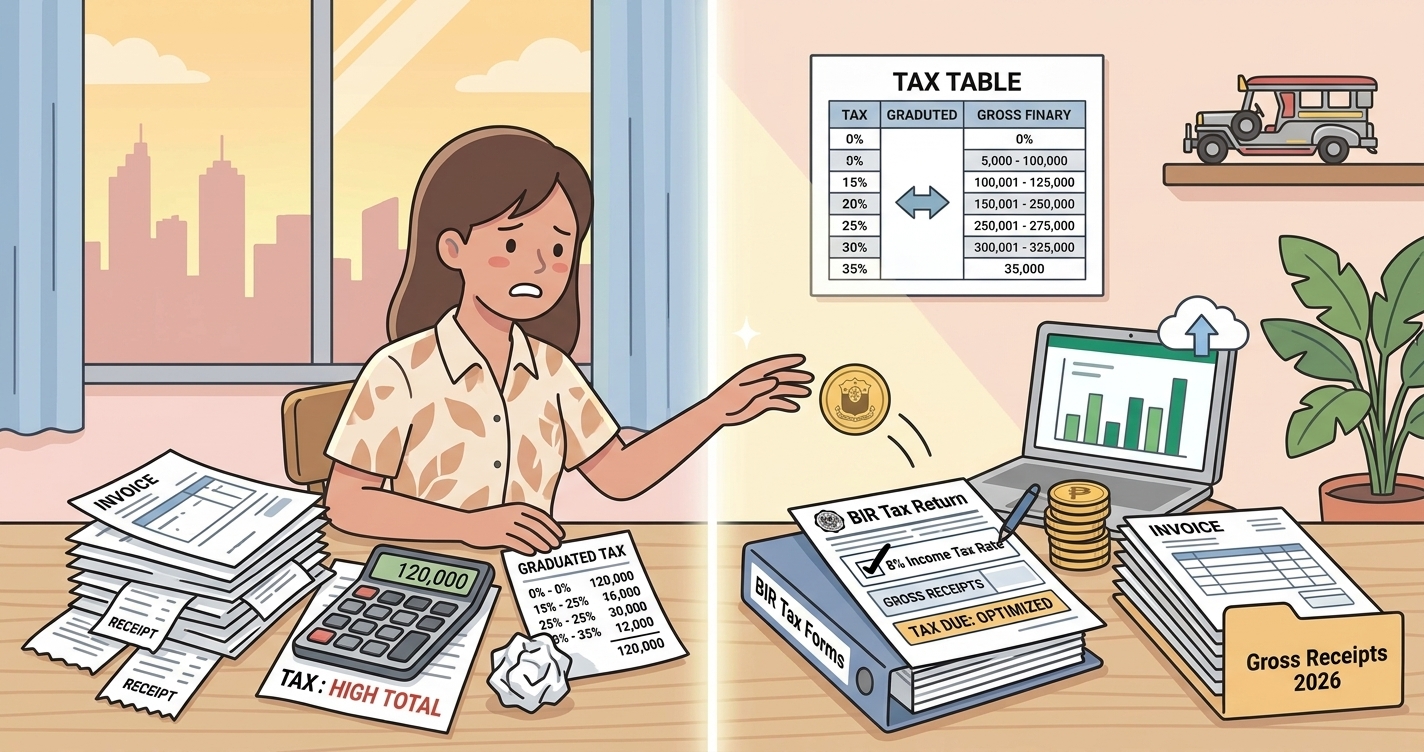
Filipino freelancers and self-employed professionals can choose between the 8% flat income tax rate and the graduated income tax table. The right choice depends on your annual gross receipts and allowable expenses. This guide walks you through both options with real calculations.
Disclaimer: This article provides general tax information for the Philippines and does not constitute individual tax advice. Tax rules are subject to change. Always verify current rates, thresholds, and filing requirements with the Bureau of Internal Revenue (BIR) or a licensed Certified Public Accountant (CPA) before filing. Figures are based on TRAIN Law and subsequent BIR issuances in effect as of 2026.
The Two Tax Rate Options for Filipino Freelancers
Under the Tax Reform for Acceleration and Inclusion (TRAIN) Law, self-employed individuals and professionals in the Philippines have two options for computing their annual income tax:
- 8% Flat Tax Rate — applied on gross receipts plus other non-operating income, in lieu of the graduated rates and the percentage tax
- Graduated Income Tax Rates — the standard progressive rates with deductions for allowable expenses
Choosing the wrong option can mean paying thousands of pesos more in tax than necessary. This guide helps you understand which is better for your specific situation.
Option 1: The 8% Flat Tax Rate
What It Is
The 8% rate is computed on your gross receipts and other income (not net income), with no deductions for business expenses. The first PHP 250,000 is exempt (for non-mixed income earners), so in practice you pay 8% only on amounts above PHP 250,000.
Who Can Avail
The 8% option is available if:
- You are a self-employed individual or professional
- Your annual gross receipts and other income do NOT exceed PHP 3,000,000 (the VAT threshold)
- You are not a VAT-registered taxpayer
- You are not a Mixed Income Earner (i.e., you do not also receive a salary from an employer) — or if you are a mixed income earner, the 8% applies only to the self-employment income component above PHP 250,000, and the salary portion is taxed separately under the graduated table
How to Compute (Simple Example)
Gross receipts for the year: PHP 1,200,000
- Less exemption: PHP 250,000
- Taxable amount: PHP 950,000
- 8% tax = PHP 76,000
No expenses to track, no depreciation schedules, no books of accounts required — just your total receipts.
Advantages of the 8% Rate
- Simplicity: no need to track or document individual business expenses
- Replaces percentage tax (3%): you do not pay the 3% Percentage Tax (BIR Form 2551Q) separately
- Lower record-keeping burden: no need to maintain complete books of accounts (though keeping basic records is still good practice)
- Predictable: you always know exactly what your tax will be based on gross income
Disadvantages of the 8% Rate
- If your actual expenses are high, you may pay more tax than under the graduated method
- You forfeit the ability to deduct legitimate business costs
- Not available once you exceed PHP 3 million in gross receipts
Option 2: Graduated Income Tax Rates
The 2026 Tax Table
Under the TRAIN Law (as further amended), the progressive tax rates for the 2023 tax year onwards are:
- Up to PHP 250,000: 0% (exempt)
- PHP 250,001 – PHP 400,000: 15% on excess over PHP 250,000
- PHP 400,001 – PHP 800,000: PHP 22,500 + 20% on excess over PHP 400,000
- PHP 800,001 – PHP 2,000,000: PHP 102,500 + 25% on excess over PHP 800,000
- PHP 2,000,001 – PHP 8,000,000: PHP 402,500 + 30% on excess over PHP 2,000,000
- Over PHP 8,000,000: PHP 2,202,500 + 35% on excess over PHP 8,000,000
How Deductions Work Under Graduated Rate
Under this method, you compute your taxable net income: gross receipts minus allowable deductions. You have two choices for deductions:
- Optional Standard Deduction (OSD): 40% of gross receipts. Simple, requires no expense documentation. Most popular choice.
- Itemized Deductions: Actual business expenses with full documentation (official receipts, books of accounts). More complex but potentially higher deduction if your real costs exceed 40%.
Graduated Rate Calculation with OSD (Same Example)
Gross receipts: PHP 1,200,000
- OSD (40%): PHP 480,000
- Net taxable income: PHP 720,000
- Tax: PHP 22,500 + 20% × (PHP 720,000 - PHP 400,000) = PHP 22,500 + PHP 64,000 = PHP 86,500
- Plus: 3% Percentage Tax on gross (if non-VAT): 3% × PHP 1,200,000 = PHP 36,000
- Total: PHP 122,500
In this example, the 8% flat rate (PHP 76,000) is clearly better than the graduated rate with OSD (PHP 122,500).
When the Graduated Rate Wins
The graduated rate becomes more attractive when your actual expenses are very high — significantly above 40% of gross receipts — and your net income after deductions falls into a lower tax bracket. Let's see a scenario:
Gross receipts: PHP 1,200,000, actual expenses: PHP 900,000
- Under 8%: tax = PHP 76,000 (as before)
- Under graduated + itemized: net income = PHP 300,000; tax = 15% × (PHP 300,000 - PHP 250,000) = PHP 7,500
- Plus 3% Percentage Tax: PHP 36,000
- Total: PHP 43,500
With very high expenses (75% cost ratio), the graduated + itemized approach can be dramatically lower. However, this scenario is unusual for most service freelancers whose main cost is their own time.
The Breakeven Point: When to Choose Which
As a rule of thumb:
- If your net profit margin is above ~55% of gross receipts (i.e., costs are less than 45% of revenue), the 8% rate is usually better
- If your net profit margin is below ~40% (costs exceed 60% of revenue) and you keep meticulous expense records, the graduated rate with itemized deductions may be lower
- Most freelancers in IT, creative, consulting, and writing fall into the high-margin category — the 8% rate is almost always the better choice for them
Use Denpyo's tax savings estimator to model both options with your actual numbers and see which saves more.
Filing Requirements by Option
8% Flat Rate
- Annual ITR: BIR Form 1701A (Self-employed / professionals under 8% rate)
- Deadline: 15 April of the following year
- Quarterly returns: BIR Form 1701Q — quarterly income tax returns still required
- No Percentage Tax (2551Q): the 8% replaces the 3% percentage tax
- Indicate your election of 8% in the first quarter return of the taxable year — this election is irrevocable for that year
Graduated Rate
- Annual ITR: BIR Form 1701 (Self-employed using OSD or itemized deductions)
- Deadline: 15 April of the following year
- Quarterly returns: BIR Form 1701Q
- Percentage Tax: BIR Form 2551Q quarterly (3% of gross receipts, if non-VAT registered)
- Books of accounts: Required if using itemized deductions
VAT Registration Threshold
Once your gross receipts exceed PHP 3,000,000 in a year, you are required to register for VAT (Value Added Tax at 12%) and the 8% option is no longer available. At that point, you move to the graduated rate and claim either OSD or itemized deductions. Plan for this threshold as you grow.
How to Elect the 8% Rate
- When registering with BIR as a new taxpayer, indicate your preferred tax regime on BIR Form 1901
- For existing taxpayers, file BIR Form 1905 to update your registration and indicate the 8% election in your first quarter return (Form 1701Q) for the year
- Ensure you are not VAT-registered and not exceeding PHP 3 million gross receipts before electing
Track Income and Receipts with Denpyo
Whether you choose the 8% rate or graduated with OSD, you still need to track your gross receipts accurately throughout the year to compute your quarterly and annual tax. Use Denpyo to photograph and log your client invoices and official receipts as you receive them. The expense checker tool can help you assess whether itemizing expenses might be worth it given your spending patterns.
Summary: Quick Decision Guide
- Choose 8% if: gross receipts under PHP 3M, not VAT-registered, most income is from services with low material costs, you want simplicity
- Choose graduated + OSD if: you want to be safe and flexible without tracking expenses, and your gross income is moderate
- Choose graduated + itemized if: your actual expenses are very high (rent, staff, equipment), you keep meticulous records, and your net income falls into a low bracket
For official guidance, visit the BIR website and refer to Revenue Regulation No. 8-2018 and subsequent BIR issuances governing the 8% option.

Track expenses, maximize deductions
Denpyo scans your receipts and finds tax savings automatically.