
SRS and CPF Top-Up Deadline: The 31 December Checklist for Your YA 2027 Tax Bill
SRS contributions, CPF cash top-ups and IPC donations only cut your YA 2027 tax if they land by 31 December 2026. A dated checklist for Singapore's self-employed, with DBS's cut-off times, caps and the new matched MediSave rule.
This article is general information for Singapore freelancers, sole proprietors and small business owners, not tax or financial advice. The authoritative sources are the Inland Revenue Authority of Singapore (IRAS) and the CPF Board. SRS contributions and accepted CPF top-ups are not refunded, so check your own position before you move any money.
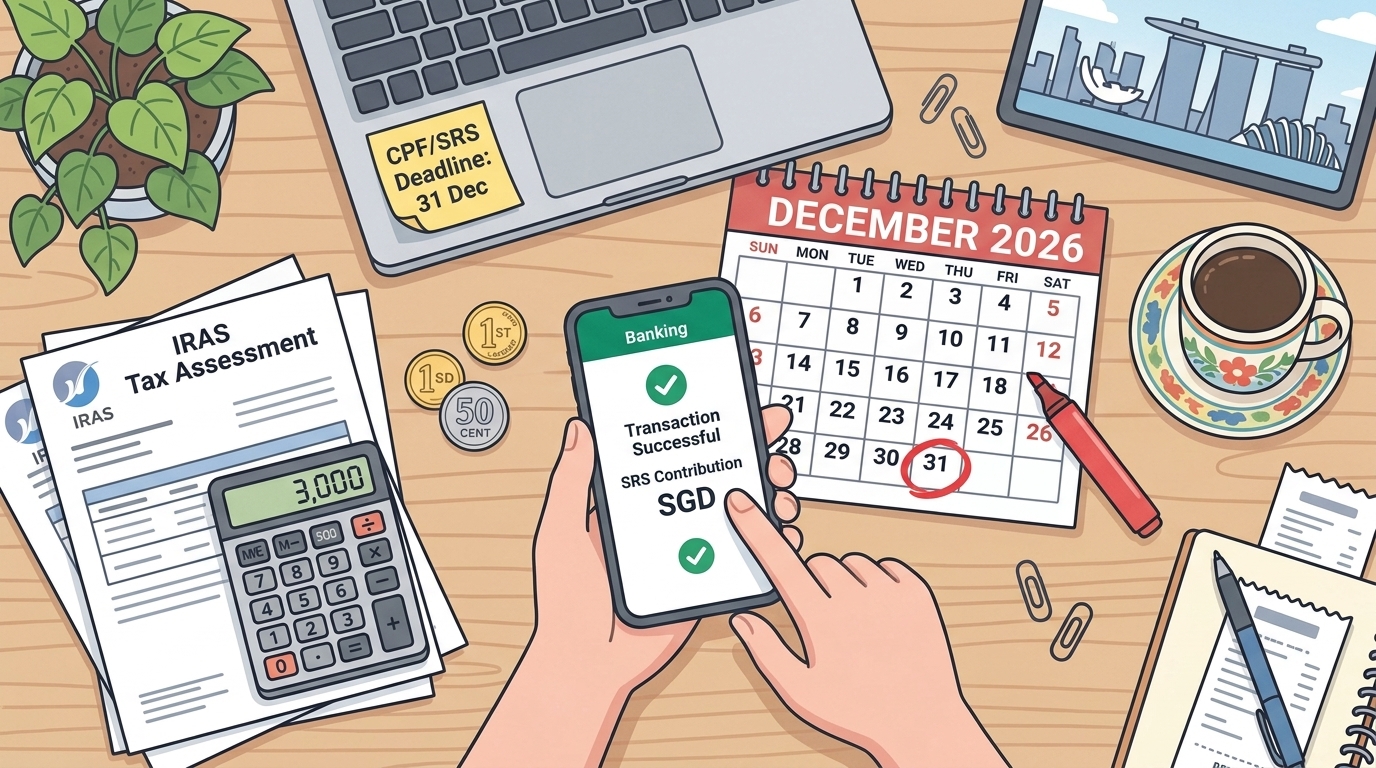
If you are self-employed in Singapore, the SRS and CPF top-up deadline of 31 December is the last date for most of the actions that can still lower your YA 2027 tax bill. What you can still decide is whether money reaches your SRS account, your CPF accounts and approved charities before the year closes. Miss the cut-off by a day and the relief slides into YA 2028.
This is a dated checklist, not a scheme explainer. For how SRS works, see our SRS tax relief guide; for compulsory MediSave, our MediSave relief guide for the self-employed. Below: what to do, in order, and the rule change that will shrink some people’s relief this year.
Key Takeaways
- SRS contributions, CPF cash top-ups and donations to approved IPCs made in calendar year 2026 count for YA 2027; anything that lands in 2027 counts a year later.
- DBS’s cut-off for YA 2027 SRS relief is 7pm on Thursday, 31 December 2026 via digibank (3:30pm at branches, 11:30am for cheques); the yearly SRS cap is S$15,300 for citizens and PRs and S$35,700 for foreigners.
- CPF Cash Top-up Relief is capped at S$8,000 for your own accounts and S$8,000 for family members, and your online application and payment must reach CPF by 31 December.
- New for YA 2027: MediSave top-ups made from 1 January 2026 that attract the Matched MediSave Scheme grant (up to S$1,000 a year) get no tax relief.
- Donations to approved IPCs earn a 250% deduction, and the Ministry of Finance confirms the S$80,000 personal relief cap does not apply to them.
Why 31 December is your YA 2027 tax relief deadline
Singapore taxes you a year in arrears: per IRAS, your statutory income for YA 2027 is what you earned in 2026. Reliefs follow the same calendar, dated by when the money arrives rather than when you file. SRS contributions must be made by 31 December (or your bank’s earlier cut-off). CPF cash top-up applications must be received by 31 December, and CPF adds that payment must reach it by then too. Voluntary CPF contributions by the self-employed are relieved “based on the date of payment”. Donations are deducted in the year of assessment after you give.
None of these need claiming: your SRS operator, CPF Board and the charity report to IRAS, so the decision is made at year-end, not at filing time. Two guardrails apply. A personal income tax relief cap of S$80,000 applies to the total of all your reliefs for each year of assessment, including SRS and CPF top-up relief. And IRAS is clear that SRS contributions and accepted CPF top-ups are not refunded, even if the relief turns out to be of no use to you.
Year-end tax planning checklist for the self-employed in Singapore
Step 1 — Early November: estimate your income and relief headroom
Rough out your 2026 net trade income. List reliefs already locked in: Earned Income Relief of S$1,000 if you are below 55, the compulsory MediSave you paid during 2026 (relieved in full, without capping, from YA 2026), and any family reliefs. Subtract the total from S$80,000 to get your headroom.
Then find your marginal rate. Under the resident rates IRAS lists from YA 2024 onwards, chargeable income between S$80,000 and S$120,000 is taxed at 11.5%, so each S$1,000 of relief there saves S$115. Our free income tax calculator gives a quick view. One thing not to plan around: IRAS lists Course Fees Relief as lapsed with effect from YA 2026.
Step 2 — By mid-December: make your SRS contribution
The yearly maximum is S$15,300 for citizens and PRs and S$35,700 for foreigners, who must declare that status to their operator every year. Three traps:
- The bank’s clock beats the calendar. IRAS tells you to check your operator’s cut-off. At DBS, YA 2027 relief needs the contribution in before 7pm via digibank, 3:30pm at a branch, or 11:30am by cheque, all on Thursday, 31 December 2026.
- Over-contributing can bounce the whole transfer. DBS states that if a contribution exceeds your remaining limit, the entire amount is refunded. Check what you have already paid in this year.
- Do not withdraw in the same year. IRAS gives no relief on amounts withdrawn in the year of contribution.
Remember that 50% of SRS withdrawals are taxable at retirement, and you must be tax resident for the year of assessment to get the relief.
Step 3 — By mid-December: CPF cash top-up to your own account
Your own-account cap is S$8,000, shared across your Special or Retirement Account and MediSave — not S$8,000 each.
- Special or Retirement Account: relief is limited to the gap between the Full Retirement Sum and your savings. For 2026 top-ups IRAS uses an FRS of S$220,400; at or above it, there is no relief.
- MediSave: relief is limited to the gap between the Basic Healthcare Sum (S$79,000 for 2026, per IRAS) and your balance. CPF refunds a MediSave top-up that exceeds the recipient’s BHS in full, without interest, so check the balance before you pay.
- Self-employed condition: your MediSave payable must be fully paid, or on a monthly instalment plan, before CPF will accept a voluntary MediSave top-up from you; IRAS applies the same condition to MediSave top-ups you make for family members.
- Cash only: transfers from your own CPF accounts do not qualify.
Step 4 — By mid-December: top-ups for family members
A separate S$8,000 cap covers top-ups to parents, grandparents (including in-laws), a spouse or a sibling. A spouse or sibling without a disability must not have had annual income above S$8,000 in 2025, the year before a 2026 top-up. If the recipient’s savings have reached the Full Retirement Sum there is no relief, even where CPF still accepts the money. Topping up a parent or grandparent aged 55 or over? Read the matched-grant section below first: MMSS covers ages 55 to 70, and MRSS no longer has an upper age limit.
Step 5 — Before 31 December: voluntary CPF contributions as a self-employed person
You can also make voluntary contributions under CPF’s Self-Employed Scheme. IRAS caps the relief at the lowest of 37% of your assessed net trade income less your compulsory MediSave relief, the CPF annual limit (which IRAS says remains at S$37,740) less compulsory contributions, or what you actually paid. Since relief follows the date of payment, a contribution paid on 2 January 2027 belongs to YA 2028. Follow CPF’s procedures so each MediSave payment is classified as you intend (scheme contribution or cash top-up), as IRAS advises; the two are relieved under different rules.
Step 6 — Before 31 December: donations to approved IPCs
Cash donations to approved Institutions of a Public Character for local causes, or to the Singapore Government, are deductible at 2.5 times the amount. IRAS’s example: a S$10,000 donation in 2026 cuts a S$100,000 statutory income for YA 2027 by S$25,000.
- Check the status. Not every registered charity is an approved IPC; verify on the Charity Portal.
- Give your NRIC or FIN. IRAS takes the deduction from the charity’s records and does not accept claims based on receipts.
- Donating shares? The donation date is when legal title passes to the IPC, so leave time.
- Too big for one year? Unused deductions for local-cause IPC donations carry forward for up to 5 years; a 2026 donation can be used until YA 2032.
The Ministry of Finance says Budget 2023 extended the 250% deduction until 31 December 2026, so this year’s donations qualify. Budget 2026 announced a further three-year extension to 31 December 2029, and the proposed Finance (Income Taxes) Bill 2026, which MOF put out for public consultation in June 2026, would give it legal effect. If that passes as proposed there is no cliff on 1 January, but only 2026 donations count for YA 2027.
The CPF cash top-up relief change for YA 2027: matched top-ups get no relief
IRAS now states that cash top-ups to eligible members’ MediSave Accounts that attract the Matched MediSave Scheme (MMSS) grant will not qualify for CPF Cash Top-up Relief from YA 2027, for top-ups made from 1 January 2026. The same rule has applied to the Matched Retirement Savings Scheme (MRSS) since YA 2026, for top-ups received from 1 January 2025.
MMSS is a five-year scheme running from 2026 to 2030. CPF lists the eligibility criteria as:
- Singapore Citizen aged 55 to 70 (inclusive) as of 31 December of the year;
- MediSave balance below half of the current Basic Healthcare Sum;
- average monthly income of S$4,000 or less;
- residence annual value of S$21,000 or less, owning no more than one property;
- for the self-employed, MediSave payable fully paid or on a monthly instalment plan.
CPF assesses eligibility yearly and notifies eligible members at the start of the year. A joint release by the CPF Board, the Ministry of Manpower and the Ministry of Health in January 2026 said that around 185,000 Singaporeans were eligible for MMSS and around 750,000 for the expanded MRSS, with around 165,000 eligible for both.
For an eligible member, the first S$1,000 of cash top-ups to MediSave received in the year from the member and their loved ones attracts a dollar-for-dollar grant, credited at the beginning of the following year, and that first S$1,000 gets no relief. Top-ups that do not attract a grant can still count toward your S$8,000 caps. Under MRSS, the grant on retirement top-ups is up to S$2,000 a year, with a S$20,000 lifetime limit.
Is that a bad deal? Not for the family: even at the top resident rate of 24%, S$1,000 of relief saves at most S$240, while the grant puts S$1,000 into your parent’s MediSave. The real risk is budgeting — repeat a 2025 MediSave top-up for a parent and your YA 2027 relief may come in lower than expected.
Worked example: what the 31 December actions are worth
Illustrative figures only, using the current resident tax rates and ignoring any rebate that may be announced for YA 2027.
Daniel is a 40-year-old Singapore Citizen working as a freelance video producer. He expects 2026 net trade income of S$120,000. His 2025 net trade income was S$105,000, and during 2026 he paid the resulting compulsory MediSave bill in full: S$7,992, the cap IRAS lists for his age band (9% of S$105,000 would be S$9,450). Before 31 December 2026 he puts S$15,300 into SRS, tops up his own Special Account by S$8,000 (his savings are well below the Full Retirement Sum), and donates S$1,000 to an approved IPC.
| YA 2027 | No year-end action | Actions done by 31 Dec 2026 |
|---|---|---|
| Net trade income | S$120,000 | S$120,000 |
| Less: donation deduction (S$1,000 × 2.5) | — | S$2,500 |
| Earned Income Relief | S$1,000 | S$1,000 |
| CPF relief: compulsory MediSave | S$7,992 | S$7,992 |
| SRS relief | — | S$15,300 |
| CPF Cash Top-up Relief (self) | — | S$8,000 |
| Chargeable income | S$111,008 | S$85,208 |
| Tax payable | S$6,915.92 | S$3,948.92 |
Daniel commits S$24,300 and his YA 2027 tax falls by S$2,967. His total reliefs of S$32,292 are well under the S$80,000 cap, and the whole reduction falls in the 11.5% band. The SRS and CPF money is locked up for retirement — the price of the relief.
If his SRS transfer only reaches the bank in January 2027, the S$15,300 relief moves to YA 2028 (and uses up his 2027 SRS limit), and his YA 2027 bill is S$1,759.50 higher.
And if he also tops up his MMSS-eligible 66-year-old mother’s MediSave with S$1,000 or more, the first S$1,000 earns him no relief — S$115 of tax at his rate — while she gets S$1,000 credited early in 2027.
Keep the year-end records in one place
CPF, your SRS bank and IPCs report to IRAS for you. What is entirely on you is your business income and expenses, which set the net trade income every cap above is measured against. Denpyo is built for that: photograph a receipt or invoice, the AI extracts the date, vendor and amount, it shows an estimated tax saving for each expense, and you can export the year for your accountant. To see how a relief or expense changes your bill, try the free tax savings estimator.
FAQ
What is the last day to contribute to SRS for YA 2027 tax relief?
31 December 2026, or your SRS operator’s earlier cut-off. DBS, for example, requires contributions before 7pm that day via digibank, 3:30pm at a branch or 11:30am by cheque.
Does a CPF cash top-up made on 31 December count for YA 2027?
Yes, if both your online application and the payment reach CPF by 31 December 2026. Relief is granted on the calendar year of the top-up, and CPF encourages you to top up earlier in the year.
Why is my CPF top-up relief lower for YA 2027 than last year?
The most likely new reason is the Matched MediSave Scheme: from YA 2027, MediSave top-ups made from 1 January 2026 that attract the MMSS grant get no relief. Other reasons IRAS lists are a recipient whose savings have reached the Full Retirement Sum, or a spouse or sibling whose income in the previous year was above S$8,000.
Do donations count towards the S$80,000 relief cap?
No. The Ministry of Finance states that the relief cap does not apply to tax deductions for donations, because a donation deduction is not a personal income tax relief. IRAS takes the 250% deduction off your income before personal reliefs.
Can I get my SRS contribution or CPF top-up back if I exceed the relief cap?
No. IRAS states there is no refund of SRS contributions or accepted CPF cash top-ups, even if your other reliefs already exceed S$80,000.
Summary
For self-employed Singaporeans, 31 December 2026 closes the window on most of what you can still do about YA 2027. Do the arithmetic in November, then make your SRS contribution and CPF top-ups by mid-December, inside each cap and your bank’s cut-off. Check whether any parent you top up is MMSS- or MRSS-eligible, and give to IPCs with your NRIC or FIN on record. What lands in time is reported to IRAS for you; what lands in January waits a year.
Sources
- IRAS — SRS contributions and tax relief
- IRAS — Central Provident Fund (CPF) Cash Top-up Relief
- IRAS — CPF relief for the self-employed
- IRAS — Compulsory and voluntary MediSave contributions
- IRAS — Donations and tax deductions
- IRAS — Tax reliefs and the personal income tax relief cap
- IRAS — Earned Income Relief
- IRAS — Individual income tax rates
- CPF Board — Top-up deadline for tax relief
- CPF Board — Top up to enjoy higher retirement payouts
- CPF Board — Terms and conditions for MediSave top-ups
- CPF Board — Matched MediSave Scheme eligibility
- CPF Board — How the Matched MediSave Scheme works
- CPF Board — CPF changes announced in Budget and COS 2025
- CPF Board, MOM and MOH — More Singaporeans eligible for MMSS and MRSS
- Ministry of Finance — Personal income tax (relief cap and donations)
- Ministry of Finance — Finance (Income Taxes) Bill 2026 consultation
- DBS — SRS contributions
- Charity Portal — Commissioner of Charities
Track expenses, maximize deductions
Denpyo scans your receipts and finds tax savings automatically.